We’ve seen headlines and social media posts claiming that astronomers have discovered a hidden ninth planet that exists beyond Neptune. Short-form content speculating on the future name of this new planet and about its landscape have been circulating on TikTok and Facebook as well.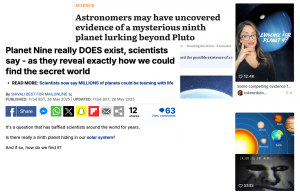
A further search shows that similar headlines have been recently shared by platforms such as Forbes and The Scientific American featuring similar (although less definitive) claims. According to these articles, there is “suddenly a 40% chance that ‘Planet Nine’ exists.”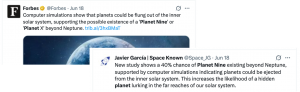
Based on our research, “Planet Nine” refers to a hypothetical ninth planet that is believed by some scientists to exist beyond Neptune. This hypothesis has existed for decades, with different astronomers proposing possible locations and potential characteristics.
However, as articles from more reputable outlets (as well as the new study they are based on) point out when carefully read, this possibility is entirely theoretical and based on simulations – not on any proven sighting or new evidence.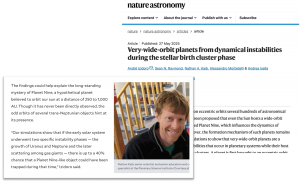
The article, published in Nature Astronomy in late May this year, used numerical simulations to calculate the likelihood of a planet forming. The 40% figure being cited in some articles was calculated based on both Uranus and Neptune meeting certain specific conditions in the early stages of our Solar System’s formation.
While some researchers are hoping that a soon-to-be-launched telescope will be able to provide actual proof of Planet Nine’s existence (or at least strong evidence of it), it remains a theory – one that other astronomers disagree with or have contested.
Therefore, while it is true that some scientists strongly believe that Planet Nine exists and a new study has described a simulation showing a 40% chance of its existing within certain parameters, headlines suggesting Planet Nine has been discovered or confirmed are inaccurate.
We give the claim that a hidden ninth planet has been recently discovered a rating of false.

When encountering headline based on “new studies,” it is important to look closely for original sources – and to critically consider how headlines might obfuscate accuracy in their quest for clicks and virality. By omitting the less exciting (but more accurate) facts and using terms such as “discovered,” some headlines kickstarted misinformation that is easily debunked by going onto the NASA website or even the “Planet Nine” Wikipedia page.