A viral post on X with over 1 million views claims in a “breaking” headline that Chinese researchers have successfully created artificial gold. According to the post, the “lab-grown” gold is identical in appearance, weight and conductivity to real gold and heralds massive changes in how gold is traded and priced. Gold is a precious metal formed through geological processes and mined by humans for a wide variety of uses. Alongside jewellery, gold is also used in electronics and as an investment. Given its high value, the possibility of artificial gold that is indistinguishable from real gold naturally sparked many comments and reposts. However, is there any truth to this claim?
While lab-grown gemstones (like diamonds) have become common, a viable method to produce lab-grown precious metals is still the subject of ongoing research and experimentation. Specifically, humans have been trying for centuries to create gold – from ancient alchemists attempting to turn lead to gold, to more modern attempts using sophisticated technologies.
Based on our research, it is possible to artificially produce gold within particle accelerators or nuclear reactors through the transmutation of other elements – sometimes as a byproduct of those machines’ actual functions. However, this produces a minuscule amount of (usually radioactive) gold and costs far more than the actual market price of gold itself.
The most recent coverage we could find of researchers making claims about lab-grown gold is from an America-based start-up, Marathon Fusion, which published a concept proposal in July this year for a fusion reactor that would turn mercury into gold. However, this remains a theoretical proposal, with no actual gold produced.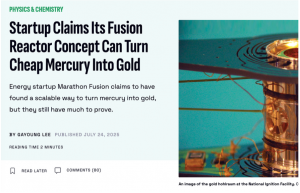 The most recent reports we could find specifically about Chinese researchers creating gold comes from 2018. A peer-reviewed paper published by researchers from the Dalian Institute of Chemical Physics claimed they had developed a process to turn copper into a new material “almost identical” to gold.
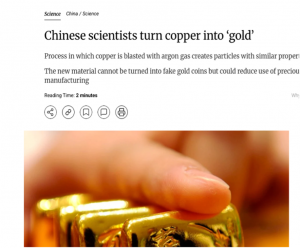 However, a closer look at the paper and credible articles about the research shows that the new material created is not, as the claim post states, “identical in appearance, weight and conductivity” to gold. Instead, it has similar reactive properties but retains the same density and colouring as copper. Rather than to substitute gold as a commodity, the aim of this research appears to be to replacing the use of precious metals in the manufacturing of electronic devices that still require significant amounts of gold and silver to produce.
We could also find no updates to the 2018 paper and no further credible research suggesting that a new breakthrough has been made when it comes to artificially producing gold.
The claim that Chinese researchers have recently created artificial gold therefore appears to be a fabrication loosely based on reports from 2018. A viable method of producing lab-grown gold that is “identical” in all ways to real gold has not been successfully tested and established (certainly not in any way comparable to lab-grown diamonds). We therefore give this claim a rating of false.