We’ve noticed clips being shared in local chat groups and on Facebook pages that seem to show Singapore university professors “crashing out” (internet slang for losing their temper in a dramatic meltdown) at students for using ChatGPT. Two of the most shared clips show professors with Singaporean accents angrily confronting students (one even using a few profanities) while flinging papers to the ground and gesturing wildly.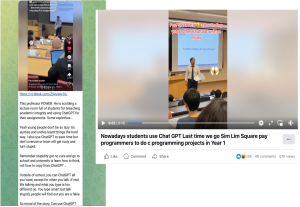
In one of the videos, the Professor says, “You think I don’t know you all using ChatGPT? Every essay same phrasing…” The text above the other video reads, “My prof in uni went crazy and uses vulgarities in front of the entire class because of misusing AI in assignments.” Many users are sharing the clips and heatedly discussing the use of ChatGPT – treating the video footage as genuine while debating the pros and cons of AI in the classroom. The clip has also spread among some international audiences on platforms such as Douyin.
@attap.kia At National University of Sora, the whole lecture hall froze when the professor lost it after spotting another ChatGPT-written essay. Papers went flying, students went silent, and everyone knew someone messed up big time. Every student’s nightmare—when the prof catches AI writing in your work. The anger, the disappointment, and that one awkward laugh from the back row say it all. Would you dare to submit an AI essay after this? Tag your classmate who always tries their luck. Comment if your prof ever called out ChatGPT in class. Like, share, and save this before your next deadline. #chatgpt #singaporeuniversity #studentlife #fyp #nationaluniversityofsora
To determine their authenticity, we first examined the clips closely to identify the exact university or professor and did some basic searches to find the original source of the video. On first glance, nothing about the videos looks out of place for a typical local university classroom setting. Looking the slides in the background of the two clips, the logos of NUS and SUSS can be seen at the top right-hand corners.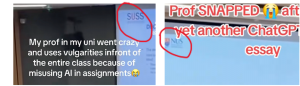
However, while many of the reshared clips circulating are fairly low-resolution and blurry, we could also make out a Sora (OpenAI’s video generator) watermark on one of the clips – which was an immediate red flag that the video might be AI-generated or altered in some way.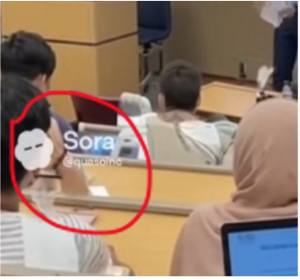 A reverse image search for the earliest appearance of the clips led us to the original iterations on TikTok which were posted in early November. The originals have garnered a significant number of views – over 800,000 and 6 million respectively – and are explicitly labeled as AI-generated. The most viral clip is even described by the original poster as taking place at “National University of Sora.”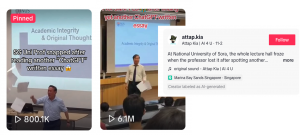
The TikTok accounts posting these viral clips (called “ai.lah” and “attap.kia”) post a steady stream of humorous AI-generated context set in Singaporean settings such as HDB walkways and hawkers centers – featuring recognisably Singaporean accents. While the majority of their AI videos do not gain traction (even among locals), several have gone viral and subsequently been clipped or reshared without the AI-label and disclaimer.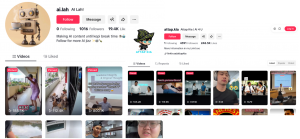 The clips circulating on social media of local university professors “crashing out” over AI use by students are, therefore, AI-generated and do not depict real events. From what we can tell, the individuals in the video do not appear to be direct deep-fakes of real professors and seem to be generated based on existing media of local university lectures. We therefore give this claim a rating of false.

Beyond the irony of AI videos about anger over Generative AI, this claim is an alarming example of how AI video generators are able to produce localised videos with characteristics accurate to Singapore – down to accents and aesthetics.
If not for the Sora watermark and certain choppy movements noticeable on when watching closely, it is difficult to immediately flag these clips as fake – particularly when they are clipped in lower resolution and reshared as authentic recordings. Most casual viewers coming across these clips on messaging groups and social media are likely to take it at face value.
While the original posters do not seem to have malicious intent and readily label their content as AI-generated, the incorporation of actual University logos by Sora and the believability of the video flag it to us as a dangerous form of misinformation that audiences should be extremely wary of.
As the technology improves by leaps and bounds, it is vital for us to remain literate about its potential and be critical when encountering viral videos. While safeguards such as watermarks still exist, it is also important to be aware of more subtle red flags. For instance, as with this claim, if you encounter multiple different videos that appear to follow a near-identical script and structure, there is a high chance that it is part of an AI trend and multiple social media accounts are attempting to get a viral hit.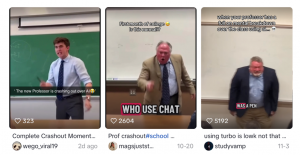 Videos about professors and teachers “crashing out” over students using AI are part of a larger trend across TikTok. Alongside less viral iterations of the video format based in Singapore, we found thousands of similar videos set all over the world in different languages and contexts.