Viral posts on X are claiming that this video depicts a new form of captcha that is used in China. In the video, passing the captcha requires users to sift through a box of cat litter to drag and drop lumps of litter into a bin. The original claim post has nearly 3 million views and no community note, which has naturally led to many users on English-speaking platforms to assume that it is true.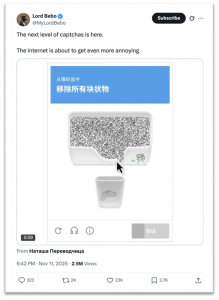
CAPTCHA is an acronym for “Completely Automated Public Turing test to tell Computers and Humans Apart.” It functions as a security measure to weed out bots on the internet by presenting them with a question that should be easy for humans but hard for automated bots to solve. Captcha is typically used to prevent spam, fake registrations, or malicious automated activities and it usually takes the form of text, audio or image recognition and identification.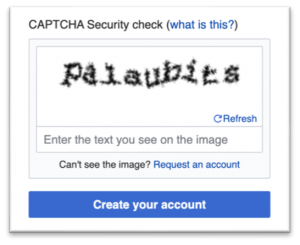
This new, more interactive form of captcha would certainly be a novel way to weed out bots. However, we took a closer look behind the viral clip find out if it is really a new form of captcha being used in China.
Firstly, while the Chinese text might be inscrutable to non-speakers, the final verification approval reads “我不是猫“ or “I am not a cat.” This stood out to us as a sign that the video might have more humorous or unserious origins.  A basic reverse image search on Google did not turn up any matches beyond the viral posts. We could also find no trace of the image existing before it went viral on X last week on English-language platforms, prompting us to examine Chinese social media platforms which often do not show up in Google searches. We began by running the captcha instruction text, 移除所有块状物 (“clear all the clumps”) through Chinese web search engine Baidu Tieba. We also ran screengrabs of the video through reverse image searches on Baidu.
This claim proved hard to fact-check owing to the backstory of its conceptualisation in the first place. Based on what we could find through our research, the video clip is not a newly introduced form of captcha. Rather, it is a humorous meme clip recently created and posted onto Rednote that draws on an existing meme popular on Chinese social media.
The video was posted on 10 November 2025 by a popular account on the Rednote with a heading that translates to “Kitty Litter Captcha” and accompanying hashtags that suggest it is an animated design experiment. It received thousands of likes and comments, with the Chinese-speaking audience clearly understanding it as an long-running meme based on the phrase 移除所有块状物 that is also used as the captcha command.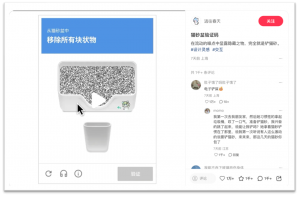 移除所有块状物 (“clear all the clumps”) became popular meme in 2022 after the release of a highly anticipated game sequel. “Mirror 2: Project X” was both a task puzzle game and dating sim. When its simulation mode was released in 2022, rather than exciting new graphics and gameplay, players were instead immediately met with an extremely mundane task – cleaning a virtual cat’s litter box with the instruction to “clear all the clumps.”
When outraged and humorous reviews of the game went viral on social media sites, this innocuous phrase came to be funny and relatable shorthand for a bait-and-switch; describing a disappointing letdown after being sold an exciting fantasy. While commonly used in Chinese-language social media, it is almost impossible to organically find out about this meme through English-language search engines.
This recent clip is, therefore, a reference to that meme and also pokes fun at the notion of complicated captcha questions. It appears to have been clipped and reshared on X without the necessary context, making it difficult for English-speaking audiences to immediately identify it as a joke. We therefore give this claim a rating of false.

While the nature of this false claim is perhaps more funny than harmful, it illustrates how hard it can be to grasp context across different languages. Anyone attempting a basic cross-check to confirm it’s veracity would be stumped and left with no clear answers – especially if they are not a Chinese speaker.
In a more serious scenario, content clipped from Chinese (or other language) platforms and presented misleadingly by English-language users can lead to serious mis/disinformation spreading. This is particularly the case with extremely specific inside jokes, satire, or localised slang that does not show up in basic searches on Google.