In the wake of the United States attack on Venezuela and arrest of its President, Nicolas Maduro, on 3 January, we have seen a range of videos being circulated that claim to show Venezuelans celebrating in the streets. On 3 January and shortly after, right-wing posters with large followings began posting videos of jubilant celebrations supposedly taking place on a large scale – with one even claiming that “millions of Venezuelans” were out in the streets. This video and several others were then reshared by prominent figures such as President Donald Trump himself, quickly reaching millions of views.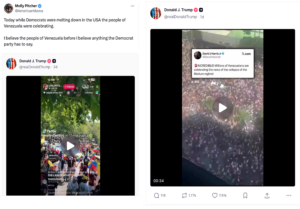 Nicolás Maduro, who has been President for 12 years (since 2013), is controversial and oft-criticised figure both internationally and within Venezuela. With both ardent detractors and supporters, large scale protests against Maduro have taken place and been recorded in the past. However, given that most of the claim videos do not appear to provide actual details beyond the claims of “celebrating the fall of Maduro,” we took a closer look to determine if widespread celebrations are really taking place.
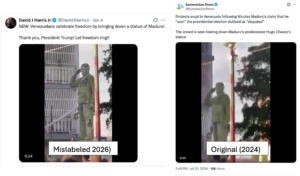
In most cases, the Venezuelan flag can be seen, with large crowds either chanting or celebrating. However, on closer inspection it quickly became clear that very few of the circulating videos were actually filmed on or after 3 January 2026. Instead, the most widely shared video of “millions of Venezuelans” is actually from a 2024 anti-Maduro protest shortly after the controversial start of his third term as President. It was posted by a Venezuela user on Instagram and clearly marked at taking place on 30 July 2024.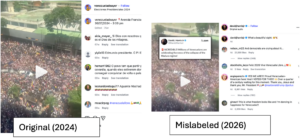 Other intentionally mislabelled videos located in Venezuela but filmed before 3 January 2026 include one of protestors supposedly bringing down a statue of Maduro in celebration. A closer look for the original video showed that it was actually from 2024 and the statue was of Maduro’s predecessor, Hugo Chavez.
 Another category of wrongly attributed videos include footage from celebrations by Venezuelan diaspora in locations such as Florida, Chile, and Argentina. We have observed a large number of these videos being shared by posters in support of the United States’ actions, with the “ecstatic Venezuelan people” being held up against criticism.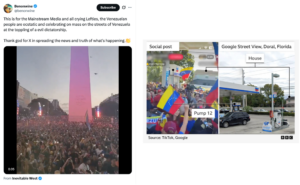
Finally, Generative-AI can also found in some cases, with one viral clip on X claiming to show an elderly lady weeping with joy. This clip was reshared by Elon Musk spreading it even further. However, a closer search for the original clip shows that it came from a “comedy” TikTok page known for creating AI content. And, the suspicious hallmarks of AI content such as incorrect flag designs and warping in the background further reveal it to be synthetic on closer inspection.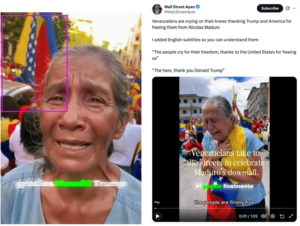
Therefore, a large proportion of the most viral videos claiming to show Venezuelans celebrating Nicolás Maduro’s arrest are mislabelled and inaccurate – seemingly intentionally in order to position the United States and Donald Trump as peacemakers and liberators. While it is certainly possible that some Venezuelans welcome the fall of Maduro, it is false that large-scale celebrations are taking place on the streets of Venezuela.

The large influx of (seemingly intentionally) mislabelled videos claiming to show celebrations in Venezuela was overwhelming in both volume and speed. This saturated social media with a glut of content that convinced many that the claims were true. Amplification by large accounts and prominent figures such as Trump and Elon Musk further exacerbated this spread. While some of the above claims have been given Community Notes and AI Warnings on the different social media platforms, most of the prominent figures have not deleted their posts, which are still being reposted and reshared as though they are accurate.
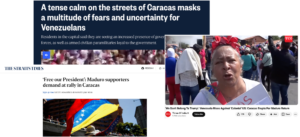
Leveraging the confusion brought on by information overload, this wave of disinformation only serves to complicate the real situation in Venezuela and stir up conflict between different ideological groups. As of writing (8 January), responses in Venezuela from legitimate news sources reporting from location are more nuanced than social media headlines suggest. For instance, a pro-Maduro protest of about 2000 people was held in Venezuela’s capital, Caracas, on 4 January. On the other hand, it is also true that Venezuelans living in other countries such as Spain and the United States have held celebrations expressing their joy at Maduro’s ousting. Mixed feelings stemming from existing resentments about Maduro weighed against the United States’ aggressive actions are also part of the equation.
While social media has allowed a rapid stream of updates and breaking news to reach our screens within hours or even minutes of major events taking place, it is also important to be aware of how disinformation can exploit these platforms through the many ways demonstrated above. As viewers, we should be wary of polarising and extreme language – particularly when encountering videos with no attribution, or that are not from a reputable news source.