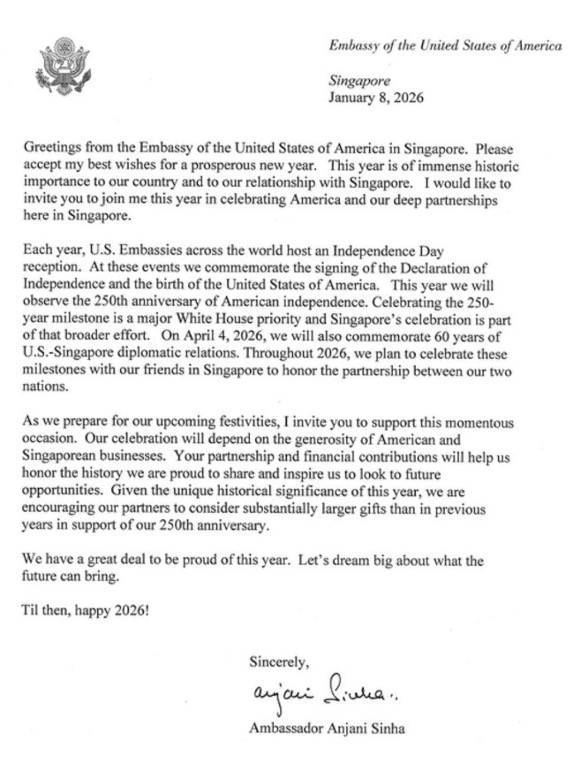
A letter circulating online claims to show the US Ambassador to Singapore directly soliciting “substantially larger gifts” from American and Singaporean businesses in connection with celebrations marking the 250th anniversary of US independence and 60 years of US–Singapore diplomatic relations in 2026. The document is dated January 8, 2026, bears the letterhead of the Embassy of the United States of America in Singapore, and is signed by Ambassador Anjani Sinha.
Dr Sinha, the current US Ambassador to Singapore had begun his tenure in November 2025, having been confirmed by the US senate in October 2025. His appointment however has met considerable criticism due to footage from a senate hearing held in June 2025 where he struggled with responses to questions about Singapore posed to him by Democratic Senator Tammy Duckworth. Due to his lack of knowledge of Singapore, Senator Duckworth had concluded that that she did not believe he was qualified for the role.
When we examined the circulating letter, we found evidence suggesting that it is real rather than a doctored letter. AsiaOne and Mothership reported that Ambassador Sinha had sent a January 8 letter to members of the American Chamber of Commerce (AmCham) in Singapore requesting financial contributions, including “substantially larger gifts,” for upcoming 2026 Independence Day celebrations. In their reports, a U.S. Embassy spokesperson confirmed that seeking private-sector support for Independence Day events is a practice US embassies engage in annually.
The request also fits within broader, documented practices of the US government. Large national milestones such as the 2026 semiquincentennial are supported by official commissions and affiliated nonprofit entities that work with private partners and donors. Separately, U.S. State Department regulations explicitly govern the solicitation and acceptance of gifts and donations, indicating that such requests, while often unseen by the general public, are a recognised and regulated part of government operations.
The claim’s traction online appears to stem less from falsity than from surprise. To many readers unfamiliar with how embassy-hosted national day events are funded, the phrasing of the letter – with the reference to “substantially larger gifts” – reads unusually blunt and therefore suspicious. That reaction, however, does not in itself make the letter fake.
That said, the existence of a genuine letter does not mean every copy circulating online should be taken at face value. Scammers have repeatedly impersonated government agencies by spoofing official letters, emails, and notices bearing the logos and formatting of bodies such as the Singapore Police Force (SPF) and the Immigration & Checkpoints Authority (ICA). In multiple past cases, victims received letters or emails that closely resembled official correspondence, complete with agency crests, formal language, and references to real laws or procedures. The deception typically did not rely on inventing an entirely new claim, but on borrowing the credibility of a real institution to pressure recipients into transferring money, paying “fees,” or responding urgently to follow-up instructions.
In short, available evidence indicates the letter itself is authentic and that the fundraising request was real, as confirmed by local reporting and embassy comment. The more credible risk lies not in the story being made up, but in the possibility of fake variants exploiting a genuine issue to solicit money through unofficial channels.