This image has been circulating on social media that purportedly shows a large, two-seater Personal Mobility Aid (PMA) on a local MRT train in Singapore. In the image, two individuals are seated on the PMA, taking up a significant amount of space in the train.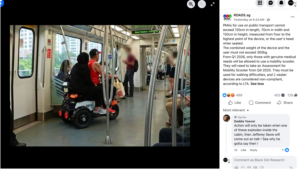 According to the Land Transport Authority (LTA), a PMA should only have one seat and be used only by individuals with certified medical needs. As of 2026, PMAs (which are allowed on public paths) need to have a maximum speed of 6km/h and meet dimensions of 70cm width, 120cm length, and 150cm height.
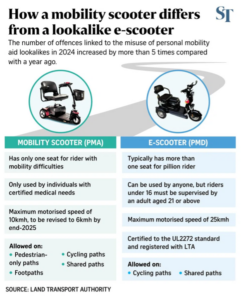 The line between PMAs and Personal Mobility Devices (PMDs) such as e-scooters is often flouted, with non-compliant PMAs a source of much discontent and complaint on local forums and social media.
Going by the LTA’s regulations, the PMA in the claim image is very likely non-compliant and should not be allowed on public transport.
The image was posted on 1 February on the Facebook page of Roads.SG (a local online platform for road users) alongside information about the new PMA regulations taking effect in 2026. In the comments, users express a great deal of annoyance – questioning the competence of MRT staff, and bemoaning the lack of enforcement when it comes to PMA regulations.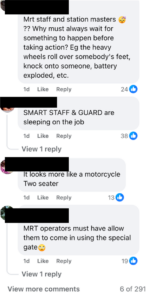 However, we took a closer look at the image and noted several red flags that have seemingly gone unnoticed. For one, while a quick glance shows all the typical features of a local train, the “next station” screen appears to be distorted, with the station name in question being an illegible jumble of letters. There also appears to be an extra metal pole next to the seats which is not a feature on local trains.
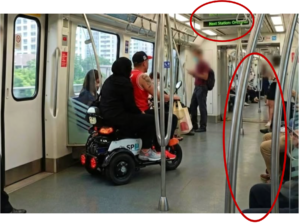 We then ran the image through Google Gemini, which immediately flagged the presence of a SynthID watermark, which indicates that a Google AI tool was used to artificially generate the image.
Therefore, the image being circulated and criticised is actually AI generated and does not show a clearly non-compliant PMA being allowed on a local MRT train.

The issue of non-compliant PMAs does exist and is especially pertinent as various legislation surrounding mobility aids and devices is set to take effect in 2026. However, it is also important to remain alert to the use of GAI and digitally manipulated images being shared about the issue. We noted a small number of disparaging, racially charged comments surround the picture and the supposed users of the PMA (one who was wearing a hijab).
Being able to recognise the signs of AI generated content also continues to be key to prevent more serious and unfounded disinformation from spreading widely in our digital spaces.