A claim circulating on Reddit asserts that playing high-level chess burns calories “at an athletic rate.” The post cites an ESPN article which reported that Russian grandmaster Mikhail Antipov burned approximately 560 calories during two hours of competitive chess – an amount likened to what Roger Federer might burn in an hour of singles tennis.
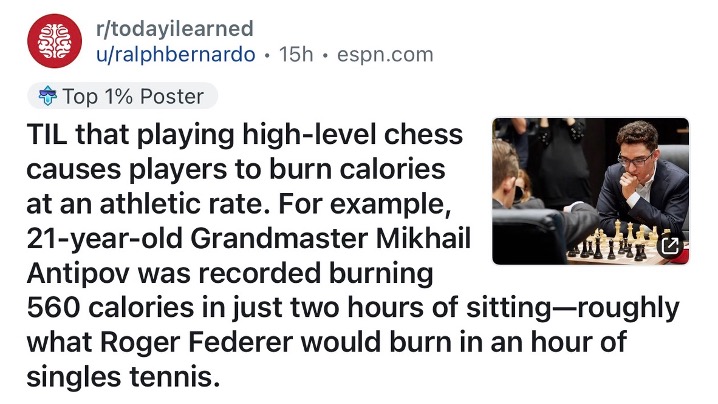
The figure traces back to a 2018 ESPN feature on elite chess players, which described how heart-rate monitors were used during tournament play to estimate energy expenditure. In Antipov’s case, a Polar wearable device reportedly calculated a burn of around 560 calories over the course of a long game.
The article further quoted neuroscientist Robert Sapolsky, who noted that elite chess can provoke intense stress responses, including elevated heart rate and blood pressure. In fact, Sapolsky posited that chess players can burn up to 6,000 calories a day while playing in a tournament, based on breathing rates (which triple during competition), blood pressure (which elevates) and muscle contractions before, during and after major tournaments. For reference, an average person consumes about 2,000 calories a day.
While the number seems newsworthy, it is important to understand its limitations. The 560 calorie estimate was derived from heart-rate data rather than direct measurement of metabolic energy use. Heart-rate-based calorie calculations are, at best, rough approximations. They are particularly unreliable in high-stress situations, where heart rate may rise sharply without a corresponding increase in actual energy expenditure. In exercise science, the gold standard for measuring calorie burn is indirect calorimetry, which tracks oxygen consumption and carbon dioxide production – not heart rate alone.
Studies that have used indirect calorimetry paint a far more modest picture of chess’s physiological demands. One controlled laboratory study found that chess players expended only slightly more energy during competitive play than at rest – approximately a 10 percent increase above baseline sitting levels. In practical terms, this places competitive chess closer to quiet desk work than to physical sports in terms of calorie burn.
This distinction matters because stress and exertion are not the same thing. Mental strain can elevate heart rate, breathing, and hormonal responses, but these changes do not automatically translate into the sustained muscular work that drives high energy expenditure. As a result, wearable devices may overestimate calorie burn when stress – rather than physical movement – is the primary driver of physiological arousal.
The comparison to professional tennis is therefore misleading. Tennis involves continuous whole-body movement, large muscle group activation, and sustained aerobic effort, all of which produce substantially higher metabolic demands than prolonged sitting, regardless of cognitive intensity. There is no credible scientific evidence showing that chess – even at the highest levels – burns calories at a rate comparable to physically demanding sports.
In summary, while intense chess play may burn somewhat more calories than resting quietly, the claim that it does so “at an athletic rate” is not supported by robust scientific evidence. The widely cited 560 calorie figure is based on an estimation method prone to overstatement, and the comparison to elite tennis conflates psychological stress with physical exertion. The claim is therefore best described as misleading rather than inaccurate.