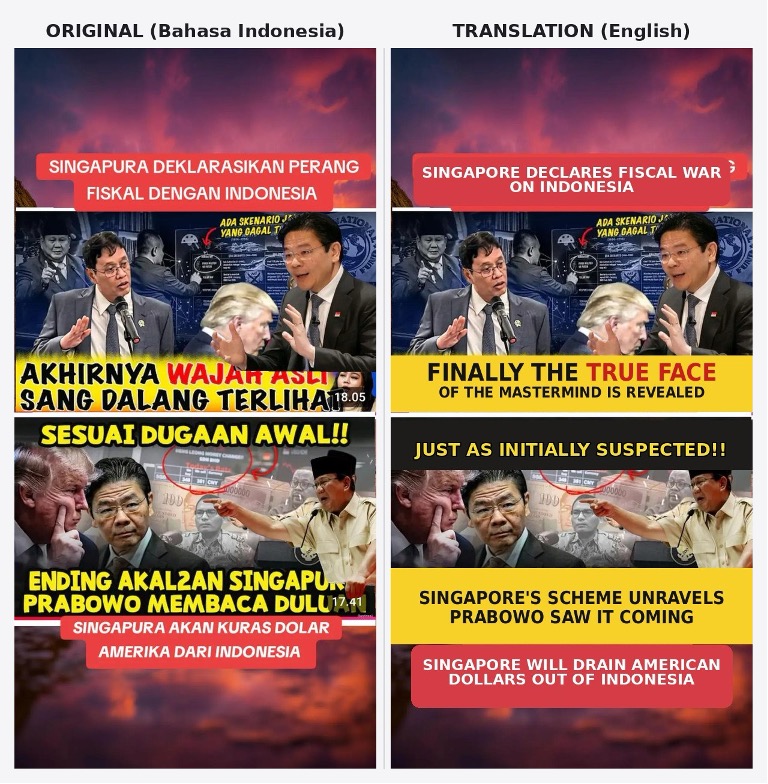
A narrative has been circulating on X and TikTok since 9 June 2026 blaming Singapore for the weakening of the Indonesian rupiah. The posts surfaced as the rupiah fell to a record low of about 14,135 per Singdollar on the same day (9 June). The TikTok video cites figures from Indonesia’s Financial Transaction Reports and Analysis Centre (PPATK) on capital outflows to Singapore – said to total some Rp3,595 trillion – accusing Singapore of “draining” US dollars out of Indonesia and engineering the currency’s fall.
Where the Rp3,595 trillion figure comes from
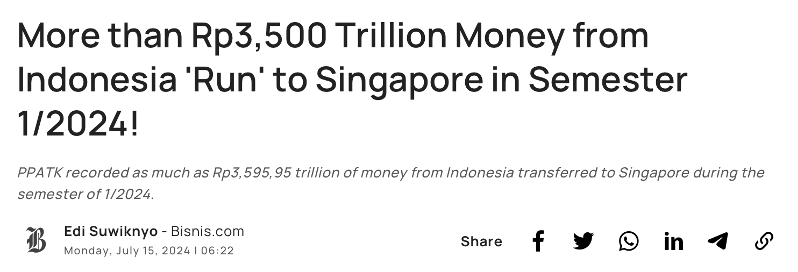
The Rp3,595 trillion figure is real, but it has been stripped of its context. As reported by Indonesian business outlet Bisnis.com, it comes from a PPATK report covering the first half of 2024 – not 2026 – which found that more Indonesian money was transferred to Singapore over that period than to the United States or China. Substantial sums also flowed to Hong Kong, the United Kingdom, Japan and South Korea over the same period.
Crucially, PPATK – whose mandate is to analyse suspicious financial transactions – itself declined to characterise the nature of these flows and did not link the transfers to any movement in the rupiah’s exchange rate. That an agency specifically tasked with identifying illicit financial activity made no such finding is significant. The figure describes the destination of outbound transfers in a six-month window two years ago. It says nothing about Singapore causing the rupiah to weaken in 2026.
Capital outflows are investor decisions, not a country’s doing
Economists who spoke to Indonesian fact-checking outlet Tempo were clear that the flow of money to and from Singapore is not what is driving the rupiah down. Anthony Budiawan, an economic and investment analyst at Political Economy and Policy Studies (PEPS), explained that while many Singapore-based investors hold Indonesian bonds and debt securities, a large-scale withdrawal of those funds – a capital outflow – reflects investment decisions, not the agenda of any government.
“These investors are not affiliated with any country or government. This is purely an investment decision,” Budiawan told Tempo. He noted that capital outflows are currently affecting many emerging markets, not just Indonesia, and that the impact has been heavier on Indonesia because its economic fundamentals are weaker. Bank Indonesia recorded a capital and financial account deficit of US$4.9 billion in the first quarter of 2026, reversing a US$9 billion surplus the quarter before – a swing it attributed to global financial-market uncertainty, maturing foreign-loan repayments and the placement of funds abroad.
So why has the rupiah weakened?
According to The Diplomat – a widely cited Asia-Pacific affairs publication that published multiple analyses of the rupiah’s 2026 slide – the currency’s depreciation reflects a mix of external shocks and domestic policy uncertainty rather than any single cause. On the external side, the Iran-US-Israel conflict drove up global oil prices, and as a net oil importer Indonesia needs more dollars to cover energy costs, adding pressure on the currency. On the domestic side, The Diplomat pointed to investor unease over President Prabowo’s economic agenda – including his 8% GDP growth target, higher defence spending, and the costly free-meal programme.
Notably, The Diplomat also argued the rupiah’s record-low level is less alarming than it sounds, since Indonesia’s external debt position and foreign reserves are far healthier than they were in 1998. None of these drivers – oil prices, the current-account picture, or concerns about domestic policy and central-bank independence – has anything to do with Singapore.
It is worth noting that this is one of several rupiah-related falsehoods that have circulated in Indonesia in recent weeks. Tempo has separately had to debunk claims that Bank Indonesia was deliberately weakening the currency and that Indonesia had abandoned the US dollar. The Singapore claim fits the same pattern: a complex macroeconomic story attributed to a single scapegoat.
The policy backdrop the claim leaves out
One piece of context absent from the viral posts is what was actually happening between Jakarta and Singapore at the time. In late May 2026, President Prabowo Subianto announced that exports of three strategic commodities – crude palm oil, coal and ferroalloy – would be routed through a single state-owned enterprise, PT Danantara Sumberdaya Indonesia (PT DSI), under Government Regulation No. 24 of 2026. Officials framed the single-gate policy as a way to tighten oversight of export revenue and curb practices such as under-invoicing, with a transition period running from 1 June to 31 December 2026 and full integration from January 2027. Because Singapore is the primary hub through which Indonesian commodity exports are financed and trans-shipped, rerouting them through a state-controlled gate could potentially reduce the fee income, deal flow and trade volumes of Singapore-based traders and financiers. It was this commercial exposure that made the Danantara policy the backdrop against which the “fiscal war” framing gained traction.
Singapore’s actual response, however, was cooperative rather than combative. Speaking in Jakarta on 9 June 2026 after a bilateral economic meeting, Deputy Prime Minister and Trade and Industry Minister Gan Kim Yong said every country has its own priorities in shaping export policy and that Singapore would continue to work with Indonesia. He described the goal as ensuring Indonesia “remains an attractive investment destination” for Singapore and its investors. The same talks produced six new commercial agreements between companies from the two countries, and Singapore – Indonesia’s largest source of foreign direct investment since 2014, at around US$17.4 billion in 2025 – reaffirmed its position as a partner. Thus, there is no record of Singapore declaring any kind of “fiscal war” or seeking to weaken the rupiah; the documented reality is continued investment cooperation, which is the opposite of the narrative.
The #SellSingapore and #BuyIndonesia movement
The Singapore-blaming claim did not spread in isolation. It rode a wider wave of online economic nationalism organised around two hashtags, #SellSingapore and #BuyIndonesia, which trended across Instagram, TikTok, X, WhatsApp and Telegram as the rupiah came under pressure. The movement appears to have emerged as a reaction to an earlier “Sell Indonesia” narrative – a market term describing foreign investors trimming their Indonesian holdings – which many Indonesians believed had been amplified by Singapore-based financial commentary. “Sell Singapore” was adopted symbolically to push back, and was boosted by public figures and influencers, giving it rapid reach.
Indonesian fact-checkers have reached the same conclusion
This “fiscal war / drain the dollars” framing was spread through a TikTok account which on 9 June 2026 posted a video alleging that Singapore had “declared fiscal war” on Indonesia and would “drain” its US dollars – casting the city-state as a resource-poor but cunning neighbour engaged in a new form of economic colonisation. By 15 June the post had drawn more than 13,000 likes, over 800 comments and some 800 shares. Two Indonesian fact-checking organisations have independently assessed the same source material and arrived at the same finding as we have.
Mafindo, which runs the TurnBackHoax platform, traced the Rp3,595 trillion figure to the same first-half-2024 PPATK report we cite above and confirmed that the flow of money to Singapore cannot be read as the cause of the rupiah’s weakening. Mafindo concluded that the depreciation stems from fundamental and expectational factors – including global market uncertainty and capital outflows affecting emerging markets broadly – rather than any Singaporean design, and rated the claim Wrong.
The Cyberity Foundation, examining the “fiscal war” narrative of the same video, focused on the bilateral context the posts omit. It noted that Deputy Prime Minister Gan Kim Yong had publicly stated Singapore respects Indonesia’s export policies and remains committed to sound trade and investment ties — remarks he made on 9 June 2026 following the 16th Indonesia-Singapore Bilateral Economic Working Groups Ministerial Meeting in Jakarta (the same meeting referenced above), which produced six new business agreements. Finding no statement or indication of any “fiscal war,” Cyberity rated the claim Misleading Content.
Both Mafindo and Cyberity are, like Black Dot Research, members of the Asian Fact-Checkers Network (AFCN), a regional coalition of fact-checking organisations. That three independent AFCN members across Singapore and Indonesia, working from the same viral source, have separately rated the claim false or misleading underscores both the cross-border reach of this narrative and the value of coordinated regional verification in countering it.
To conclude, with capital outflows reflecting investor decisions rather than state action, the cited PPATK figure being a contextless 2024 statistic that PPATK itself did not link to the exchange rate, and economists attributing the rupiah’s fall to oil prices, the current-account deficit and market sentiment, we rate the claim that Singapore is the mastermind behind the weakening of the Indonesian rupiah as false.