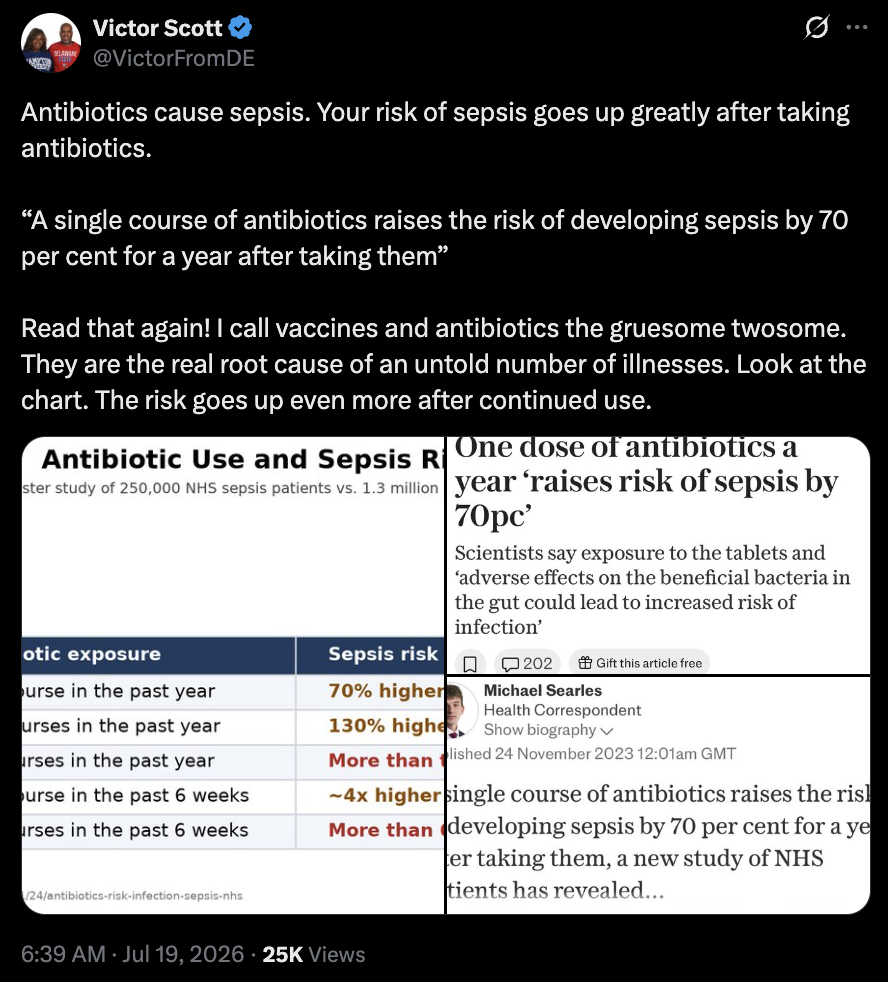
A post on X claims that “antibiotics cause sepsis,” stating that “a single course of antibiotics raises the risk of developing sepsis by 70 per cent for a year after taking them.” The post goes on to describe vaccines and antibiotics as “the gruesome twosome” and “the real root cause of an untold number of illnesses.”
The post shares a series of screenshots of an article by the UK-based broadsheet The Telegraph, published in November 2023, which cites a study led by researchers at the University of Manchester, drawing on the UK’s National Health Service (NHS) patient data. The claim recycles a more than two-year-old news report but a reader scrolling past the post without opening the screenshots or looking up the original article might not realise that.
What is sepsis, and why do antibiotics matter?
Sepsis is a life-threatening reaction to an infection that causes the immune system to harm healthy tissues and organs. About 15 out of every 1,000 patients hospitalised in Singapore develop sepsis, and it accounts for an estimated 5,000 deaths here each year.
Antibiotics kill or slow the growth of bacteria, and are required to treat bacterial infections, such as tuberculosis or whooping cough.
While the post has a modest 25,000 views so far, a claim that frames this common, often necessary treatment as a hidden cause of serious illness has the potential to make people hesitant about a medicine they may genuinely need. That risk is why the underlying study is worth examining carefully, rather than taking the post’s framing at face value.
What did the study find?
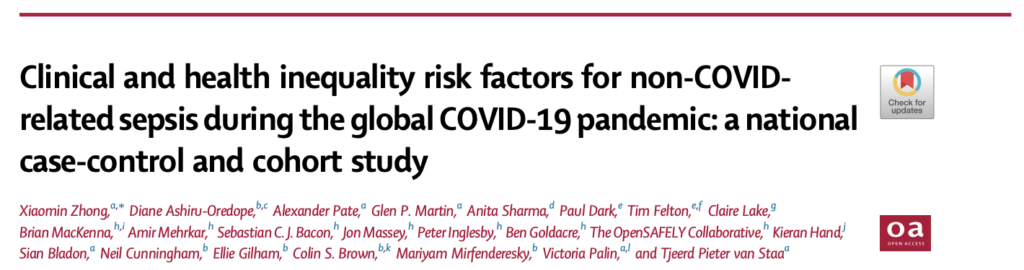
The peer-reviewed study titled “Clinical and health inequality risk factors for non-COVID-related sepsis during the global COVID-19 pandemic: a national case-control and cohort study,” looked at how a patient’s financial circumstances and health history relate to their chances of developing sepsis in England during the pandemic. Antibiotic use was one of several factors examined along the way.
Researchers examined the medical records of 22 million patients in England between January 2019 and June 2022, comparing 224,361 sepsis cases against 1.3 million people who did not develop sepsis. They found that patients who had taken exactly one course of antibiotics in the year before were 73 per cent more likely to develop sepsis than those who had not, a figure the Telegraph rounded to 70 per cent. Two to three courses of antibiotics were linked to a 130 per cent higher chance of sepsis, and three or more courses to a more than three-fold higher chance, matching the Telegraph’s reporting of that pattern too.
What the study did not find is any reason to describe this as antibiotics causing sepsis. This is explicitly mentioned in the research paper’s conclusion: “it is crucial to recognise that these findings are primarily descriptive and necessitate further research to establish causality.” Co-author Xiaomin Zhong told the Guardian, “we’re not sure why exposure to multiple courses of antibiotics increases patients’ risk of sepsis,” adding that “it could also be down to underlying differences in immune status or comorbidities.”
In essence, people who need repeat courses of antibiotics may already have health conditions or recurring infections for reasons unrelated to the antibiotics themselves, and it may be those underlying issues, not the antibiotics, that raise their sepsis risk.
Is antibiotic use really the real root cause of sepsis?
The study’s central focus was health inequality relate to sepsis risk. After taking other health conditions into account, people living in England’s poorest neighbourhoods still had 40 per cent higher odds of developing sepsis than those in its wealthiest neighbourhoods; and those with the most advanced stage of chronic kidney disease were more than six times as likely.
A person’s antibiotic history was one of several additional clinical factors examined separately, not the study’s central research question. Building a claim that antibiotics are “the real root cause of an untold number of illnesses” on one factor among many, drawn from outside the study’s main focus, misrepresents what the research was actually about.
In addition, vaccines play no part in the study’s data or findings. The “gruesome twosome” framing of vaccines and antibiotics, and the link drawn between the two, has no basis in the source material used to lend the post its credibility.
Hence, we rate the claim that antibiotics causes sepsis, on the basis of this study, as misleading and false.

Posts like this can sound convincing because they highlight one part of a study and attach their own conclusion to it. Here, that meant taking a real statistic and building an unsupported claim about causation and vaccines on top of it. It is worth reviewing the original article or study before accepting a post’s framing of it.