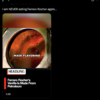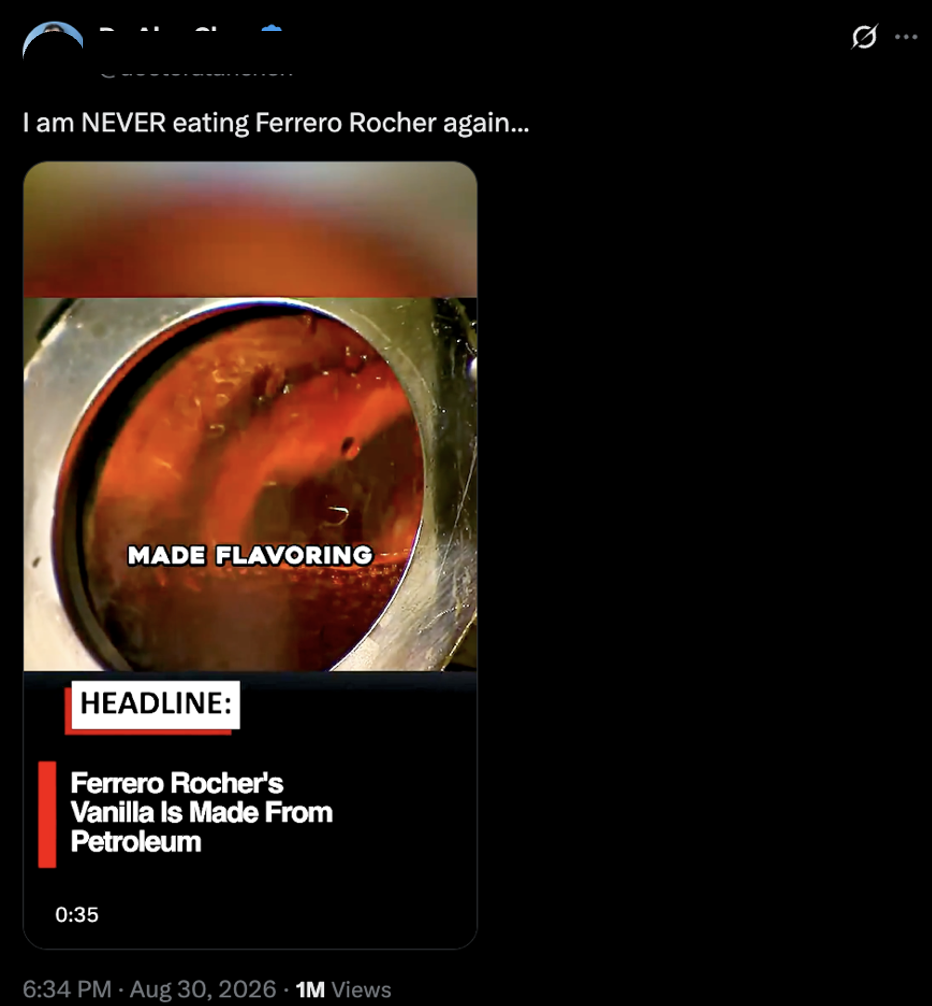
A widely viewed video on X, with around 1 million views, claims that Ferrero Rocher uses vanillin, a synthetic flavouring made from petroleum. The video further alleges that the company misleads consumers into believing the chocolates contain real vanilla, when they actually use synthetic vanillin.
We checked Ferrero Rocher products sold in Singapore, the US and the UK, reviewing ingredient information and images of product packaging shown on retailer and supermarket websites. The ingredient lists include vanillin, with several products explicitly describing it as a flavouring or artificial flavour.
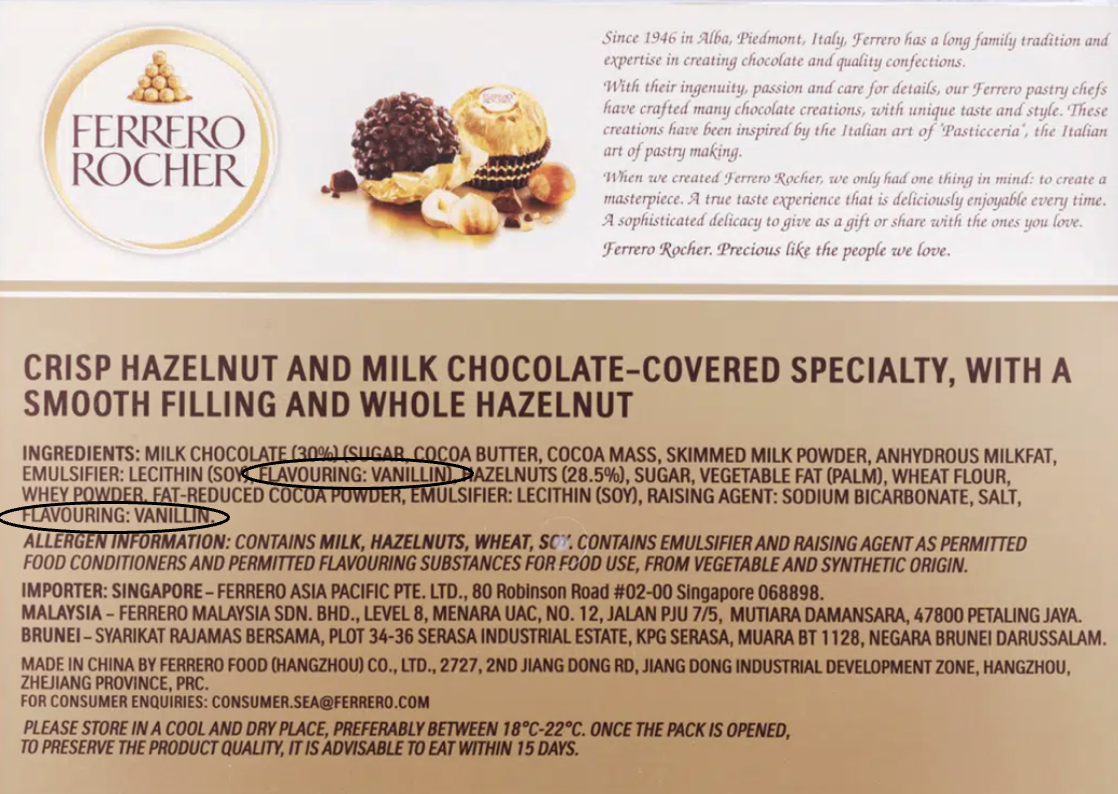
Image: Fairprice Singapore
What is vanillin?
Vanillin is the primary flavour compound responsible for vanilla’s characteristic aroma and taste. It occurs naturally in vanilla beans, but the amount that can be obtained from natural vanilla is insufficient to meet global demand, so most vanillin used commercially is produced through industrial processes, including synthetic production.
Vanillin is not unusual in this respect. Many familiar food ingredients are produced through industrial processes. Menthol, the compound responsible for the characteristic minty flavour and cooling sensation associated with mint, is another example. It can be extracted naturally from peppermint oil, but can also be produced synthetically. In industrial production, menthol can be made from other chemical compounds, such as thymol, through a series of chemical reactions. Synthetic menthol is used as a flavouring in foods, particularly mint-flavoured confectionery.
How is vanillin produced?
One major route of vanillin production is chemical synthesis using guaiacol, which is produced from petrochemical raw materials (materials derived from petroleum or natural gases). Guaiacol is also a naturally occurring organic compound found in plants, and in foods and drinks such as roasted coffee and whiskey. The guaiacol used to make vanillin, however, is manufactured rather than extracted from these foods. It is then reacted with glyoxylic acid to form an intermediate called vanillylmandelic acid, which is subsequently converted into vanillin.
Vanillin can also be produced from different plant-based materials such as lignin, a byproduct of wood-pulp processing, and ferulic acid, a compound found in the cell walls of plants. These materials contain compounds that can serve as starting materials, which manufacturers can transform into vanillin through chemical or biological processes.
A 2026 review of vanillin production methods estimates that about 85% of synthetic vanillin worldwide is produced through the petrochemical guaiacol route, while about 15% is produced from lignin.
This may be where the claim that Ferrero Rocher’s vanilla is made from petroleum comes from. However, we could not find publicly available information from Ferrero identifying the raw materials or production process used for its vanillin. As such, there is insufficient evidence to conclusively state that the vanillin in Ferrero Rocher is petroleum-derived.
Is vanillin safe to consume?
The fact that vanillin can be produced using petrochemical raw materials does not, by itself, mean that the resulting food ingredient is unsafe. In the petrochemical production route, guaiacol is used as a starting material and is subsequently converted into vanillin. In other words, petroleum-derived materials are used at the start of the production process; the finished ingredient is vanillin, not petrol or crude oil.
Separately, vanillin itself is an established food flavouring that has been evaluated and permitted for use in food in several jurisdictions. The US Food and Drug Administration lists vanillin among substances permitted for use as a food ingredient under specified conditions. The European Union authorises it as a flavouring substance, while the Singapore Food Agency identifies vanillin as an example of a flavouring agent.
Is Ferrero Rocher trying to hide that it’s vanilla flavourings are made from petroleum?
Ferrero Rocher does contain vanillin, which is clearly listed as an ingredient on the product packaging. Based on the product information we reviewed online, Ferrero does not appear to claim that their products contain real vanilla. Therefore, there is insufficient evidence to conclude that the company is misleading consumers into believing that natural vanilla is used.
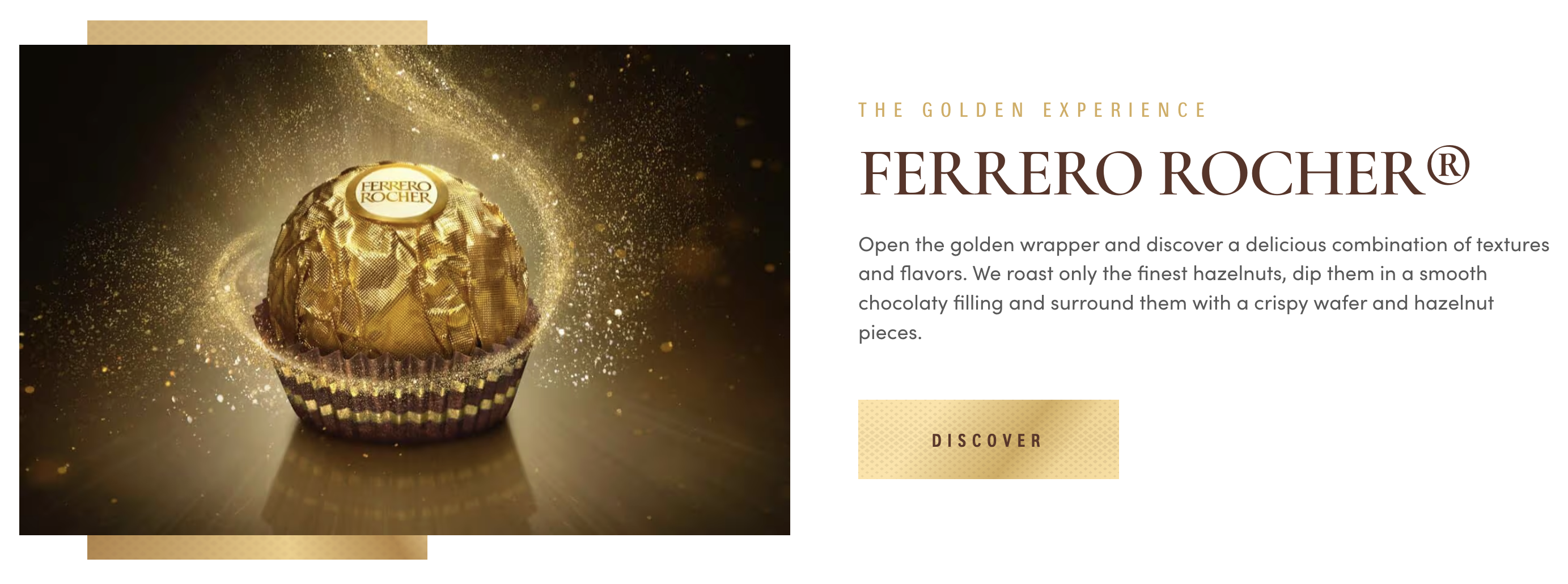
Image: Ferrero Rocher, US
Petrochemical production is the dominant production route for synthetic vanillin globally. However, vanillin can be produced through different routes and from different starting materials. We found no public information confirming which raw material or production process is used for the vanillin supplied to Ferrero. Therefore, the available evidence does not establish the video’s specific claim that Ferrero Rocher uses petroleum-derived vanillin. We rate the claim as unproven.

Viral claims can leave out important context. Before getting alarmed, it is worthwhile to check the evidence and dig a little deeper, as “synthetic” does not automatically mean that something is harmful or unsafe.