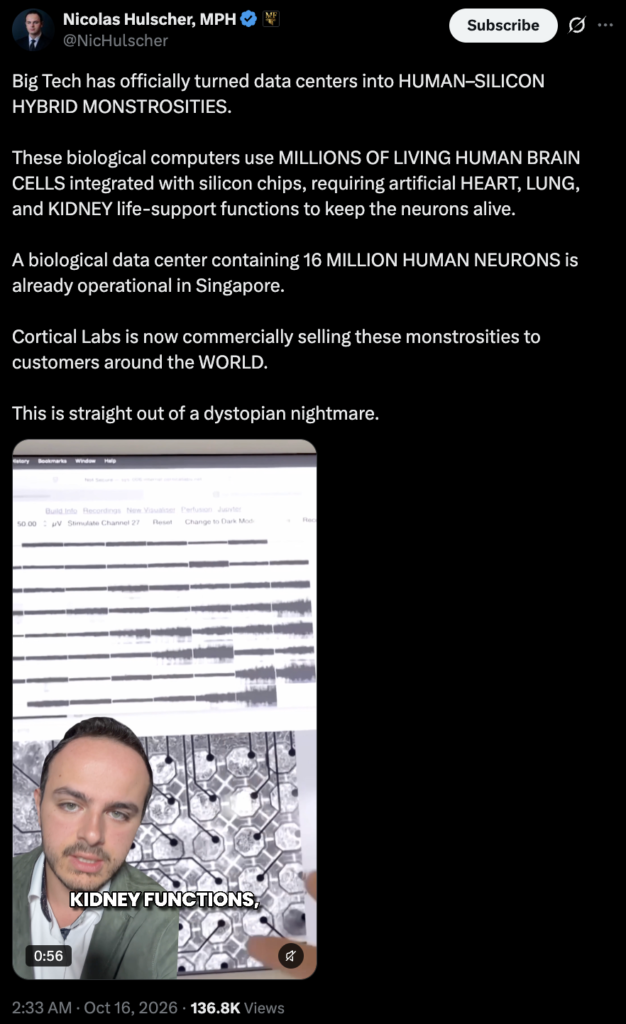
A video on X, which has drawn more than 136,000 views, claims that “Big Tech” has turned data centres into “human-silicon hybrid monstrosities”. The speaker says these computers run on millions of living human brain cells connected to silicon chips, with built-in life support systems likened to an artificial heart, lungs and kidneys to keep the neurons alive.
The speaker also suggests that the systems could potentially develop some form of consciousness. He claims that a biological data centre containing 16 million human neurons across 20 units is already operational in Singapore, and that Australian startup Cortical Labs is selling individual biological computers to customers around the world. With such alarming language linked to a biological data centre in Singapore, we took a closer look at the claims.
What is Cortical Labs?
Cortical Labs is a Melbourne-based company that develops what it calls biological computers. Its main product, the CL1, combines living human neurons with a silicon chip. The neurons are derived from adult human cells, which are first reprogrammed into stem cells and then developed into neurons, the nerve cells found in the brain.
These neurons grow on a silicon chip fitted with tiny electrodes. The chip sends electrical signals to the neurons and records their responses. Software then interprets these responses and uses them to carry out computing tasks.
In other words, the CL1 is not made entirely from biological material, nor does it replace silicon chips altogether. It is a hybrid system that combines living neurons with conventional electronic hardware and software.
The neurons are kept alive by a dedicated life-support system, which supplies them with a mixture of sugar, micronutrients and pH buffers every three days, while a gas mixer provides oxygen, carbon dioxide and nitrogen to maintain the conditions needed for the cells to survive.
What was launched in Singapore?
In March 2026, NUS Medicine, Cortical Labs and DayOne, a Singapore-headquartered data centre developer and operator, announced a partnership to develop a biological data centre prototype in Singapore.
The prototype reportedly went live on 16 July 2026 and was showcased to invited guests on 6 August 2026. NUS Medicine publicly announced it on 17 August 2026. Located at the NUS Life Sciences Institute, the prototype brings together 20 CL1 biological computing units developed by Cortical Labs. DayOne provides the supporting infrastructure, while NUS Medicine oversees the culturing and growth of the neurons used in the system.
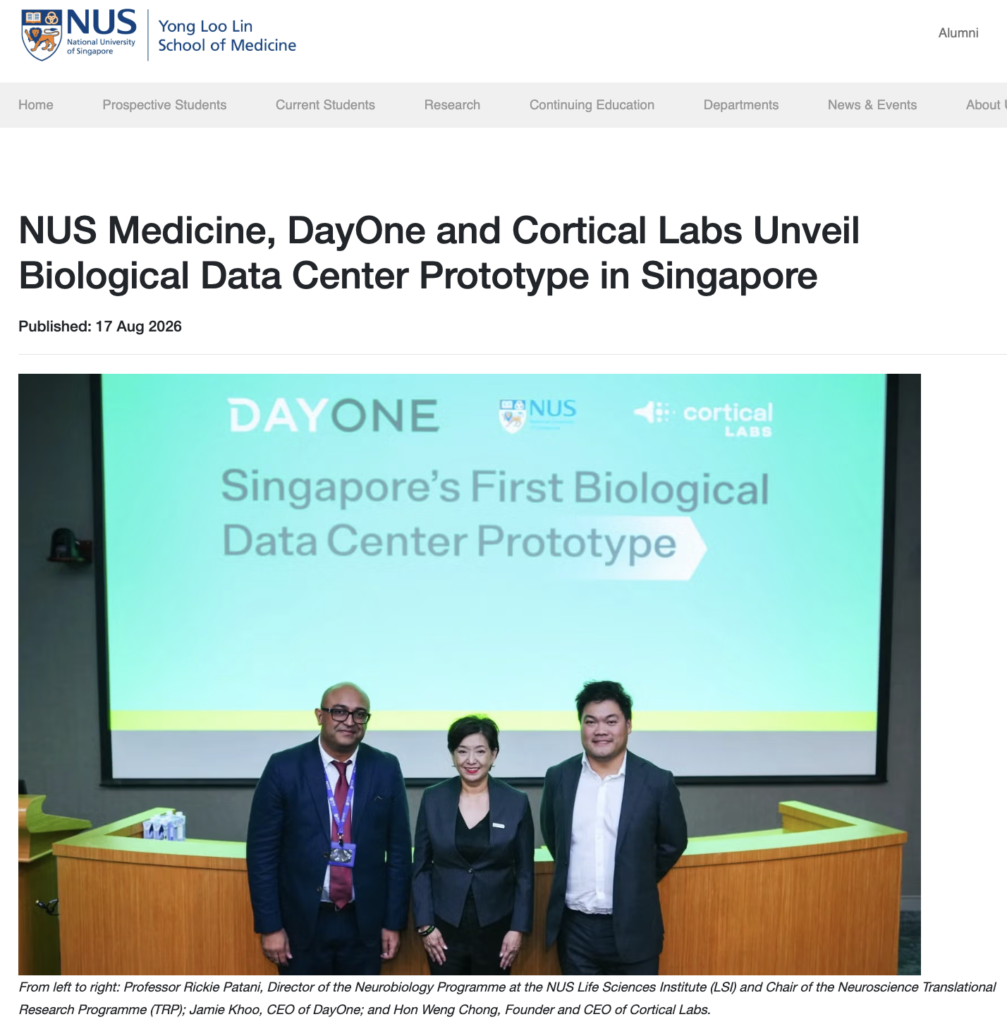
The partners describe biological computing as a way to use living neurons alongside electronic hardware to process information and support AI-related applications. They are exploring potential uses in drug discovery, biomedical research and computing tasks that may benefit from learning from limited data or adapting to changing conditions.
For now, the 20-unit installation remains a research prototype, rather than a large-scale commercial data centre. DayOne and Cortical Labs have said they are exploring a phased expansion that could eventually reach up to 1,000 units in a DayOne facility in Singapore, subject to technical validation and regulatory approvals.
The technology is also being promoted as a more energy-efficient alternative to conventional computing. The Straits Times reported that each CL1 unit uses around 30 watts, including its life-support systems. However, lower power consumption alone does not establish greater computing efficiency. The sources reviewed do not provide a direct comparison of how much useful computing work the CL1 can perform per watt against conventional chips. Cortical Labs’ founder has also acknowledged that conventional silicon chips remain better suited to fast, precise and repeatable calculations, such as those used in large language models.
The X post claims that the Singapore installation contains 16 million neurons across its 20 units, but does not provide a source. Published figures for the CL1 differ. IEEE Spectrum, a technology publication by the Institute of Electrical and Electronics Engineers, reported approximately 800,000 neurons per unit, while The Straits Times reported at least 200,000. Neither figure independently confirms the total number of neurons in the Singapore installation, and we could not find an official figure from the project partners.
Is Big Tech involved?
The X post claims that “Big Tech” is behind the development of data centres that run on living human brain cells. The term “Big Tech” generally refers to the world’s largest technology companies, such as Apple, Meta and Microsoft, and is often used in discussions about their market power and influence.
The publicly identified partners behind Singapore’s biological data centre are NUS Medicine, DayOne and Cortical Labs. DayOne provides capital and strategic input, NUS Medicine contributes research expertise, and Cortical Labs supplies the biological computing technology.
We found no evidence in the partners’ public announcements that major technology companies are directly funding or operating the project. While this does not rule out indirect or undisclosed involvement, the claim that Big Tech is behind the Singapore installation is not supported by publicly available evidence.
Is Cortical Labs selling these computers around the world?
Cortical Labs has moved into commercial sales and services. In an August 2026 interview with The Edge Singapore, its founder and CEO, Hon Weng Chong, said the company had at least 40 customers worldwide, including Honda Research Institute Europe and two Italian universities.
Sales of the CL1 began in November 2025. Customers can purchase a physical unit, access one remotely through the company’s Cortical Cloud platform, or pay Cortical Labs to design and run experiments for them. The customer figure therefore does not mean that all 40 customers have bought physical computers.
Could the neurons become conscious?
The X post raises the possibility that biological computers could eventually develop consciousness. However, this remains speculative. The presence of living neurons and their ability to respond to electrical signals do not, on their own, demonstrate consciousness, sentience or human-like awareness.
A 2026 consensus paper by the Asia Pacific Neuroethics Working Group notes that current human brain organoids (three-dimensional, lab-grown structures derived from human stem cells that mimic certain aspects of brain development and function) are very likely to lack the complexity required for sentience. However, the paper examines brain organoids generally, rather than the CL1 system specifically, and notes that the ethical implications of combining brain organoids with computing systems require further consideration.
Hence, we rate the claim that Big Tech is behind a data centre running on human brain cells in Singapore as partly true. A 20-unit biological computing prototype is operating in Singapore, and Cortical Labs has customers internationally. However, we found no evidence that major technology companies are directly involved in the Singapore project, which remains a research prototype rather than a large-scale commercial data centre.

New technologies can sound alarming when described in sensational terms. Before sharing such claims, it is worth checking what the technology actually does, what has been independently verified, and what remains speculation.