The claim that New Year’s Eve celebrations are being suddenly cancelled has been spreading across social media. On X and TikTok, multiple viral posts claim that historic annual celebrations and firework displays in large cities such as Paris, Sydney and Tokyo (among others) have been abruptly cancelled.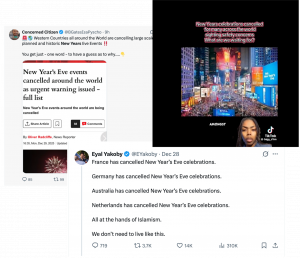
Most of these claims suggest that the cancellations are linked in some way. Some posters explicitly say this is due to immigration of peoples from other cultures either because the cities are “forced to accommodate those who do not share values and cultures” or because of “terror threats.” Others speculate about a wider conspiracy about potential nefarious activity planned to take place on New Year’s Eve.
Is it true that New Year’s Eve celebrations are being canceled en masse?
Based on what we could find, this claim gradually took shape as separate reports of certain New Year’s Eve events being cancelled or altered hit the news cycle in December. For instance, the articles on Tokyo, Paris and Sydney pictured below all note that specific annual celebrations will not take place as planned.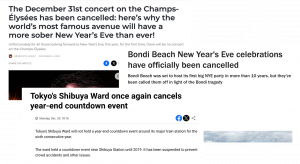
These disparate reports were than brought together by suggestively worded headlines published by UK tabloids such as the Daily Express and the Mirror titled “New Year’s Eve events cancelled around the world as urgent warning issued.” Implied in these headlines is that a single issue or “warning” has prompted multiple events to be cancelled.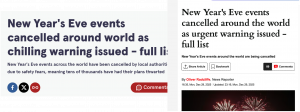 However, when looking closer at the reports from different cities, this is very much not the case. Rather, the facts suggest that while certain events have been cancelled due to a wide range of different circumstances, many other historic events are set to continue as usual.
For instance, in the case of Sydney, the annual Bondi Beach fireworks display was cancelled in the wave of the recent tragic shooting. However, another large annual countdown fireworks event at Sydney Harbour is set to continue without change. In cities such as Bali and Hongkong, fireworks displays have also been cancelled to honour those impacted by recent tragedies (fatal flooding in Sumatra and the deadly high-rise apartment fire in Tai Po respectively), with more muted celebrations taking place instead.
In Tokyo, while reports of the annual Shibuya New Year’s Eve event being cancelled are true – this has been the case for six years running due to fears over congestion and potential crowd accidents. And, while a large New Year’s Eve music festival at the Champs-Élysées in Paris has been cancelled due to similar location-based safety challenges, a large-scale fireworks display will still take place and be open to revellers.
Therefore, while it is true that a number of New Year’s Eve events have been cancelled or altered in multiple cities across the world, other events and celebrations are very much still ongoing at the same scale. For instance, the iconic Times Square Ball Drop in New York is set to continue – as are the Marina Bay Countdown Fireworks here in Singapore.
Claims that suggest a sudden and related cancellation of New Year’s Eve worldwide misleadingly correlate disparate circumstances to push a false narrative.

In particular, an anti-Islam and anti-immigration narrative seems to have formed around this claim – with posters claiming that “Islamism” is behind this cancellation of long-running or traditional cultural events.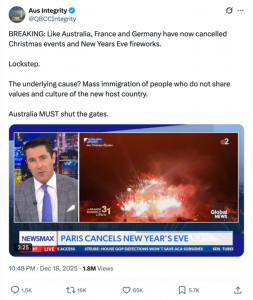 However, the claim itself is untrue and rooted on a misleading premise that only serves to create unfounded anger and build resentment. The use of disinformation to stoke racial or cultural tensions is one which we must be on high alert for – particularly when they repackage real, legitimate news into a false and harmful narrative.