The claim that combining Coca Cola and avocado produces an instant pain relieving ointment has been circulating on social media.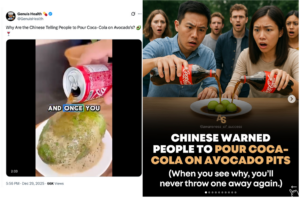 Some of the posts we’ve seen include an instruction video on how to make this pain remedy at home – with headings such as “why are the Chinese telling people to pour Coca Cola on avocado?” While the video begins with Coca Cola being poured on a whole avocado, a voiceover explains that this “Chinese remedy” actually involves soaking a sliced avocado pit in Coca Cola and rubbing the steeped liquid over external body parts that require pain relief (such as joints and muscles aches).
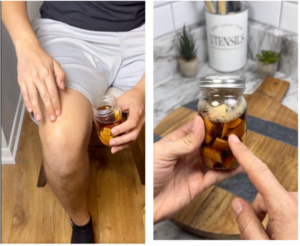 Per the video, Coca Cola was originally formulated as a pain cure with strong medicinal ingredients. Mixing it with avocado pits supposedly amplifies its benefits even more. Multiple accounts on YouTube, Instagram, Facebook, and X have made iterations of this video, but we decided to looked a bit closer for any scientific or medical evidence to back it up.
The first red flag we noticed was that a simple google search about “Coca Cola and avocado pits” only shows a high volume of similarly-worded social media posts concentrated in latter half of 2025. No reputable research or articles from medical platforms come up in the search. The only earlier mention we found of the claim is another wave of viral social media posts from 2023 which had similar content, but slightly different wording and imagery.
From what we could find, some studies have shown that avocado seeds might have anti-inflammatory properties. Some folk and homeopathic remedies also involve consuming the seed as a tea (by boiling it) or as a food additive (by drying and grinding it into powder).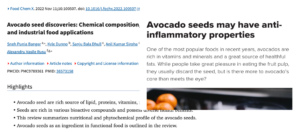 However, the efficacy of avocado seeds as a remedy or supplement has not been comprehensively tested on humans, and the seed itself tends to be both bitter and difficult to consume without additional processing. Further, many of the studies conducted on the properties of avocado seeds use specifically extracted and processed parts of the seed rather than just directly steeping it for topical use.
We could also find no indication that this is something practiced in Chinese Traditional Medicine (which has a well-documented set of medical practices that do not include avocados) – nor could we find anything of the sort on Chinese-language social media platforms.
Finally, while Coca Cola was originally formulated in the 1800s as a headache remedy and “brain tonic” due to its use of coca leaves (which contain cocaine) and kola nuts (which have high caffeine levels), neither ingredient is present in the product being made and sold today. Any claimed medicinal value is, thus, also inaccurate and misleading.
Therefore, there is no evidence to show that mixing Coca Cola and avocado seeds makes a pain relief remedy – much less a “Chinese” one. Instead, as our research below indicates, this claim appears to be designed for clickbait and views using popular buzzwords and tutorial-style video formats to sound legitimate. We give this claim a rating of false.

We also found a claim about soaking avocado seeds in rubbing alcohol as a pain remedy which seems to pre-date the Coca Cola claim and could have possibly inspired it. However, this claim has a similar lack of reliable scientific backing despite being touted as a “natural” and “traditional” recipe.
The inclusion of Coca Cola in the recent wave of claims began in 2023. The earliest version we could find is a TikTok posted in August 2023. The format of the video, which starts with Coca Cola being poured directly on a whole avocado as clickbait, seems to be the prototype on which many of the other video iterations are based. Shortly after, multiple other videos with this same format popped up on YouTube and Facebook.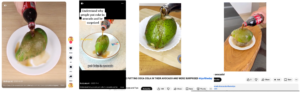 These videos fit the trend of low quality “life hack” style content popular on social media that is often ineffective or inaccurate but uses eye-catching, click-bait style visuals to gain clicks, comments, and views for profit. When a topic gains views, these channels all jump to replicate the content with only minute variations.
The recent wave of claims seem to be clipping the older videos and incorporating new, AI-generated elements to it. For instance, overlaying an AI-generated Asian doctor delivering the instructions, or generating new visuals to accompany the claim.
This claim falls within a pattern of a slop content-style mis/disinformation we have been noticing over the past few years – now made more insidious with Generative AI.
Low-quality content with fabricated facts is mass produced by different posters, saturating the information space and making it difficult to avoid. Over the years, this content is embellished with different visuals and details (such as the “Chinese remedy” detail), resulting in thousands of videos all repeating the same misinformation. Generative AI technology can be used not only to produce videos, but to write scripts, captions, and other inaccurate information quickly, cheaply and at a high volume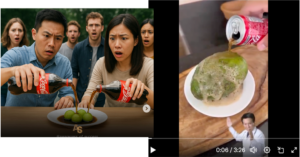
Recent surveys of social media platforms such as YouTube indicate high levels of “slop” content – low effort, mass produced, and unoriginal media designed to farm views. AI slop, in particular, is proving to be a scourge, with a recent report suggesting that 21-33% of YouTube’s feed may consist of AI slop or brainrot videos. This same report found that Singapore-based users contributed 2.08 billion views to trending AI slop channels. While this might appear like harmless or silly entertainment, the proliferation of such content erodes media literacy and the ability to identify when content is untrue or synthetic. Some researchers have theorised that this could further make audiences more vulnerable to manipulation by bad actors who use the “slop” medium to convey certain narratives or disinformation.
As such, while content like this claim is now an unavoidable part of the online experience, it is important for us to be aware and apply a critical lens to all the content we come across. Claims that sound even a little dubious – or that are presented in short-form, click-style formats – should be cross-checked and taken with a huge pinch of salt to prevent them from gaining even more momentum.