We came across a TikTok trend in which users squash slices of North American sandwich bread and watch them spring back into shape. The videos claim that the bread contains so many “shelf extenders” that it behaves like memory foam.
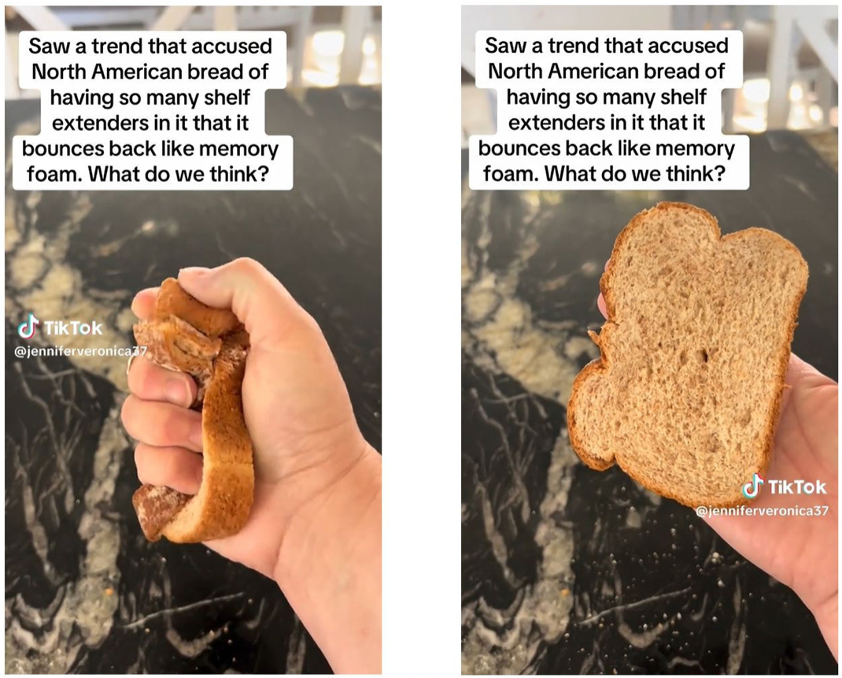
It is true that many mass-produced breads contain additives, dough conditioners such as emulsifiers, enzymes, oxidizing agents, and mold inhibitors that improve texture, extend shelf life, and stabilize moisture. But the mere presence of these additives is not sufficient to explain the memory-foam bounce.
The key to the “springy” effect lies in gluten. Gluten is a network of proteins—chiefly glutenin and gliadin—that forms when wheat flour is mixed with water and kneaded. This network gives the dough elasticity (the ability to bounce back) and extensibility (the ability to stretch). Scientific studies of dough rheology confirm that wheat dough develops elastic properties through its gluten network, which allow it to deform and then partially recover shape (i.e. “bounce back”) under mechanical stress. In short, even in the absence of additives, a well-developed gluten structure can produce the rebound effect seen in those videos.
Where North American breads may differ from their counterparts elsewhere is in which additives are legally permitted. For example, Potassium bromate is used in some U.S. breads as a dough improver (an oxidizing agent), to strengthen dough, allow greater rise, and improve texture. However, potassium bromate is banned in many countries including the European Union, the United Kingdom, Canada, India, and others due to health concerns and its classification as a possible carcinogen.
Critics point out that even though the U.S. Food and Drug Administration (FDA) technically permits its use, good manufacturing practice requires that bromate convert to bromide during baking. Still, residual amounts sometimes remain. Other additives that are more restricted or banned in other jurisdictions but may appear in U.S. baked products include azodicarbonamide (ADA), propylparaben, and certain artificial colorants.
It is important to note that not all U.S. breads use bromate or controversial additives; many manufacturers now market “clean label” or “no added” versions.
Putting this all together: the claim that North American bread “bounces back like memory foam” because of heavy use of shelf-life extenders is misleading. The elastic rebound shown in the videos is better explained by the underlying gluten network in wheat dough—not by the additives. Although U.S. regulations are less strict in some cases, the springiness is not proof of chemical overuse.