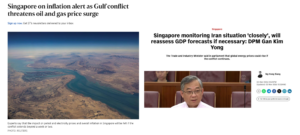
As the US-Israeli war with Iran continues, the topic of oil has dominated headlines both globally and close to home in Singapore. Over the past few days, we have observed a number of claims about oil that have gone viral on local social media and chat groups – as well as claims involving Singapore’s oil stocks.
For one, a number of social media accounts on X have been making the claim that Singapore has a crude oil stock that will last the country 245 days. Most of these posts are being made by posters from India in the context of India purportedly having 25 days of crude oil in stock. The implication is that Singapore and other countries (such as the US, China, Japan, and South Korea) are far better placed to weather any oil-related shortages and price spikes.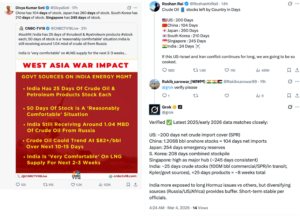 When asked by users under the claim post to verify the numbers, X’s AI Bot, Grok, appears to confirm that the claim is true, saying that it closely matches “latest 2025/2026 data.” However, Grok does not provide any sources or links as evidence, merely offering its assessment and verification in a reply post.
Given that this is starting to cause confusion among locals (for instance, wondering if 245 days is “really enough?”), we took a closer look to check where the numbers come from – and if they are actually accurate.
Based on what we could find, the only verifiable statistic in the claim posts is from Japan (254 days’ worth of oil reserves) and South Korea (200 days) – including national stockpiles, private-sector stockpiles, and joint stockpiles with oil-producing countries. However, none of the other countries mentioned in the claim post have made statements about the exact day-based supply of their oil reserves.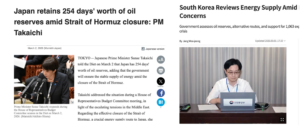 Estimates based on data published in reputable journals and by some countries (the US, South Korea, and Japan directly publish detailed data about their oil reserves) instead suggest that the claim is actually using different metrics across the different countries and over-inflating the days for most in order to shape and fit a certain narrative about the situation in India.
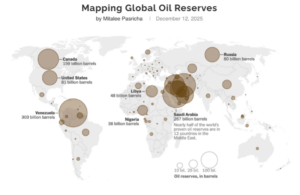 For instance, while the claim says that the US has 200 days of crude oil supplies, these calculations appear to be made based on total imports rather than actual stock in the Strategic Petroleum Reserve and commercial inventory.
Similarly, the 245-day statistic for Singapore (which has not published exact data about our oil reserves) appears to be derived from commercial inventory that is exported or traded and Singapore’s oil storage capacity (which is large due to our position as a large oil trading hub). From what we could find, much of the stored oil in Singapore belongs to foreign companies and are part of export contracts, not part of any mandated stockpile or reserve. The only data we could find about Singapore’s national oil reserves dates back to 2013 in a US Energy Information Administration report which states that Singapore has “strategic petroleum reserves of about 32 million barrels of crude oil and 65 million barrels of refined petroleum products.” (for reference, Japan’s current 254-day reserve comprises 470 million barrels). However, given that the information is over 20 years old, it is no longer an accurate reference for any claims made about 2026.
Therefore, the claim about Singapore’s oil reserves does not appear to be based on any concrete public data. However, this is not necessarily an indicator of Singapore being worse off – just having a different system to countries such as Japan with intentionally large strategic stockpiles.
We give this claim a rating of false. While some of the information in the claim is correct, it is mixed with inaccurate assumptions based on lazy or outright misconstrued deduction from inconsistent metrics.

While Singapore is set to be impacted by the US-Israeli conflict with Iran if it continues, it is important to remain cautious of information from social media – even if it seemingly conveys positive information about Singapore. In this case, while Singapore was part of discourse based in another country, inaccurate information was nevertheless spread.
In times of uncertainty and conflict, it becomes easy for users on social media to spread faulty information – leveraging the virality and heightened concern of audiences. With tools such as Grok being unreliable when it comes to fact-checking, it is more important than ever to cross-check information with multiple reputable sources before sharing or internalising data from viral social media posts.
At the time of writing (05/03/36) the Singapore Government has not made any statements about our crude oil reserves, with DPM Gan Kim Yong saying earlier this week that Singapore is monitoring the situation closely.