A viral post on Instagram with over 85,000 likes claims that a 20-year study found women who regularly cleaned their homes lost lung function equivalent to smoking 20 cigarettes a day for 20 years, and that men didn’t show the same damage.
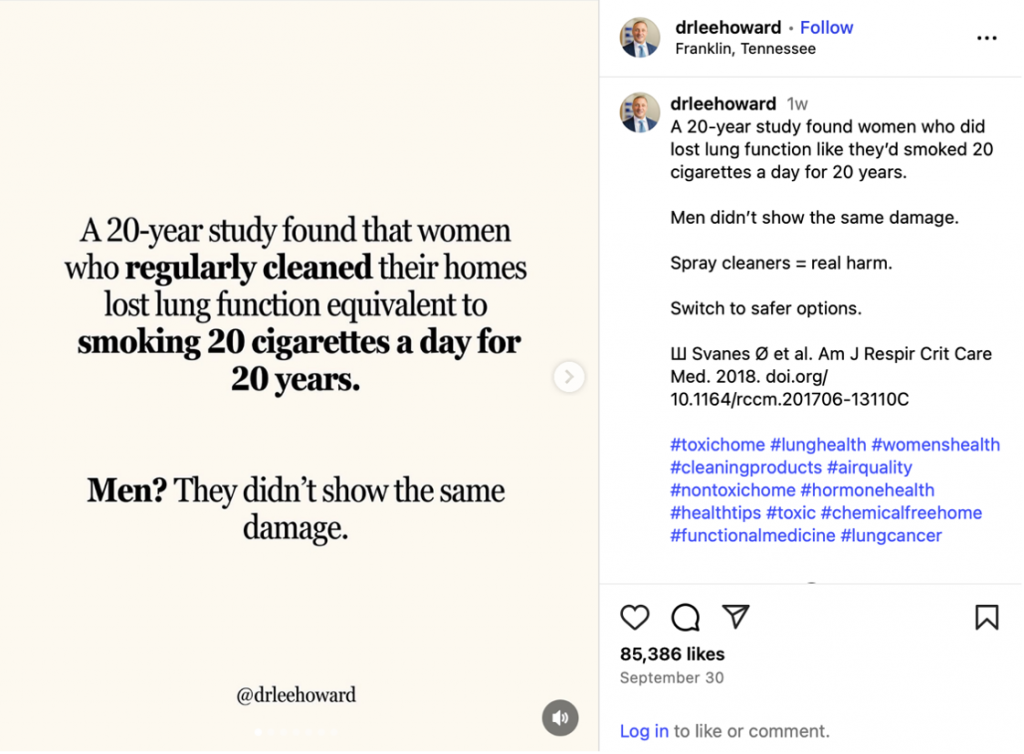
A 2018 analysis from the European Community Respiratory Health Survey (6,235 adults) reported that women who cleaned (either at home or as occupational cleaners) had faster declines in lung function than women who did not clean, while the same association was not observed in men in this dataset. Crucially, the study cites chemical exposure from cleaning products as the cause of the damage – not dust exposure. Women reporting use of spray cleaners and other chemical agents experienced steeper decline in lung function, decline, consistent with repeated inhalation of irritant/sensitising compounds (e.g., fragrances, solvent cleaning agents, glycol ethers) that inflame airways over time.
Where the post gets ahead of the science is the cigarette comparison. The journal article does not say “20 cigarettes a day for 20 years.” That phrase comes from a University of Bergen press release that simplified the effect for a general audience. What the research says is that the decline among women working as cleaners was “comparable to smoking somewhat less than 20 pack-years”—i.e., less than a pack a day for 20 years.
Additionally, there are caveats the post leaves out. The study relies on self-reported data, via questionnaires about cleaning frequency and products. And while the effect was seen in women and not in men, the authors note possible reasons such as different exposure patterns and the relatively small number of male cleaners, which limits statistical power; the study does not establish a biological reason for the sex difference.
In conclusion, it is mostly true that long-term, routine use of cleaning products, aerosols in particular, are associated with faster lung-function decline in women in this cohort, with no similar association detected in men in the same data. However, the claim that cleaning your home is “as bad as smoking 20 cigarettes a day for 20 years” is sensationalist framing, not a statement from the journal article, and overstates what the study supports. Sensible precautions for cleaning remain prudent: ventilate well, favour lower-emission or fragrance-free products, and use microfiber/water where feasible.

Posts like this spread misinformation by oversimplification and omitting essential context. The post cherry-picks a statement (“20 cigarettes a day”) and presents it as a literal scientific finding, while omitting key qualifiers about who was affected (women in this cohort), how exposures were measured (self-report), and the uncertainty around the sex difference. It’s a classic case where a catchy analogy becomes the headline, and the nuance in the underlying peer-reviewed paper gets lost.