Posts reporting on a “new study” about the role cheese plays in our nightmares have been gaining traction on social media, with one post on X at over 9.5 million views. According to reports and articles covering this claim, researchers found that cheese is associated with a higher likelihood of disturbing dreams – with 25% of study subjects saying cheese is the cause of their nightmares. Other headlines even claim that it has been “confirmed” that cheese causes nightmares.
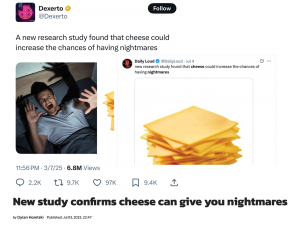
However, while this headline is pretty eye-catching and many websites have picked up the story with the same, cheese-y headline, we took a closer look to see how much truth there is to the claim.
According to our research, this claim comes from a study published on 1 July titled “More dreams of the rarebit fiend: food sensitivity and dietary correlates of sleep and dreaming.”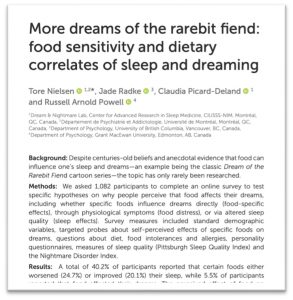 We reviewed the article, which is available in full to read online, and found that the study surveyed just over 1000 participants using an online survey to gather their self-reported observations about the impact of consumed food on their sleep quality and dreams. That is, no actual direct monitoring of sleep quality or dream activity took place – the results are based entirely on responses from the online survey.
While some news outlets and viral posts focus on the 25% statistic of self-reported cheese-related nightmares, almost none mention that out of 1076 respondents, only 5.5% reported that food affected their dreams (which comes to only 59 respondents). The “25% of cheese-related nightmares” refers to 25% of that minority – making it far less definitive and significant than is being suggested. And, rather than just cheese, this percentage refers to dairy products in general, which includes cheese but not exclusively so.
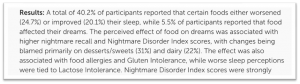
Further, “desserts and sweets” were associated with nightmares by this group even more than dairy at 31%, making the claim headline even less supported by the actual content of the research paper. While the researchers do posit possible correlations between “dairy induced gastrointestinal symptoms” (or lactose intolerance) and disturbing dreams, this is not proven or demonstrated by the study.
We also found older articles discussing the theory (and, in some cultures, folklore) that food impacts our dreams. Cheese, in particular, seems to be an often brought up alleged culprit when it comes to nightmares. However, the expert consensus across these articles appears to be that there is no solid evidence of this being true – despite some strongly believing it to be the case. 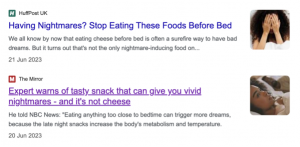 Therefore, the paper at the centre of this claim does not purport to have found that cheese is associated with high chances of nightmares. Instead, it is a psychology paper that examines perceptions held by its subjects about how food impacts their sleep and dreams. We give this claim a rating of false.

We have fact-checked other similar claims where a “new study” is inaccurately reported on, leading to misleading headlines. This case is a particularly egregious example of how far a paper can be taken out of its very limited scope and re-crafted to go viral in today’s digital environment.
Rather than accurately reporting the findings laid out by the paper (which is easily accessible through a quick google search), many small news outlets and large social media accounts cherry-picked parts of the paper to craft the most eye-catching headlines. For instance, using “cheese” instead of “dairy products,” or neglecting to mention the parameters and context of the study which might cause readers to lose interest.
While some more reputable news outlets and platforms used the headline as a springboard into clarifying the lack of definitive evidence and unproven nature of this claim, many others did not – including the viral social media posts which, arguably, have a far wider reach.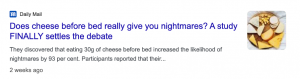 In a landscape where cases such as this are more common than not, we as social media users find ourselves with a growing responsibility to carry out more careful and critical fact-checks on our own. Within this uncertain digital environment where virality is prioritised over accuracy, being attuned to potential false claims is more important than ever in order to making well-informed health choices and food choices.