We’ve seen this claim circulating on several posts across social media – with one X post having nearly 2 million views and thousands of reshares. Per the claim, a new lab-made butter is set to hit supermarket shelves in under 2 years. The posts specifically frame it as “Bill Gates’s butter”– with some even asserting that Gates wishes to replace all butter with “his” lab-grown version by 2027.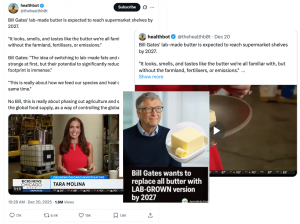 Many responses are heated and against the idea of a food staple being “replaced” or “phased out to…. seize control of the global food supply.” However, being that Black Dot Research has conducted numerous food-related fact-checks (from GMO vegetables to Apple Cider Vinegar and livestock being mass vaccinated) involving Gates’ supposed machinations, this claim raised some red flags.
For one, a large number of claims which center Bill Gates actually stem from the grants and funding his various companies and foundations gives to start-ups and non-profits. In almost every case, the grants or investments do not give Bill Gates power or control over the organisations – nor a key decision-making role in their direction or scope.
Based on our research, this is also the case with “lab-grown” butter.
Savor, a California based company, was started in 2022 and has received $33 million in funding from a number of investors – including $10 million of seed funding from Breakthrough Energy Ventures, which is the investment arm of another Gates-founded company.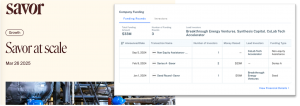
Savor’s butter alternative is part of the company’s experiments with creating animal and plant fat alternatives using chemical and biological processes. This involves building fat molecules by transforming gases into fatty acids. These fatty acids are then turned into components of various food products (such as butter, cheese and ice-cream), replacing conventional fats while recreating their flavor and texture. Scientists at the company have published a paper on this process, which proposes that synthesised dietary fats could significantly mitigate and reduce the environmental impact of agriculture.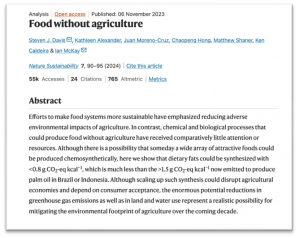 In 2024, Gates expressed support for the company in a blogpost about the environment impacts of fat and oil production. However, while he does have a stake in the business through his company’s investment, it would be inaccurate to describe Savor’s product as “Bill Gates’ butter” or even describe the company as a Gates initiative as many of the claims do.
Further, while Savor does plan to scale its operations (with a commercial production facility set to open in 2027), it does not appear set to replace all “real butter” on supermarket shelves. Rather, the company has positioned itself as an “agriculture-free alternative” and “ingredient supplier” to other brands to create more sustainable versions of existing food products. This means that it is not even certain that the butter will directly appear on shelves as a product, much less replace dairy butter completely.
Therefore, the claim that Bill Gates’ lab-made butter hitting supermarket shelves soon and “replacing real butter?” is mostly false – comprising misrepresentations and exaggerated, cherry-picked assertions that do not accurately reflect the facts. An agriculture-free butter is being developed and produced by a company that received funding from one of Bill Gate’s companies. However, it is not being positioned to “replace real butter” on supermarket shelves by 2027, nor is it being directly orchestrated by Gates.

This claim exists as part of a wider line of (some might argue conspiratorial) thought which sees plant and animal product alternatives as an attack on agriculture and global food supply chains. In many cases, this is also a subset of wider theories about a shadowy cabal of elites (with Bill Gates being a key malevolent figure) planning to control and de-populate the world.
Within this existing conspiracy, claims such as this one seek to affirm and influence by squeezing the facts to fit the theory. This leads to inaccurate headlines and claims that fill the information space with misinformation – something we need to be increasingly wary of especially as such claims easily and frequently go viral.