A viral thread on X this past week has claimed that “quick regional elections” were held by “unidentified militants” in three Russian provinces – with voters choosing to join Finland. An image showing military figures surrounding by civilians carrying Finnish flags supposedly depicts Russian citizens celebrating the news.
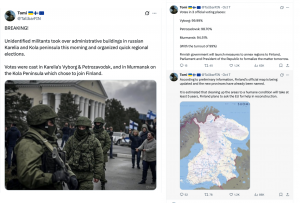 The posts go on to claim that the Finnish Government will launch measures to annex those regions to Finland, even including a supposed map of Finland’s map being updated to include its new, expanded territory. These posts were widely shared on social media (garnering over 500,000 views on X) and across telegram groups. Given the precarious geopolitical tensions in the region as the Russia-Ukraine conflict continues, responses range from incredulous to celebratory, with many screenshots of the original claim post being reposted and circulated.
When looking at a map of the region, it is true that the provinces named in the viral posts are close in proximity to the border Russia shares with Finland. Running for 1340km, the border also serves as an external boundary of the European Union and NATO. It has been effectively closed since 2023 with the entry of Russian citizens being tightly restricted.
The areas around the border have historically been the subject of back-and-forth between the two countries – for instance the region known as Karelia which is currently divided between Finland and Russia. Prior to this Karelia was a province of Finland, but it was split up after the 1930-1940 Winter War with the eastern part ceded to Russia as part of a peace treaty between the two countries. Indigenous groups native to the region, however, do still retain and share some customs and cultures despite the border separation.
This makes the concept of those inhabitants desiring a return to Finland not entirely implausible. However, the idea of Finland taking such aggressive and drastic action to annex foreign territory (something currently illegal under international law) is an extremely wild claim that warrants further cross-checking.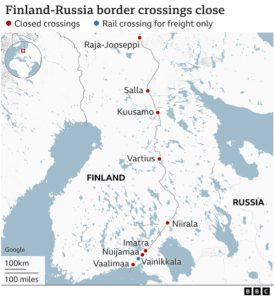 A search of reputable sources from both Russia and Finland did not unearth any reports of regional elections or militant takeovers near the Russia-Finland Border. A closer look at the first image used in the claim post also reveals a small (although easily missed) Grok watermark in the bottom right corner, suggesting that the image was AI-generated using Grok Imagine – which is Grok’s image and video generator. Using Grok Imagine, paid verified users on X can generate up to 10 image prompts every two hours, while unlimited use of both image and video generation are available to paid subscribers.
With no authentic pictorial evidence of the claimed “regional elections: and “militant takeovers,” the claim is even less likely to be true. And, the supposed map showing Finland’s proposed incorporation of Russian Territories is, upon further research, actually a map that has been in circulation for several years that actually depicts the fringe (and unpopular) idea of “Greater Finland” held by some nationalist groups in Finland. It is not a map depicting new proposed annexation.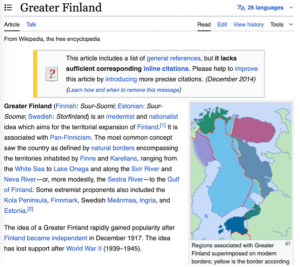
We therefore give this claim a rating of false. It is entirely unsubstantiated and appears to be an elaborate fabrication by the X user.

After allowing the post to circulate and gain traction for several days, the original poster of this claim then clarified in a post (with significantly less views) that it was fabricated by them – saying the “amount of people who actually thought this is true is highly alarming.”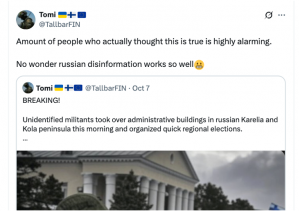 However despite their insistence that this fabrication constitutes an experiment to show how easily people believe such false information, disinformation spread to prove a point is, nevertheless, still disinformation – particularly given the eye-catching and detailed nature of the claim. This claim was particularly easy to spread amongst those unfamiliar with the specifics surrounding European borders and ongoing conflicts as it was written coherently and with a great amount of plausible sounding specifics.
When encountering such claims it is therefore necessary to approach with scepticism keeping an eye out for AI-generated content (sometimes easily identifiable from watermarks) and cross-checking with reputable sources to confirm the veracity of the claim.