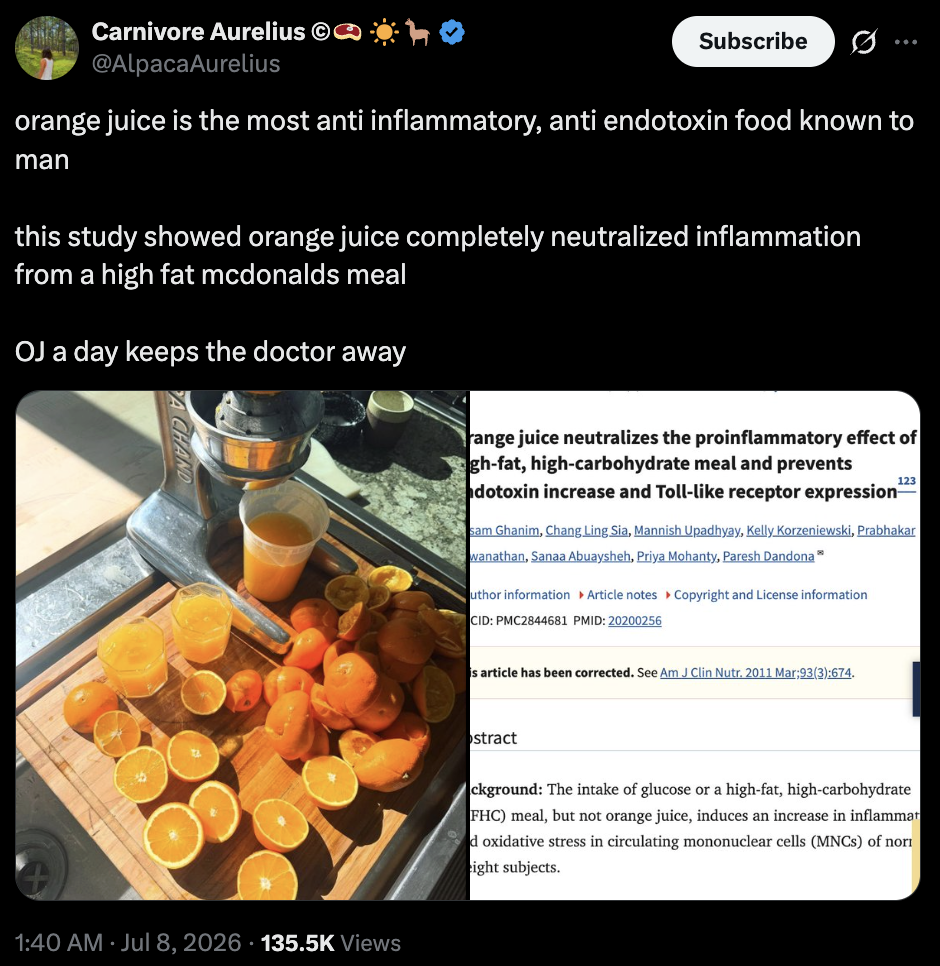
A post circulating on X claims that orange juice is “the most anti-inflammatory, anti-endotoxin food known to man,” citing a study that purportedly showed it “completely neutralized inflammation from a high fat McDonald’s meal.” The post has garnered over 135,000 views thus far. We decided to examine what the study actually found, and whether the broader claim holds up.
What is inflammation, and why does it matter?
Inflammation is the body’s natural response to injury, infection or harmful substances. In the short term, it is protective, helping the body fight off threats. For instance, when we fall ill, fever is the body’s way of signalling that its inflammatory system is working.
However, inflammation becomes harmful when it occurs in healthy tissue or persists for too long. Chronic inflammation is associated with a range of serious conditions including heart disease, high blood pressure, and type 2 diabetes. This has fuelled growing public interest in anti-inflammatory diets, a term describing an overall pattern of eating associated with lower levels of chronic inflammation in the body.
What does the study say?
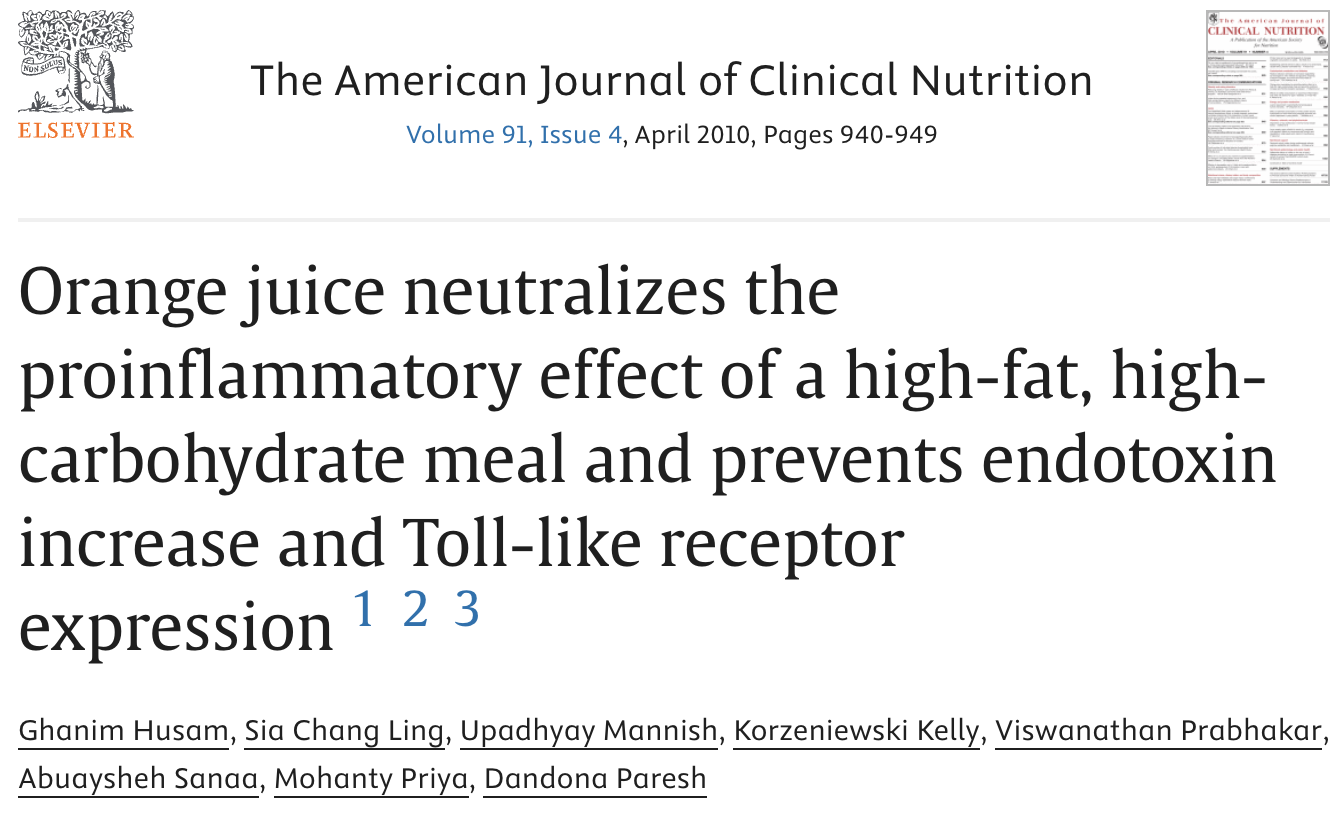
The post references a peer-reviewed study published in the American Journal of Clinical Nutrition in 2010, by researchers at the State University of New York at Buffalo. The study was funded by the Florida Department of Citrus, a state agency responsible for promoting and regulating the citrus industry, alongside grants from the US National Institutes of Health and the American Diabetes Association.
The study involved 30 healthy adults aged 20 to 40, divided into three equal groups of ten. All participants had a Body Mass Index (BMI) of between 20 and 25, a range considered to indicate a healthy weight. Each group consumed a controlled 900-calorie high-fat, high-carbohydrate meal with one of three beverages: water, a glucose drink, or orange juice. Blood samples were taken before and at one, three and five hours after the meal.
The researchers explain that eating a high-fat, high-carbohydrate meal triggers a temporary inflammatory response, as fat promotes the absorption of bacterial toxins from the gut into the bloodstream, while the high carbohydrate content activates inflammatory pathways at the cellular level. Eaten repeatedly, such meals may cause these responses to accumulate over time, contributing to conditions like heart disease and insulin resistance.
Among the participants who drank water or glucose with their meal, the study found significant increases in three key inflammatory measures. Plasma endotoxin levels, which are bacterial toxins in the bloodstream that can trigger inflammation, increased significantly above pre-meal levels, though the study notes that the magnitude of this increase was not likely to cause clinical symptoms on its own. Toll-like receptor expression, proteins on immune cells that detect threats and activate the inflammatory response, also rose significantly, as did the generation of reactive oxygen species, unstable molecules that damage cells and contribute to inflammation. The orange juice group showed none of these increases.
The researchers attributed this effect to two flavonoids naturally present in oranges, naringenin and hesperidin, which appear to suppress the production of inflammatory molecules. However, they noted that further research is needed to fully confirm the mechanism, as the concentrations of these compounds that reach the bloodstream after drinking orange juice may not fully account for the observed effect.
What the post might be overstating
The post describes the meal as a ‘high fat McDonald’s meal.’ The study itself does not name McDonald’s or any specific restaurant. It describes the high-fat, high-carbohydrate meal as consisting of egg muffin sandwiches, sausage muffin sandwiches and two hash browns, items commonly associated with McDonald’s breakfast menu, though the study does not confirm this as the source.

Image: McDonald’s
The study found that orange juice neutralised specific inflammatory markers over five hours in a group of 10 healthy young adults consuming a high-fat, high-carbohydrate meal. This is a more limited finding than the post implies. It does not mean orange juice neutralises all forms of inflammation, in all contexts, or across different populations.
More significantly, the study compared orange juice only against water and a glucose drink. It did not compare orange juice against other foods or beverages with known anti-inflammatory properties, making it difficult to draw conclusions about whether orange juice is superior to other options. The study’s own authors acknowledge this, noting that “there may be food products that may be noninflammatory and protective against the proinflammatory effects of other foods”, tentative language that explicitly leaves open the possibility that other foods produce similar effects.
Does an OJ a day keep the doctor away?
While orange juice does contain anti-inflammatory compounds such as vitamin C, hesperidin and naringenin, and other studies have found modest anti-inflammatory effects, these results vary between individuals and contexts. No single food has been identified by peer-reviewed research as definitively “the most anti-inflammatory.” The scientific consensus points to an overall dietary pattern that is rich in fruits, vegetables, whole grains and healthy fats as the basis of an anti-inflammatory diet, rather than any single food.
It is also worth noting that the anti-inflammatory effects observed in the 2010 study were measured specifically when orange juice was consumed with a meal, not in isolation, meaning the findings do not support a general claim that drinking orange juice daily reduces chronic inflammation. Nutritionists generally recommend eating whole oranges over drinking juice, because juicing removes most of the fruit’s fibre, which not only slows sugar absorption but also provides additional digestive and health benefits that are lost in the process.
Therefore, we rate the claim that orange juice is the most anti-inflammatory food known to man as false.

When encountering health claims based on a single study, it is worth checking what was actually measured and what it was compared against. In this case, the study’s own authors left open the possibility that other foods may produce similar anti-inflammatory effects.