We came across a Facebook post by the page Toxins in Children, dated 22 September 2026, which claims that “in 1932, a woman proved that cavities can be healed through diet but her research was resisted by the mainstream dental establishment—drilling and filling is much more profitable”. The graphic pairs the claim with an old portrait of a woman and a close-up of a decayed molar.
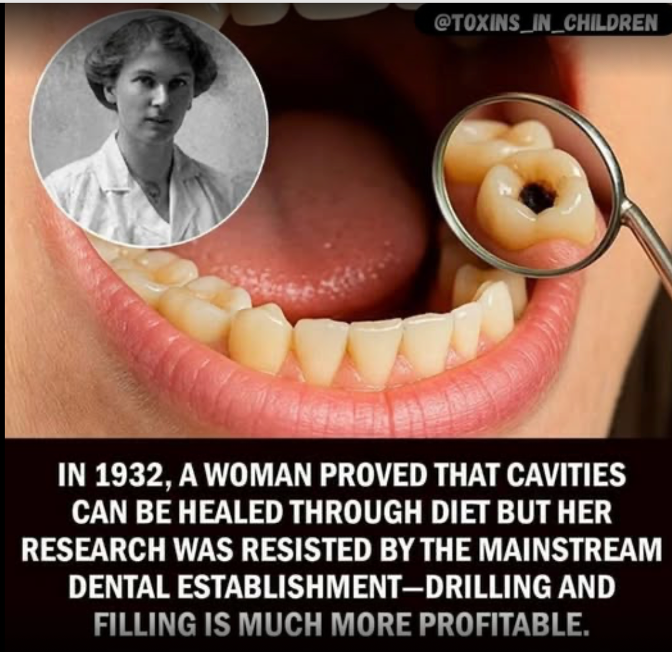
Using Google reverse image search, we found that the woman the post appears to refer to is May Mellanby, a British researcher who, together with her husband Sir Edward Mellanby, studied how diet affects bones and teeth in the 1920s and 1930s. Her experiments on dogs, published by the Medical Research Council from 1929 onwards, showed that vitamin D was important for the proper formation of teeth, and she went on to run feeding trials on children living in institutions. In 1932, she and C. Lee Pattison published a paper in the British Medical Journal on the influence of a cereal-free diet rich in vitamin D and calcium on dental caries in children, which is likely where the post’s “1932” comes from.
What these trials showed, however, is narrower than the post suggests. A 2024 review in the journal Nutrients describes an earlier Mellanby and Pattison trial in which 71 children were split into three diet groups for six months. Children given a diet rich in fat-soluble vitamins developed fewer new or spreading cavities, and more of their existing cavities showed “hardening”, than children given oatmeal and fewer of these vitamins.
The 1932 paper reported similar findings for children on a cereal-free diet with added vitamin D. What Mellanby described as healing was this hardening, in which the soft, decayed area of a tooth became firm again, a sign that the decay had stopped spreading. It did not mean that lost tooth structure grew back. The trials were also small, short and carried out in institutions where the children’s meals could be tightly controlled. Even the authors of the 2024 review, who are sympathetic to Mellanby’s work, note that these historic studies “have not been revisited in decades” and call for rigorous modern research before they are used to inform dental advice.
The claim that her research was buried does not hold up either. Mellanby was nominated three times for the 1939 Nobel Prize in Physiology or Medicine, by Frederick Hopkins, Charles Sherrington and J. Burn, according to the Nobel Prize nomination archive.
Modern dentistry accepts that early tooth decay can be reversed, but not through diet alone. Carole Palmer, professor emerita at the Tufts University School of Dental Medicine, told AFP that cavities cannot be healed through diet, even though diet is what causes them. Dentist Joy Nisnisan, a consumer advisor spokesperson for the American Dental Association (ADA), added that a diet high in calcium and phosphorus can help teeth remineralise, but only alongside fluoride.
In summary, May Mellanby was a real and respected researcher whose work helped establish that diet, particularly vitamin D, affects how teeth develop and how decay progresses, and the dental profession came to accept her findings. However, her trials showed that decay could be slowed or halted in some children, not that cavities can be healed through diet, and her research was recognised with Nobel nominations rather than suppressed. Early enamel damage can be remineralised with fluoride, but decay that has reached the dentin needs a dentist. Therefore, we rate this claim as false.