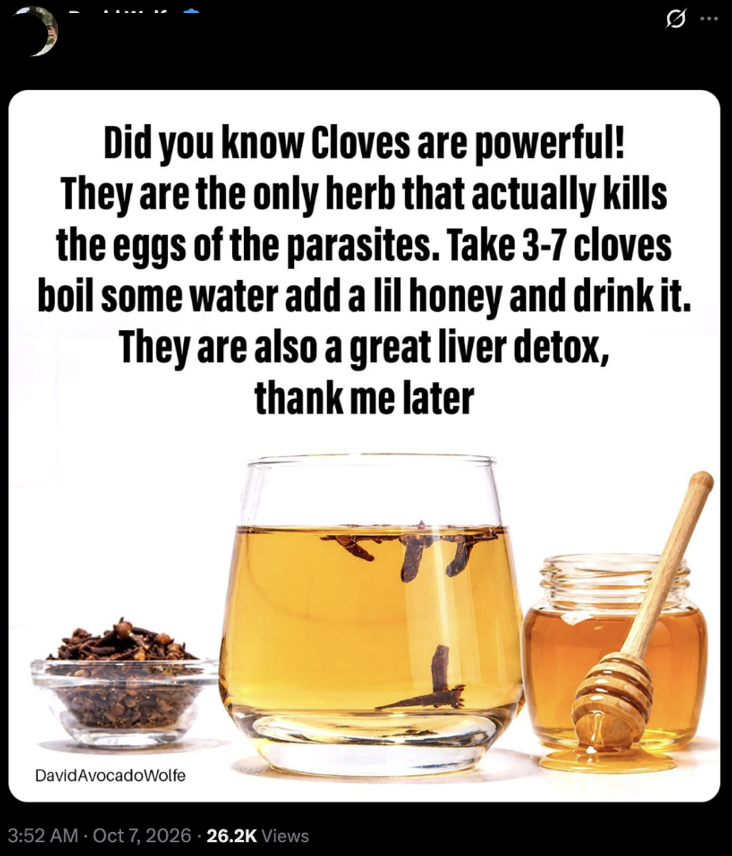
A couple of posts on X claim that cloves are “the only herb that actually kills the eggs of the parasites” and are also “a great liver detox,” advising readers to boil three to seven cloves in water, add a little honey and drink it. Since being posted recently, the posts have garnered more than 643,000 views, prompting us to take a closer look. Neither cites a study or any other source.

Why cloves?
Cloves are used in various cuisines in Singapore, including in spice blends such as five-spice powder and garam masala. They are the flower buds of the clove tree (also known as Syzygium aromaticum), which are harvested before they bloom and then dried for use. In culinary terms, herbs are generally the leaves or flowery parts of a plant, while spices come from other parts such as seeds, bark, or roots. Since clove buds are picked before they bloom, they are typically classified as a spice rather than an herb.

Cloves have a long history of use in traditional medicine. Biting or chewing a clove bud, for example, has traditionally been used as a remedy for toothache. Researchers have also been studying the potential health effects of cloves. They contain several compounds with anti-inflammatory properties, the most prominent being eugenol, and are rich in antioxidants.
Research suggests cloves may help reduce inflammation and bacteria in the mouth, and some animal studies suggest they may protect the stomach from ulcers. Studies have also found that eugenol may help reduce signs of liver cirrhosis, the permanent scarring of the liver that stops it from working normally, and fatty liver disease, a build-up of excess fat in the liver that can progress to cirrhosis. However, findings from laboratory or animal studies do not necessarily mean that consuming cloves produces the same effects in people.
Do cloves kill parasite eggs?
The posts do not specify which parasites they mean. Since they recommend drinking a boiled clove preparation, they appear to refer to parasites that infect people internally.
The two main types of parasites that can be found in the human body are protozoa, which are single-celled organisms too small to see without a microscope, and helminths, which are parasitic worms. Parasitic worms include organisms such as tapeworms, roundworms and flukes. Many of these worms produce eggs during their life cycle.
Depending on the parasite, people can become infected by swallowing eggs or larvae in contaminated food, water or soil, or through other routes. Symptoms vary widely but can include diarrhoea, abdominal pain and vomiting. Treatment depends on the parasite and may require specific antiparasitic medicines.
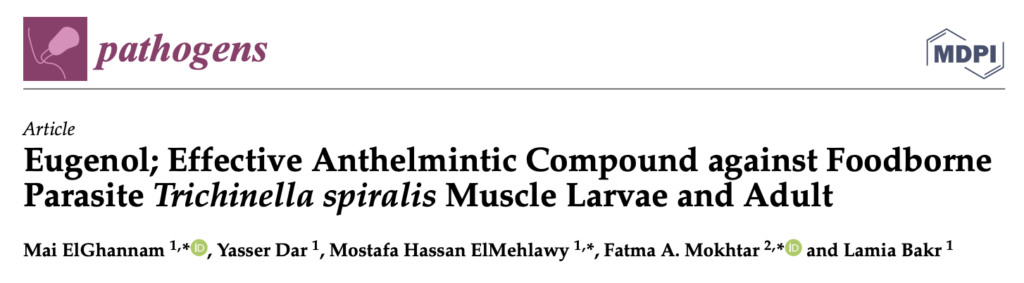
There is some evidence that cloves or compounds found in cloves have antiparasitic effects. In one laboratory study, purified eugenol killed adult Trichinella spiralis worms (a type of roundworm) and their young larvae at sufficiently high concentrations. The study tested purified eugenol applied directly on the worms, rather than cloves consumed by people, so the findings cannot be taken as evidence that eating or drinking cloves would have the same effect.
In another study of naturally infected sheep, feeding ground cloves reduced the number of parasite eggs shed in droppings by about 41 per cent. However, this was a reduction in egg shedding, not evidence that the cloves cleared the infection. A separate fish study also found that clove extract could kill a parasite infecting fish.
The claim that cloves are the only plant that can have this effect is also contradicted by research. Other plants have shown antiparasitic effects too. In the sheep study, pumpkin seed cake (processed pumpkin seeds) actually produced a greater reduction in parasite egg shedding than ground cloves. Research on garlic has also found effects against parasitic worms in laboratory and animal studies. However, these findings do not show that eating these plants treats parasitic infections in humans.
Taken together, these studies show that plants and plant-derived compounds can have antiparasitic effects under certain experimental conditions. They do not show that drinking a preparation made by boiling three to seven cloves in water treats a parasitic infection in people. The extracts, purified compounds, concentrations and methods used in the experiments cannot be assumed to be equivalent to a homemade clove drink.
We also found no clinical studies showing that drinking a clove preparation or clove tea treats a parasitic infection in humans.
Do cloves detox the liver?
The liver already helps the body process and remove potentially harmful substances. It processes nutrients, medications and other chemicals and helps convert some substances into forms that can be eliminated from the body. There is no evidence that drinking a clove preparation “detoxes” the liver.
Research suggests that concentrated clove extracts may have protective effects on the liver. In two studies in rats, clove extracts reduced some signs of liver damage and improved certain measures of liver function. However, these studies used concentrated extracts in animals, not cloves consumed by people, and they do not show that consuming cloves detoxes the human liver.
Hence, we rate the claim that cloves are the only plant that kills parasite eggs, and are “a great liver detox”, as false. There is no evidence that drinking a clove preparation clears a parasite infection or detoxes the liver in people.

Cloves are a common cooking spice and an active area of scientific research, but promising results in laboratory experiments or animals are not the same as a proven treatment in humans. Anyone who suspects a parasitic infection should seek appropriate medical advice rather than rely on a home remedy.