We came across an Instagram post from July 2026, which claims that a woman was paralysed after eating grocery store beef. The post has received over 6000 likes at the time of writing.
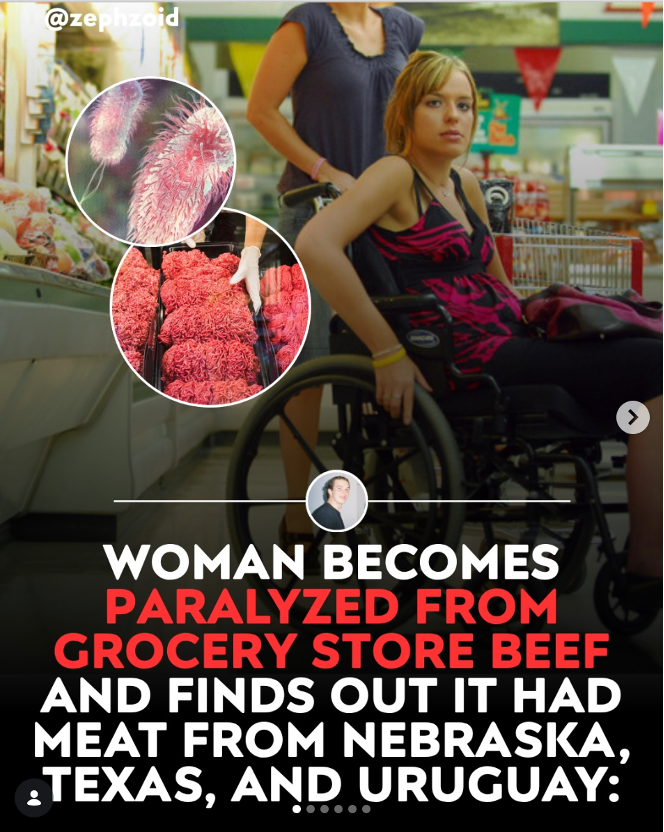
The post refers to the victim as Stephanie Smith, a 22-year-old dance instructor from Cold Spring, Minnesota, who fell severely ill after eating a hamburger patty made by meat processor Cargill, grilled by her mother for a Sunday dinner. Ms Smith developed haemolytic uraemic syndrome, a severe complication of E. coli infection; her kidneys failed and she suffered seizures so relentless that doctors placed her in a medically induced coma for nine weeks. When she woke, she could no longer walk and remains paralysed from the waist down.
When we conducted research on the case, we found that the incident had occurred in 2007, almost 20 years ago and was the subject of a front-page New York Times investigation by reporter Michael Moss, published in October 2009, which won the 2010 Pulitzer Prize for Explanatory Reporting. Moss obtained confidential Cargill grinding logs showing that the patty Ms Smith ate was not a single cut of meat but an amalgam of slaughterhouse trimmings and a mash-like product derived from scraps, blended at a plant in Wisconsin. Those ingredients were traced to slaughterhouses in Nebraska, Texas, and Uruguay, along with a South Dakota facility that processed fatty trimmings treated with ammonia to reduce bacterial contamination – corroborating the exact details in the Instagram post.
This blending practice is common across the ground beef industry and is not itself illegal. The Times reported that combining trimmings from multiple, cheaper sources let Cargill spend roughly 25 percent less than it would have on whole cuts. But it also meant that when contamination was later found, investigators could not trace it to a single supplier, since the meat had already been ground together – a gap that formed the core of the Times investigation and of subsequent congressional and regulatory scrutiny.
According to the Singapore Food Authority, minced/ground meat is more likely to harbour E.coli bacteria as compared to whole cuts of meat as the parts contaminated with bacteria could have been mixed thoroughly and brought deep below the surface of the meat, where they are well-protected from heat. Besides minced meat products like burger patties, sausages, meat pies, the same principle also applies to all other non-intact meat products such as meat marinated through injections or tenderised with needles and blades. The best way to reduce E.coli risk is thus to cook meat thoroughly to an internal temperature of 72°C, measured using a food thermometer, avoid cross-contamination by washing hands and tools, and store the meat safely at or below 4°C.
Context the post omits
The post carries no date, byline, or sourcing, and its present-tense framing (“woman becomes paralyzed”) gives the impression of a recent incident. In fact, the outbreak occurred in 2007 and was reported in 2009 – 17 years before this post circulated. Ms Smith later sued Cargill and settled. Her case, alongside continued advocacy from food-safety lawyer Bill Marler, contributed to regulatory change: in 2012, the USDA’s Food Safety and Inspection Service declared six additional non-O157 E. coli strains adulterants in ground beef and mandated testing for them, on top of the O157:H7 testing requirement already in place since 1994. Illnesses linked to those additional strains subsequently declined.
It is also worth noting who is amplifying the claim. The account @zephzoid belongs to Zephyr Zoidis, who is the developer of an app called “Localize” that promotes farmers’ markets as an alternative to what the account calls “Big Food” and conventional grocery chains. This does not make the underlying claim false – the Cargill case is real and accurately described – but it indicates the post is being used to advance an argument against conventional grocery and meat-supply systems, which is relevant context for readers deciding how much weight to place on an undated, decontextualised retelling.
Therefore, we rate this claim as true, though presented misleadingly as a current event. It accurately recounts a real, well-documented 2007 case investigated by the New York Times in 2009 and not a new or recent incident.