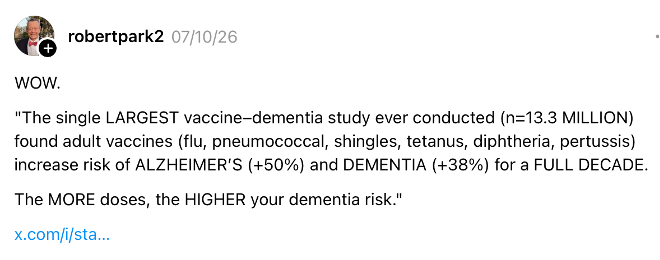
Since mid-July 2026, a wave of posts across Facebook, Instagram, and Threads has claimed that routine adult vaccinations against influenza and pneumonia sharply raise the risk of dementia and Alzheimer’s disease.
The posts we’ve found cite an 18 July 2026 X post by Nicolas Hulscher, an epidemiologist and administrator at the McCullough Foundation, whose caption states “Adult vaccination is associated with a 50% HIGHER risk of ALZHEIMER’S and a 38% HIGHER risk of DEMENTIA, according to the LARGEST vaccine-dementia study ever conducted”.
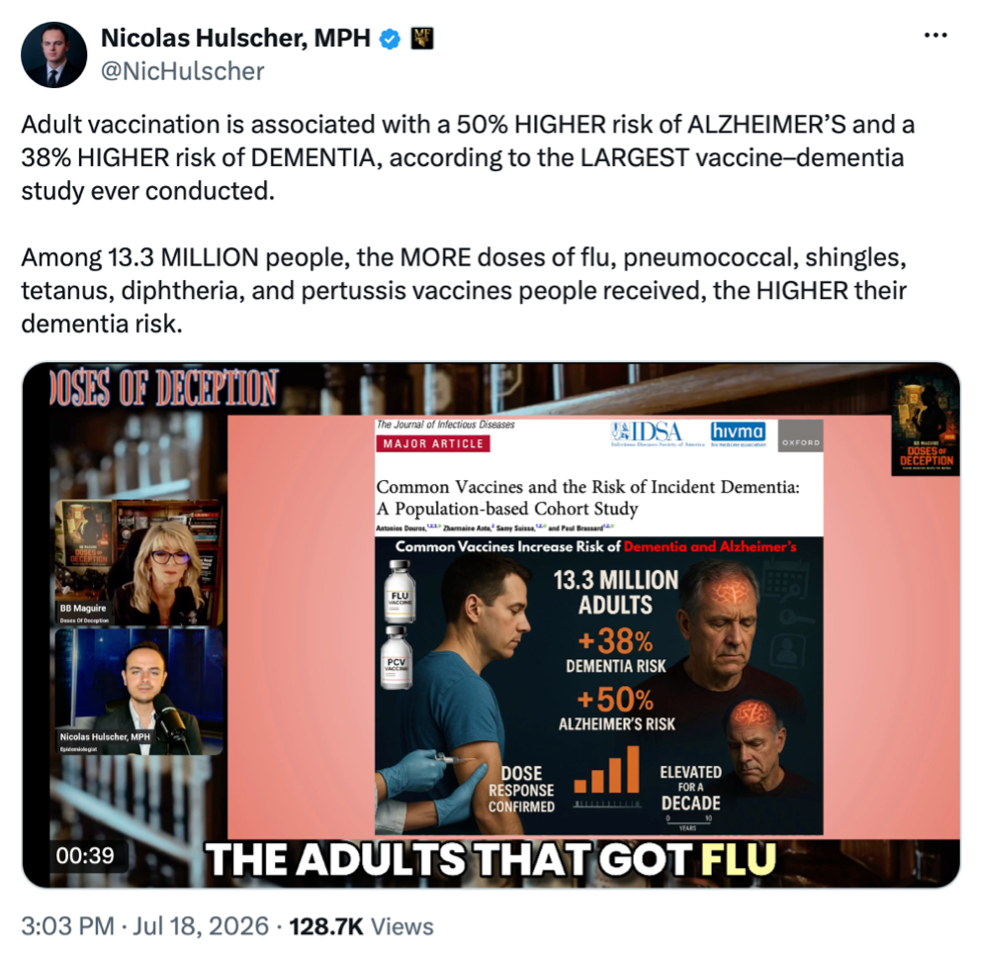
Investigating the claim, we found a May 2023 paper published in The Journal of Infectious Diseases, titled ‘Common Vaccines and the Risk of Incident Dementia: A Population-based Cohort Study’. Drawing on a United Kingdom-based cohort, the researchers examined the association between a list of common vaccines and the onset of dementia.
The paper reported that common vaccines were associated with an increased risk of dementia. However, the authors found this was driven by regularly recurring vaccinations – influenza and pneumococcus for those at higher risk – that is, vaccinations leading to more frequent physician visits and potentially to elevated chances of disease detection, and not by vaccinations more likely to be administered in a one-off fashion. In other words, the increased risk reflected greater opportunity for a dementia diagnosis to be made, not any harm caused by the vaccines themselves.
The study itself concluded that immunisation does not help to prevent neurodegenerative disease, not that vaccination increases dementia risk, the interpretation promoted by the social media posts we found.
The bottom line
The underlying study is real, and it did find a statistical association between certain routine adult vaccinations and a higher rate of dementia diagnosis. However, its authors attribute that association to an increase in physician visits when having a vaccine administered rather than to any causal effect of the vaccines. Presenting the study as definitive proof that vaccination causes dementia or Alzheimer’s disease misrepresents both its design and its authors’ stated conclusions.
Therefore, we rate the claim that routine adult vaccines raise the risk of dementia and Alzheimer’s disease as false.

Why this kind of claim spreads — and what to watch for
This fact-check is a textbook case of a particular and increasingly common species of health misinformation: not a fabricated study, but a real, peer-reviewed one whose findings are inverted. Hulscher did not invent the data. He took a genuine paper from a reputable journal, seized on its headline statistic, and stripped away the very caveats its authors built the paper around. That makes the claim far more durable than an outright hoax, because anyone who checks can confirm the study exists – and a citation of an academic journal lends an air of authority to the claim.
This is not an isolated case. It reflects a return to a broader wave of vaccine disinformation that circulated at the peak of the Covid-19 pandemic, when Black Dot Research found viral posts falsely claiming that mRNA Covid-19 vaccines directly caused strokes and brain damage, that the World Health Organisation had confirmed a link between the Covid-19 vaccine and Multiple Sclerosis, and that a Covid-19 vaccine had caused a woman’s breasts to “quadruple” in size — each dressed up with a veneer of scientific or institutional authority. Hulscher’s claim follows the same template, resurfacing years after the pandemic’s peak and applied to routine adult vaccinations rather than to Covid-19 jabs specifically.
For readers in Singapore, where influenza and pneumococcal vaccinations are actively recommended for older adults and those at higher risk, the stakes of getting this wrong are not abstract. As we have noted before, the antidote is not cynicism but a healthy scepticism: the habit of asking who is making a claim, what they are leaving out, and whether the source they cite actually says what they say it does.