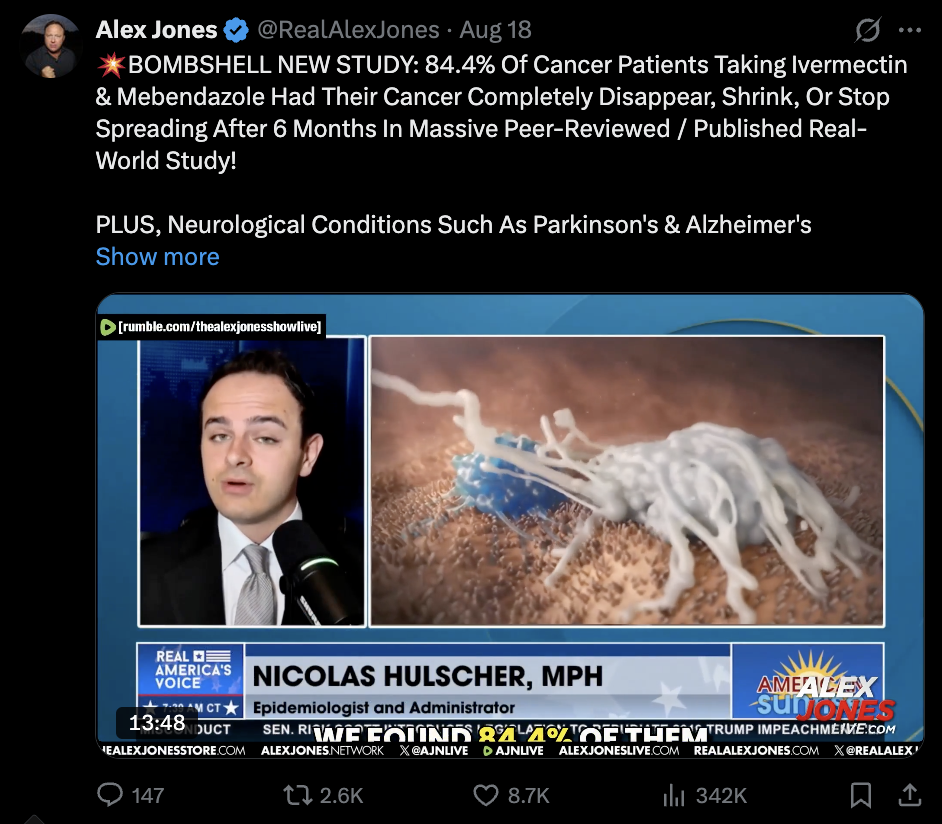
A fairly viral post on X, with over 340,000 views claims that a real-world, peer-reviewed study found that ivermectin and mebendazole caused cancer to completely disappear, shrink, or stop spreading in 84.4% of patients within six months.
The post was shared by Alex Jones, an American far-right figure, and founder of Infowars, a platform that has been widely criticised for promoting conspiracy theories alongside medically dubious health products.
What are ivermectin and mebendazole?
Ivermectin and mebendazole are long-established antiparasitic drugs, approved for entirely different purposes than cancer treatment.
Doctors may prescribe oral ivermectin to treat parasitic worm infections, while a topical formulation is used to treat rosacea, a skin condition. It also gained notoriety during the Covid-19 pandemic, when it was widely promoted as a treatment despite not being approved to do so. We previously fact-checked a similar claim that a US health agency had started recommending ivermectin for Covid-19, which was false.
Mebendazole, meanwhile, is used mainly to treat gut infections such as threadworms. Neither drug is approved for treating cancer in humans currently.
There is ongoing interest in testing existing drugs like these for new uses, known as drug repurposing. Laboratory research has shown ivermectin may have anticancer effects, and a 2021 Johns Hopkins studysimilarly found mebendazole slowed pancreatic cancer in mice. These remain early-stage lab findings, not proof either drug works in humans.
What is the study about?
The study, titled “Real-world Clinical Outcomes of Ivermectin and Mebendazole in Cancer Patients: Results from a Prospective Observational Cohort”, was published in the journal Anticancer Research, in June 2026. Its first author, Nicolas Hulscher, is a U.S-based epidemiologist at the McCullough Foundation with a history of spreading inaccurate claims about Covid-19 vaccines. The foundation is affiliated with co-author Peter A. McCullough, a well-known vaccine skeptic.
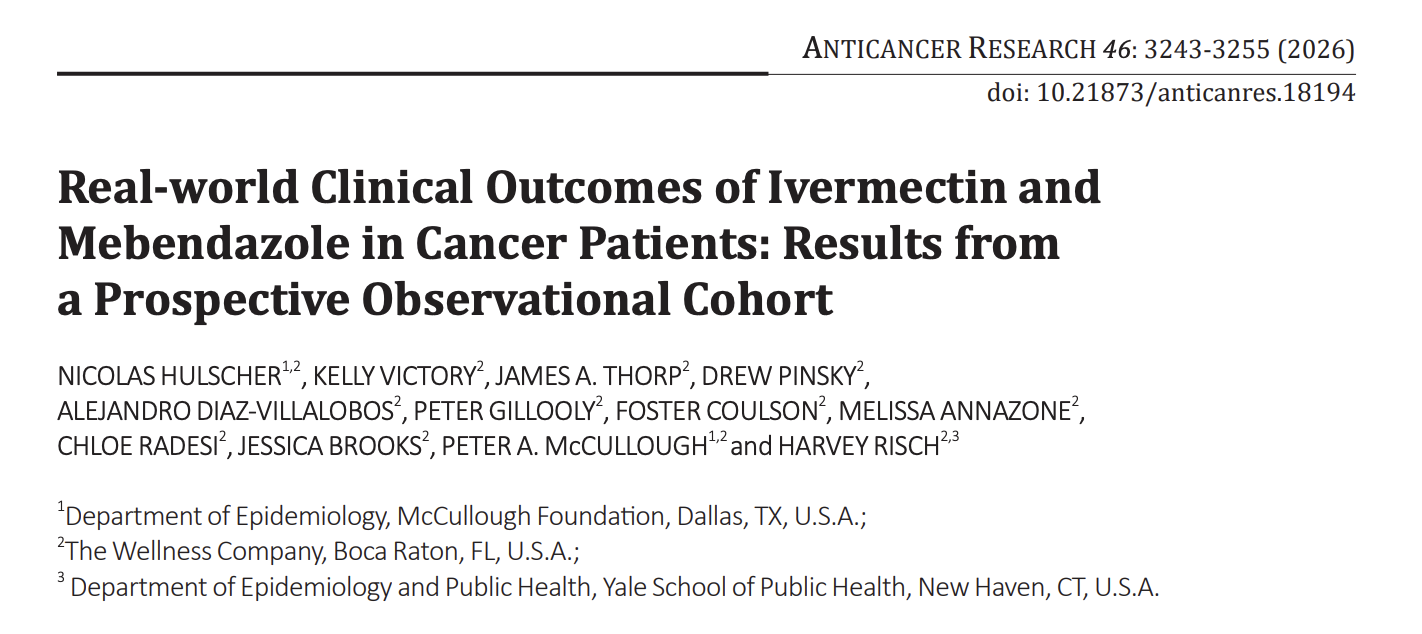
The study followed 197 cancer patients who had been prescribed a compounded ivermectin-mebendazole capsule, through a telemedicine platform run by The Wellness Company, where McCullough serves as Chief Scientific Officer. The company sells the exact product being studied.
Data were collected through electronic surveys, which participants filled in themselves. The baseline survey covered demographics, cancer type, disease status at enrolment, and prior or concurrent treatments, while the follow-up survey asked participants to report any changes in their cancer status, along with their medication adherence and side effects. Only 122 of those patients, around 61.9%, completed the six-month follow-up survey the results are based on.
Issues with the study
The 84.4% clinical benefit figure is not one clear result. It combines three different outcomes into a single number: patients who reported their cancer was gone, patients whose tumours had shrunk, and patients whose cancer had not gotten worse. Less than half, 48.4%, saw their cancer actually shrink or disappear. The rest of the 84.4% is made up of patients whose cancer just stayed the same, which the drugs may have had nothing to do with.
There was no control group of similar patients who did not take the drugs. That gap matters as most participants had already had conventional cancer treatment, including surgery, chemotherapy, radiation, and immunotherapy, and many kept combining treatments throughout the study itself.
At follow-up, patients also reported combining the ivermectin-mebendazole capsules with other interventions such as other cancer-related supplements, dietary changes, and chemotherapy. With this much overlap and no control group to compare against, it becomes very difficult to know what, if anything, the ivermectin and mebendazole actually contributed.
Every outcome was also self-reported through a voluntary survey, with no independent verification of diagnosis, treatment history, or actual cancer status through scans, biopsies, or medical records, and peer review took just 16 days from submission to acceptance, unusually fast for a cancer study.
In June 2026, the journal that published the study, Anticancer Research, issued a formal Expression of Concern, a signal that a journal has identified serious methodological or ethical issues that readers must weigh when interpreting the results. It explicitly cited the absence of a control group and the reliance on self-reported outcomes. The study has not been retracted, but the journal that published it is on the record saying it should not be relied on as evidence the drugs work. The study’s own authors acknowledge this too, writing that their findings are “hypothesis-generating” and that “randomised, placebo-controlled trials are needed” .
Hence, we rate the claim that this study shows ivermectin and mebendazole cure cancer as mostly false. The study’s design, including its lack of a control group, its self-reported outcomes, and the fact that most participants were already on conventional cancer treatment, means it cannot support that conclusion, a limitation the journal that published it has since acknowledged.

While the 84.4% results might sound impressive on its own, it is worth reading the study closer before taking it as proof of anything.