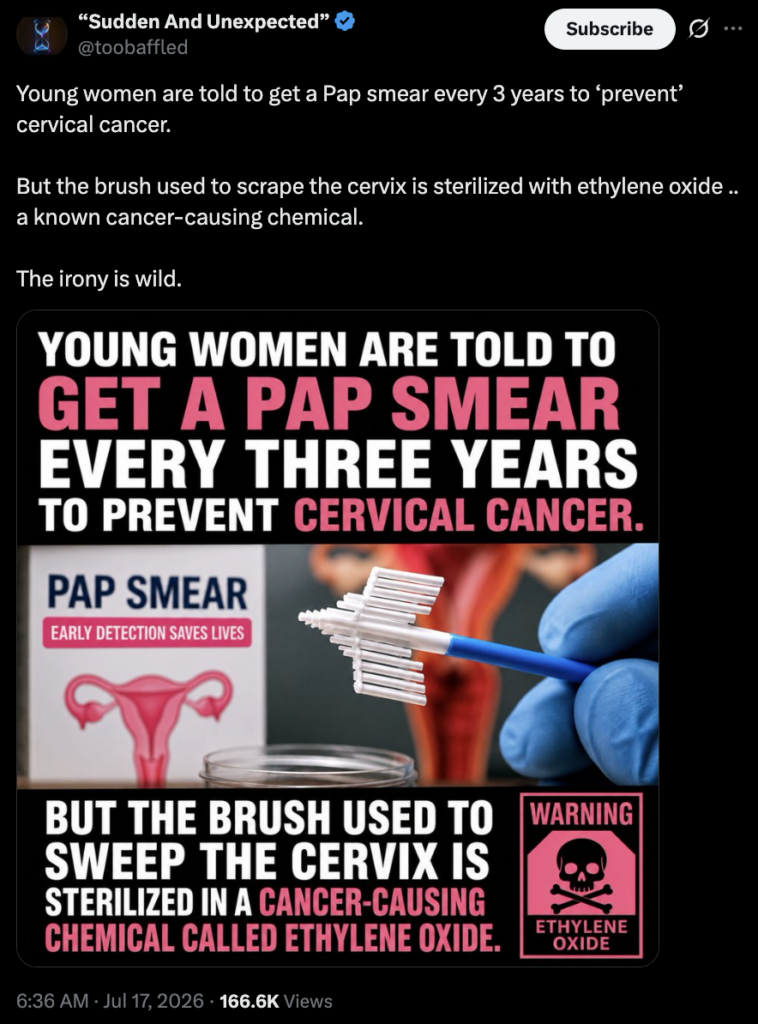
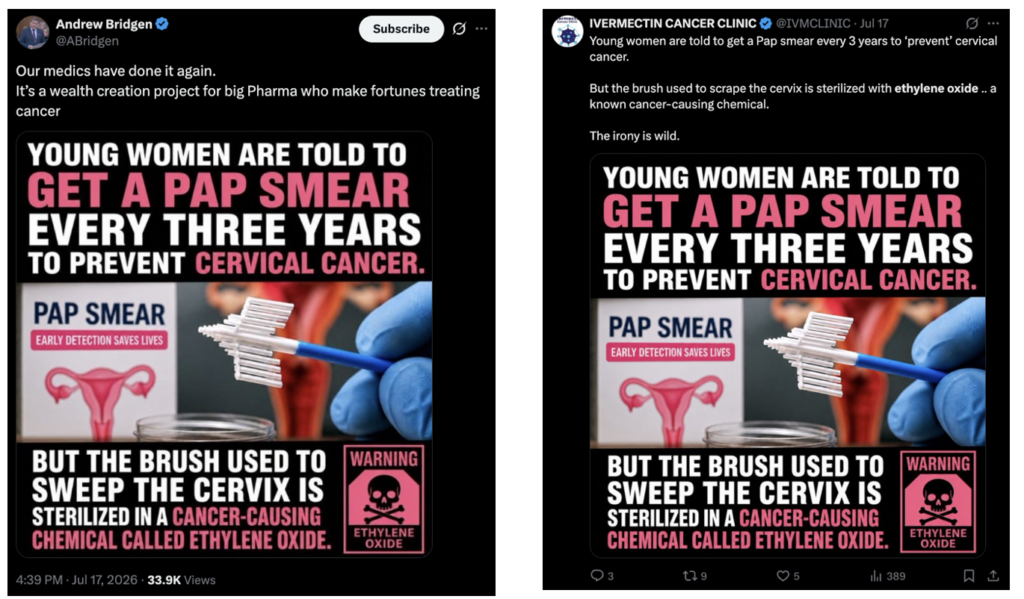
We came across the same graphic being circulated recently across multiple X accounts, claiming that the brush used during a Pap smear is sterilised with ethylene oxide, a substance classified as a carcinogen, and suggesting that it is contradictory to recommend Pap smears as a way to prevent cervical cancer.
The posts collectively garnered over 200,000 views. Among those sharing the graphic was Andrew Bridgen, a former UK member of parliament with a documented history of sharing anti-vaccine content. The graphic was also shared by accounts associated with anti-vaccine and alternative medicine narratives.
We have previously debunked a similar claim about COVID-19 PCR and ART test swabs being coated with cancer causing substances. However, given that cervical cancer screening uptake remains a concern in Singapore, we decided to take a closer look at the claim.
Why this matters in Singapore
Cervical cancer is the tenth most common cancer among women in Singapore. Unlike other cancers, it is largely preventable through HPV vaccination and regular screening, and can be cured if detected early and treated promptly.
According to the National Population Health Survey 2024, conducted by the Ministry of Health and Health Promotion Board, only 44.9% of Singapore female residents aged 25 to 74 reported having gone for cervical cancer screening in 2024.
A claim that implies the screening itself causes cancer could discourage women from attending a potentially life-saving appointment.
How does cervical cancer screening work?
Cervical cancer develops slowly, typically over 10 to 20 years. Before a cancerous growth appears, the cells of the cervix undergo gradual changes, known as precancerous changes, that can slowly progress over time. During this phase, there are often no noticeable symptoms, making regular screening an important tool for detecting these changes early and preventing them from progressing to cervical cancer.
Cervical cancer screening involves a doctor or nurse gently brushing cells from the cervix and sending the sample to a laboratory for examination. In Singapore, the type of screening recommended depends on age: women aged 25 to 29 receive a Pap smear every three years, which looks for abnormal cell changes that may develop into cancer, while women aged 30 and above receive an HPV test every five years, which detects high-risk HPV infections linked to cervical cancer and is more effective for this age group.
On the ethylene oxide claim
Ethylene oxide is a gas widely used in the healthcare industry to sterilise medical devices that cannot withstand heat or moisture-based sterilisation methods. Pap smear brushes are among the medical devices that may be sterilised using ethylene oxide.
It is true that ethylene oxide has been classified as a carcinogen (a substance capable of causing cancer), by the International Agency for Research on Cancer, an intergovernmental agency that forms part of the World Health Organisation. However, the health risks associated with ethylene oxide depend on the level, duration, and route of exposure.
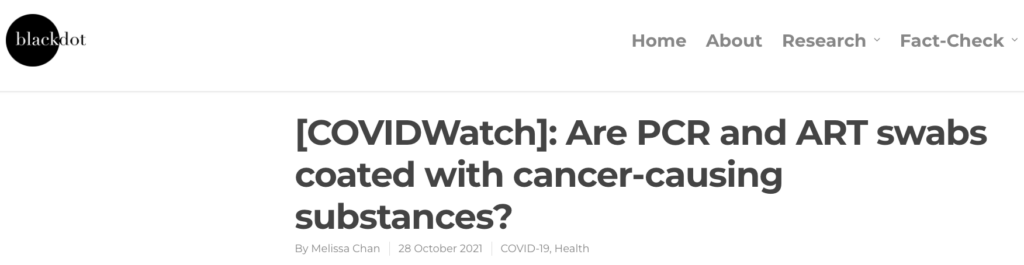
A similar claim was previously made about COVID-19 PCR and ART test swabs being coated with ethylene oxide, a cancer-causing substance. We examined this in detail in an earlier fact-check, where we explained why the presence of ethylene oxide in the sterilisation process does not mean users are exposed to cancer-causing levels of the substance. The same principle applies to Pap smear brushes.
The key distinction is between being exposed to ethylene oxide as a gas and coming into contact with a device that was sterilised using it. The sterilisation process works by exposing the device to ethylene oxide gas for a short period, followed by aeration and testing processes designed to remove residual ethylene oxide before the device is packaged and used.
The cancer risks associated with ethylene oxide are linked to sustained occupational exposure, such as workers in sterilisation facilities who breathe the gas at high concentrations over extended periods. Brief contact with a sterilised device is a categorically different form of exposure.
There is no credible evidence that tools used for cervical cancer screening cause cancer. The claim draws on two factual elements, that some Pap smear brushes may be sterilised using ethylene oxide and that ethylene oxide is classified as a carcinogen under certain exposure conditions, but incorrectly implies that patients are exposed to harmful levels of the substance during the screening procedure. This implication is not supported by scientific evidence.
We therefore rate this claim as misleading and false.

Health misinformation often works by creating fear or uncertainty. Claims that cast doubt on preventive care can have real-world consequences, which is why it is important to look beyond the headline and examine what the evidence actually shows.