We came across a post on X by Clayton Tucker (@ClaytonTuckerTX), dated 14 April 2026, which claims that noise from artificial intelligence (AI) data centres causes chickens to lay “50% less eggs”, cattle, goats and sheep to “lose 30% of their body weight”, and horses and wildlife to suffer from stress.
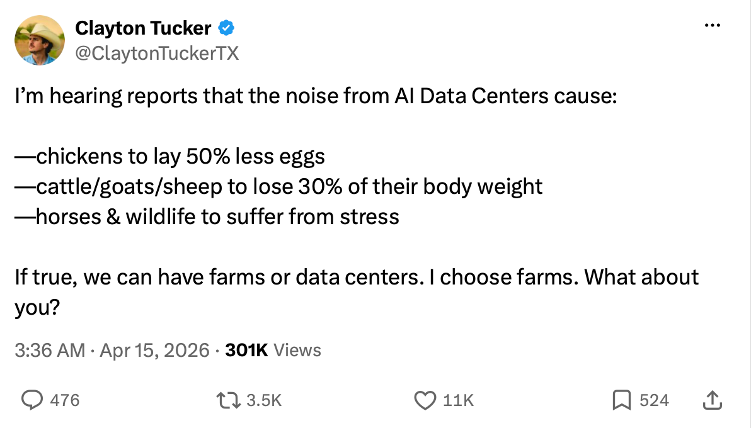
As of 5 November 2026, the post had drawn more than 300,000 views. Tucker won the nomination for Texas Agriculture Commissioner in the November 2026 election, and opposition to data centres is central to his campaign. Heatmap News reported that his campaign wants to use the commission’s powers to carry out impact studies on data centres, water and cropland, and a follow-up to the post links to a petition on his campaign website to stop AI data centres.
Research does show that noise can reduce egg production, but none of the studies we found involved data centres. A study by O’Connor and colleagues found that hens kept in pens with continuous background noise of 80 dB(A) laid fewer eggs per day in the early laying phase than hens kept at 60 dB(A). The figure closest to the post’s 50 per cent comes from a 2000 study in the Korean Journal of Veterinary Service, which examined damage at chicken farms near construction sites and found that egg production fell by 38 to 45 per cent depending on the strength of the noise. That study was designed to help set standards for damage compensation, and the noise came from construction work rather than a data centre.
Other research is less alarming. A 2011 study of 13 commercial layer farms in South Korea measured noise from feeding and egg-collecting machinery at an average of 69 dB and a maximum of 90 dB, and found that the noise did not appear to affect productivity, although vibration above a certain level did. A technical bulletinon noise and domestic fowl published by the US Department of Defense also cautions that much of the data on production losses comes from damage claims, which it describes as a biased sample.
We could not find any study that recorded livestock losing 30 per cent of their body weight because of noise. A similar figure was cited two months after Tucker’s post by Alton Fowler, ranch manager of Fowler Farms in Bell County, Texas, who told KWTX in June 2026 that data centre noise “causes grown cattle to lose 30 percent of their body weight”. Fowler did not say where the figure came from, and no measurements have been published to support it.
The scientific literature generally describes noise as slowing weight gain rather than causing animals to lose weight. A summary of research on cattle published by DairyGlobal notes that cattle can adapt to noise levels of 60 to 90 dB, and that frequent exposure can reduce appetite and lead to lower-than-expected weight gain. A 1974 study by D. R. Ames found that continuous sound above 100 dB reduced daily weight gain in sheep, while continuous background sound of 75 dB actually increased it.
The third part of the claim, that horses and wildlife suffer from stress, is too vague to verify on its own. Noise is a recognised stressor for farm animals, and a 2022 review of the research on cattle describes it as an environmental stressor that can affect behaviour, physiology and production. However, the size of these effects depends on how loud the noise is, how long it lasts and whether animals have time to get used to it.
Concerns about data centre noise are not baseless. Texas Public Radio reported in September 2026 that residents living near xAI’s data centre campus in Memphis, Tennessee, have filed a lawsuit over noise pollution, and experts quoted in the report said that the low-frequency noise produced by data centres travels far, is poorly captured by standard decibel measurements and is still being studied. This is not the first time Tucker has made such a claim without evidence. Wide Open Country reported that he said an unnamed farmer had not had a single calf born since a data centre was built nearby, and noted that no calf counts, veterinary diagnoses or noise measurements had been released to support it.
In summary, there is evidence that loud, sustained noise can reduce egg production and slow weight gain in livestock. However, we found no study linking AI data centres to the specific figures in the post. The closest figure for egg production comes from a study of construction noise, the 30 per cent weight loss figure has no published source, and Tucker has a history of making unverified claims related to AI data centres. Without measurements of noise levels near data centres or of their effects on nearby animals, the claim cannot be confirmed. Therefore, we rate this claim as unproven.