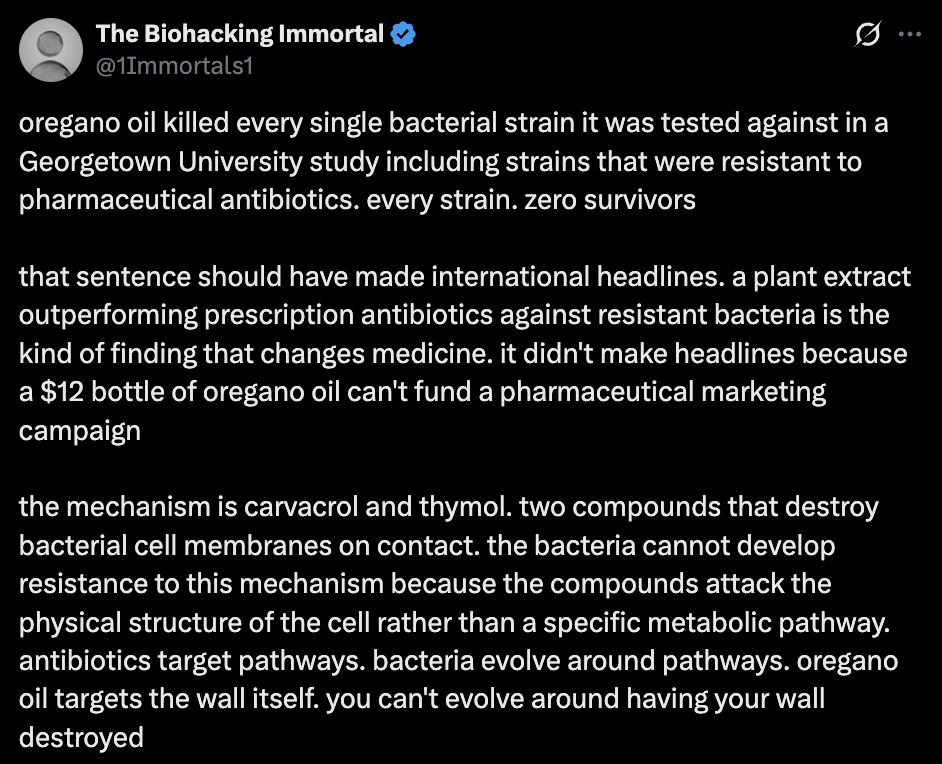
A post on X claims that a study from Georgetown University in the U.S. found that oregano oil killed “every single bacterial strain” it was tested against, including bacteria resistant to pharmaceutical antibiotics, with “zero survivors”.
Oregano oil is presented as a cheap, natural alternative to antibiotics, with references to research on bacteria, fungi and viruses. The post also suggests that oregano oil can work as well as prescription drugs in some clinical settings and provides dosing instructions for treating acute infections. It ends by recommending a specific commercial product, Oreganol P73.
The post does not provide a link to the Georgetown study or identify its authors, journal or publication date. Instead, it only names Georgetown University. Published on 15 September 2026, the post had received over 758,000 views at the time of writing.
What did the Georgetown study actually find?
We traced the research to a study led by Dr Harry Preuss and colleagues at Georgetown University Medical Center. It was first presented at a conference in October 2001 and covered in a press release at the time. The full study was published in 2005, in the journal, Toxicology Mechanisms and Methods, with an additional experiment added.
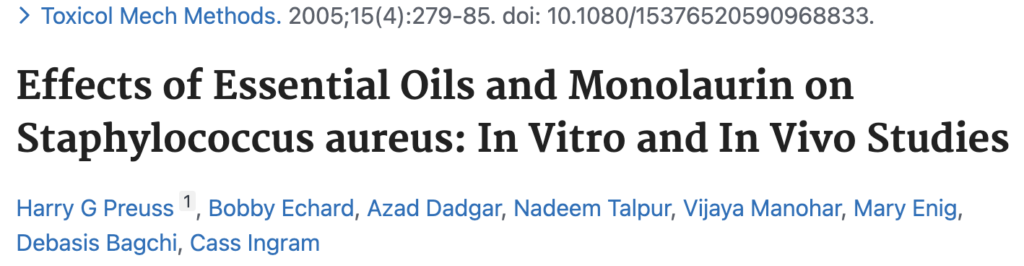
The researchers investigated whether natural products could inhibit Staphylococcus aureus (staph), a bacterium that can cause serious infections. Their work was motivated in part by concerns about antibiotic resistance, including reduced susceptibility to vancomycin, an antibiotic used to treat serious staph infections.
They tested 12 essential oils, as well as carvacrol, a major component of oregano oil, and monolaurin, a compound derived from lauric acid. Oregano oil was the most effective of the essential oils tested and was able to kill two strains of staph when added directly to laboratory cultures. Monolaurin also showed antibacterial activity, and the two substances were more effective in combination.
The researchers also gave oregano oil orally to mice infected with staph. In two separate experiments, all untreated mice died within a week. After 30 days, 3 of 6 mice given a higher dose of oregano oil survived in the first experiment, compared with 3 of 6 given vancomycin. In the second experiment, 3 of 8 mice given oregano oil survived, compared with 4 of 8 given vancomycin. A combination of oregano oil and monolaurin produced the highest survival rate in that experiment, with 5 of 8 mice surviving.
These findings do not support the claim that oregano oil killed “every single bacterial strain” with “zero survivors”. The laboratory experiments involved only two strains of staph, and neither was described as antibiotic-resistant. While oregano oil was able to kill both strains in laboratory cultures, some mice given oregano oil still died. The authors called for further research to determine whether these natural products could be effective against bacteria resistant to antibiotics.
Do other studies show similar findings?
There is research that goes further than the Georgetown study. A 2018 study by researchers affiliated with Massachusetts General Hospital, Harvard Medical School and the U.S. military tested oregano oil against 11 multidrug-resistant bacterial isolates obtained from combat casualties. These included four methicillin-resistant Staphylococcus aureus (MRSA) strains, three Pseudomonas aeruginosa (P. aeruginosa) strains and four Acinetobacter baumannii strains. The researchers reported that oregano oil was effective against all 11 isolates in laboratory tests.
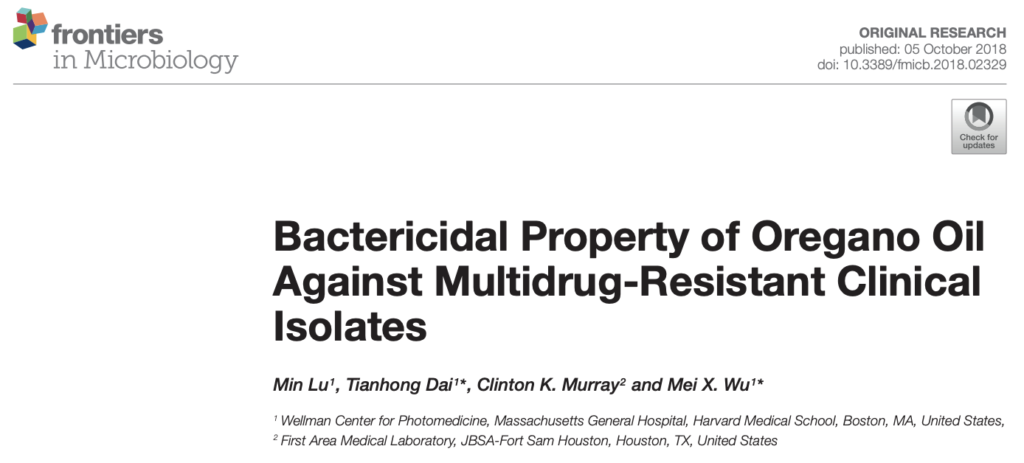
In separate experiments, researchers applied oregano oil topically to burn wounds infected with laboratory strains of MRSA or P. aeruginosa in mice and found substantial reductions in the amount of bacteria in the wounds.
These findings are notable and show that oregano oil has antibacterial effects under some laboratory and animal conditions. However, they do not establish oregano oil as an alternative to antibiotics for treating infections in people.
Does oregano oil work as well as antibiotics in humans?
The X post cites a 2014 Johns Hopkins study to suggest that oregano oil works just as effectively as prescription antibiotics. However, the study does not support that conclusion.
The 2014 study looked at small intestinal bacterial overgrowth (SIBO), a condition in which there is an unusually high amount of bacteria in the small intestine. Led by Dr Gerard Mullin at Johns Hopkins Hospital, the study compared the antibiotic rifaximin with herbal treatments in patients with SIBO.
However, this was not a randomised clinical trial. The researchers reviewed the outcomes of patients who had already been treated in a gastroenterology practice, with some receiving rifaximin and others receiving herbal therapy. This type of study can show whether treatments are associated with different outcomes, but it cannot establish as reliably as a randomised trial that one treatment works as well as another.
The herbal treatment was also not oregano oil alone. Patients consumed commercial herbal preparations containing several ingredients, including berberine and garlic extract. While the study found similar rates of negative follow-up breath tests in the herbal and rifaximin groups, since the herbal treatment contained several ingredients, the findings do not conclusively show that oregano oil alone works as well as rifaximin or can replace antibiotics.
The same caution applies to the post’s other claims about oregano oil. Laboratory studies have found that oregano oil can kill or inhibit the growth of some bacteria and fungi, but these findings show what oregano oil can do under laboratory or animal conditions. They do not establish that taking oregano oil will safely or effectively treat these infections in people.
There is also a relevant connection between the Georgetown study and the product mentioned in the X post. The paper says the oregano oil used in the experiments was provided by North American Herb and Spice, the company that markets Oreganol P73. The paper also acknowledges support from the company. These details do not, by themselves, show that the study’s findings are unreliable, but they are relevant context when assessing the research and the claims made about the product.
Overall, we rate the claim as false. Taken together, the studies cited in the post show that oregano oil has demonstrated antibacterial activity in laboratory experiments and has shown effects in some animal models, including against certain multidrug-resistant bacteria.

However, the Georgetown study did not show that oregano oil killed every antibiotic-resistant bacterial strain it was tested against. The broader claim that oregano oil has been shown to be as effective as prescription antibiotics is not supported by the available evidence.
The post goes beyond describing research and gives specific instructions for using oregano oil to treat acute infections. Online health claims can move from genuine research to treatment advice without the evidence supporting that leap, a distinction we should be careful to make.