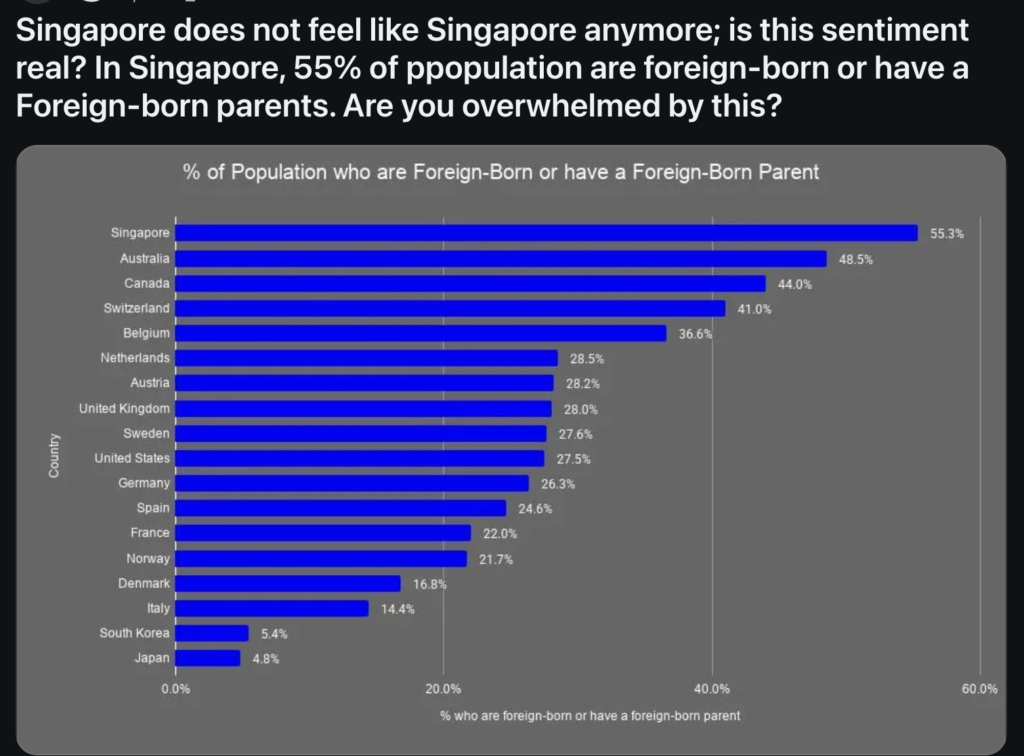
We came across a post, shared on two Singapore-focused Reddit forums, r/asksg and r/singaporespeaks, claiming that “55% of [the] population are foreign-born or have a foreign-born parent”. The post, titled “Singapore does not feel like Singapore anymore; is this sentiment real?”, shared a chart that was not attributed to any source and asked readers whether they were “overwhelmed” by this. The same account posted it in both forums on 23 November 2026, within two minutes of each other, and the two threads have since drawn 91 comments between them.
Immigration is an actively debated issue in Singapore. In a 2024 Institute of Policy Studies survey of 4,000 citizens and permanent residents, 37.5 per cent said mismanaged immigration would lead to anger against particular communities, and 35.5 per cent said it would weaken national identity, the highest share for any issue on that measure. Participants in a later IPS dialogue on local-foreign integration, whose report was released in January 2026, raised concerns over fair access to jobs and cultural dilution.
Yet Singapore relies on immigration as its birth rate falls. Citing this, Acting Transport Minister Jeffrey Siow said in January 2026 that “immigration can only go as far as integration allows”. Narratives that cast newcomers, or Singaporeans with migrant parents, as outsiders work against that.
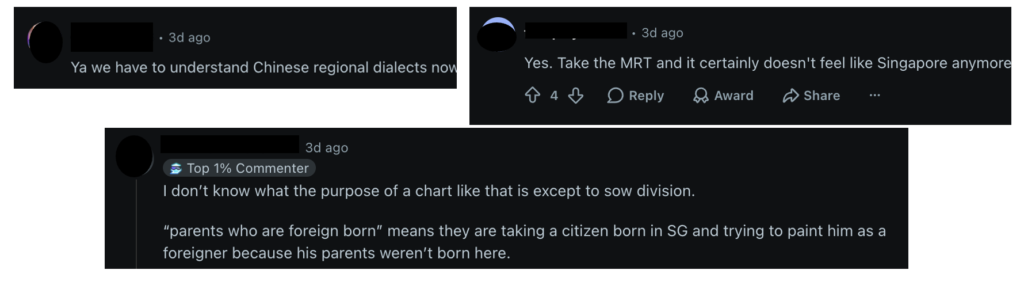
Although the posts have drawn limited engagement, they are already dividing readers. Some commenters echoed the post, with one writing that on the MRT, “it certainly doesn’t feel like Singapore anymore”, while others singled out immigrants from China. Others accused the poster of stirring up division. This prompted us to take a closer look early.
What was the post about?
The chart ranks 18 countries by the share of people who are foreign-born or have a foreign-born parent. Singapore tops the list at 55.3 per cent, ahead of Australia at 48.5 per cent and Canada at 44.0 per cent. It gives no source, year or definition.
The chart did not originate in the Singapore forums. The earliest version we found was posted by a different user on r/Infographics, an international forum, where others asked for its source and got no answer. We could not find the chart’s source either. At least one of its figures does not match official data on its own terms. According to Australia’s Department of Home Affairs, the 2021 census found that 51.5 per cent of residents were born overseas or have at least one parent born overseas, not the 48.5 per cent shown.
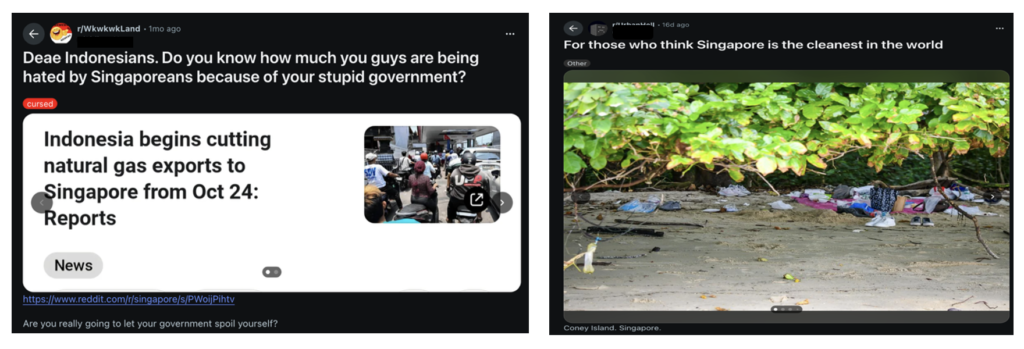
The user behind the Singapore posts reshared the chart, adding the question of whether Singapore still “feels like Singapore”. That user has previously posted negatively about Singapore in other Reddit forums as well. On 24 October 2026, during the gas supply dispute, the user told Indonesian users that Singaporeans hated them. On 9 November 2026, in a forum for photos of unpleasant urban scenes, they posted pictures of litter at Coney Island. They claimed Singapore is kept clean only in the central business district and tourist areas, which they described as managed around the clock by an “authoritarian Singaporean government”.
What counts as foreign-born?
Neither the chart nor the post defines “foreign-born” or “foreign-born parent”, and in Singapore’s case the answer matters. Singapore became independent in 1965, and many Singaporeans’ parents or grandparents migrated here from the wider region before then.
Singapore’s census, the Census of Population conducted every 10 years by the Singapore Department of Statistics, records where each resident was born, but does not appear to publish where their parents were born. Take a Singaporean born here in 1960 to parents who arrived from China in the 1940s. The census counts them as Singapore-born. By the chart’s description, however, they would count as having a foreign-born parent, the same as the child of a family that arrived last year.
Some countries, such as Australia, ask census respondents where their parents were born, which is how they can count people with a foreign-born parent.
What do official figures say?
According to the National Population and Talent Division, part of the Prime Minister’s Office, Singapore’s population stood at 6.21 million in June 2026. Of these, 1.98 million, or about 32 per cent, were non-residents, meaning foreigners working, studying or living here on passes.
The most recent census in 2020 found that 947,580 citizens and permanent residents, or about 23 per cent, were born outside Singapore. If that share has held, about 990,000 of today’s 4.23 million residents were born overseas.
Counting these residents together with non-residents as “foreign-born” gives about 2.97 million people, or roughly 48 per cent of the population. However, this estimate assumes the share has not changed since 2020, and that nearly all non-residents were born abroad.
For the claim to hold, 55 per cent of the population, or about 3.4 million people, would need to be foreign-born or have a foreign-born parent. Our estimate accounts for about 2.97 million of them. The remaining 450,000 or so would have to be Singapore-born residents with at least one parent born overseas, about one in seven of the 3.24 million residents born here. No official data counts this group, so we are unable to verify this part of the claim.
Official data supports an estimated foreign-born share of about 48 per cent, but we are unable to verify the rest. Hence, we rate the claim that 55 per cent of Singapore’s population are foreign-born or have a foreign-born parent as unproven.

Whatever the exact figure, the post’s framing is misleading. Rather than simply sharing a statistic, it asks readers whether they feel “overwhelmed”, inviting an emotional reaction to an unsourced number. Posts like this can deepen divides on issues such as immigration, so we encourage readers to check where such figures come from before sharing them.