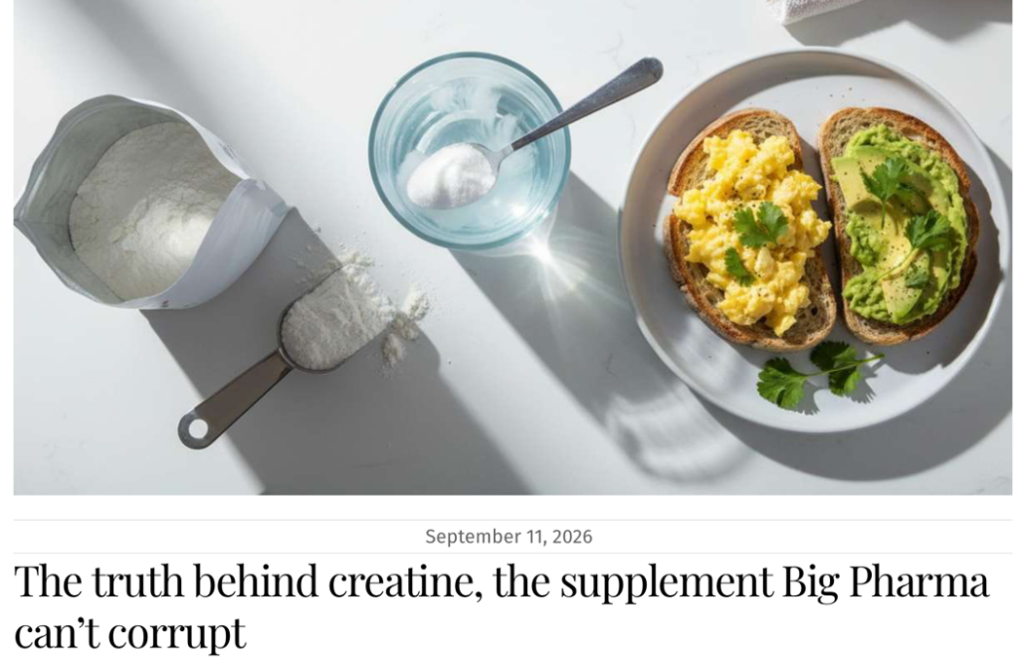
An article published on Activist Post on 11 September 2026 claims that creatine is “one of the few honest products left”, because it cannot be patented, and that mainstream medical authorities only call it safe because its natural status means it poses no threat to their profits. It adds that creatine could improve blood sugar and insulin sensitivity, which would cost makers of diabetes drugs money, and that the medical establishment will eventually turn against it, as the article says it did with ivermectin and hydroxychloroquine. Along the way, it describes Covid-19 mRNA vaccines as bioweapons that alter DNA, cause mass infertility and shed spike proteins onto bystanders, and presents creatine as part of resistance to a globalist plot to spread sickness and depopulate.
Creatine has become one of the most talked-about supplements online, and we have looked at it before. In our June fact-check, we rated a viral claim that creatine causes blood clots as false, and drew on a 2025 pooled safety analysis of 685 clinical trials covering 12,839 people on creatine and 13,452 on placebo. The proportion of trials reporting side effects was effectively identical, at 13.7 per cent for creatine and 13.2 per cent for placebo. The Activist Post article distorts that statistic in the opposite direction: while the clot claim inflated a single case report into proof that creatine is dangerous, this one recasts creatine’s ordinary safety record as proof of a hidden conspiracy led by “Big Pharma”.
The latest article’s central premise, that creatine cannot be patented and so cannot be monetised by pharmaceutical firms, is only partly true. Creatine is a naturally occurring compound, but companies have patented ways of making it, including a US patent granted in December 2001 to Tianjin Tiancheng Pharmaceutical Co. for an industrial process to produce creatine and creatine monohydrate, as well as modified versions such as creatine hydrochloride, which its patent claims is far more soluble than the standard form.
The suggestion that creatine may help with blood sugar has some basis, but it is much weaker than the article implies, and nothing in it shows suppression. The strongest evidence is a 2011 randomised, double-blind trial in Medicine & Science in Sports & Exercise, in which people with type 2 diabetes who took five grams of creatine a day during a 12-week exercise programme saw their HbA1c, a measure of average blood sugar, fall from 7.4 to 6.4 per cent, while the placebo group stayed at around 7.5 to 7.6 per cent. However, the participants were also exercising, and a systematic review of the wider literature found that creatine’s benefits for glucose metabolism appeared mainly alongside exercise, with creatine on its own showing positive results in only a few studies. A trial in healthy, untrained men found that neither five days nor 28 days of creatine changed glucose tolerance or measures of insulin sensitivity.
Reviews of the diabetes trials are cautious. A systematic review of randomised trials in type 2 diabetes found only three trials with 87 participants in total, which compared creatine against placebo, metformin and glibenclamide respectively. Creatine performed no differently from the two drugs, which hints at a glucose-lowering effect, but the authors rated the certainty of the evidence as low and called for larger, longer trials. A separate meta-analysis that searched the literature up to December 2020 found no significant effect on fasting blood glucose or insulin resistance overall, and concluded that creatine’s efficacy for improving glycaemic control is yet to be confirmed. All of this research was published openly in medical journals. Neither the article nor anything we found points to an effort by drug makers or regulators to suppress it; it is what an ordinary, unfinished area of research looks like.
The article’s claims about COVID-19 vaccines are false, and fact-checkers have examined each of them. On infertility, the US Centers for Disease Control and Prevention says there is currently no evidence that COVID-19 vaccines cause fertility problems in women or men, a 2024 evidence review by the National Academies of Sciences, Engineering, and Medicine concluded that the evidence favours rejecting a causal link between Moderna’s mRNA-1273 vaccine and female infertility, and Rappler rated the claim false as early as May 2021. On DNA, the CDC explains that the genetic material in mRNA vaccines never enters the nucleus of a cell, where DNA is kept, and Full Fact has rated the claim false. On shedding, PolitiFact rated it false, and FactCheck.org has explained that the spike protein made after mRNA vaccination cannot lead to the virus reproducing and shedding. Placing these claims beside a discussion of a well-studied supplement gives them an undeserved air of credibility.
The argument is also structured in a way that no evidence can disprove it. The article treats creatine’s safety as proof of its honesty, yet its closing commentary says mainstream medicine’s promotion of creatine should be viewed with extreme suspicion and is probably a pharmaceutical “psyop”. If creatine is unpatented then it is proof of a plot by Big Pharma, however if it is endorsed, that is also a sign of a trap by them.
We rate the claim that creatine is a supplement Big Pharma cannot corrupt as misleading. The article is right that creatine is a naturally occurring compound with a strong safety record, and there is genuine, if preliminary, research on its effects on blood sugar. But its premise that creatine sits beyond commercial reach is oversimplified, its suggestion that drug makers are suppressing the research is unsupported, and its claims about COVID-19 vaccines are false.
Creatine monohydrate remains one of the most heavily studied supplements, and the three to five grams a day that the article recommends matches the dose we cited in June. As with any supplement, people with kidney disease, a clotting disorder or another medical condition should speak to a doctor before starting.