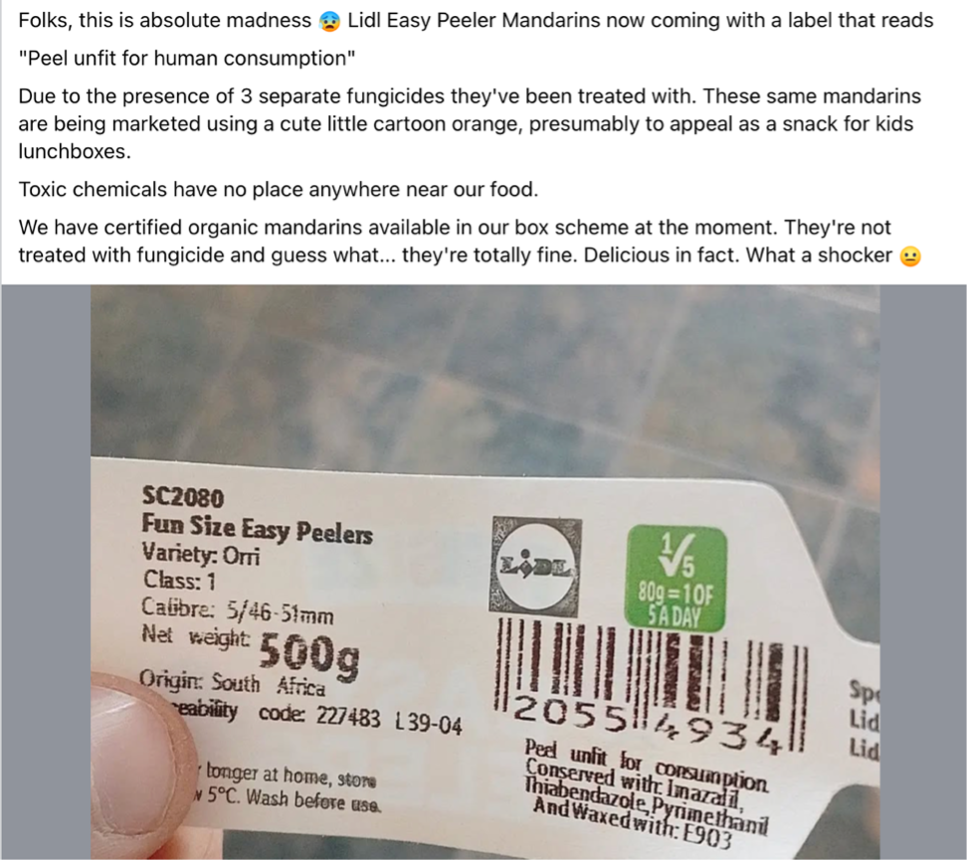
A Facebook post by Richard’s Select Organics, an Irish organic food shop, claims that Lidl’s Easy Peeler Mandarins now carry a label reading “Peel unfit for human consumption”. It says this is because the fruit has been treated with three separate fungicides. Lidl is a German supermarket chain with over 12,000 stores worldwide, mostly in Europe.
The post includes a photo of the label. It also alleges that the mandarins are marketed to children with a cartoon orange, says that “toxic chemicals have no place anywhere near our food”, and ends by promoting the page’s own certified organic mandarins.
At the time of writing (28 October 2026), the post had over 20k likes, which indicates that it has gone viral.
Mandarin oranges are a familiar sight in Singapore, particularly around Chinese New Year, and citrus peel and zest are common ingredients in baking, cooking and drinks. Given the alarm that a warning like this can cause, we decided to take a closer look at whether citrus peel and zest are unsafe to eat.
What does the label in the photo actually say?
The photograph shows a label for “Fun Size Easy Peelers”. The small print at the bottom reads “Peel unfit for consumption. Conserved with: Imazalil, Thiabendazole, Pyrimethanil and Waxed with: E903”.
This means the post is right that three fungicides are named. However, the word “human” does not appear in the warning, and the warning refers to the peel, not the fruit.
The wax listed, E903, is carnauba wax, a coating derived from a Brazilian palm. The European Food Safety Authority (EFSA) re-evaluated it as a food additive and concluded that its currently authorised uses would not be of safety concern.
Why does citrus carry these labels, and has anything changed?
Post-harvest fungicides are routinely applied to citrus to stop the fruit from going mouldy before it reaches shoppers. Sarah Compson, head of policy and campaigns at the charity Pesticide Action Network UK (PAN UK), told The Guardian that imazalil, for example, is “used extensively on citrus fruit during storage and transportation”.
Citrus is singled out for labelling because of how it is eaten, with zest commonly used in baking and whole peels added to drinks. A 2021 European Commission decision notes that Commission Implementing Regulation (EU) No 543/2011 sets out labelling rules for citrus fruit treated with preserving agents or other chemical substances. The UK’s retained version of the citrus marketing standard likewise calls for a “mention of the preserving agent or other chemical substances used at post-harvest stage” when these are used. The rule requires the treatment to be named, and does not require a statement that the peel is unfit for consumption.
Other retailers use similar treatments. Tesco’s product listings for its own easy peelers name imazalil, thiabendazole and pyrimethanil for fruit from Spain, with different combinations for other countries.
The fungicides are also not banned. A fact-check by Fact Crescendo on a similar viral claim about Tesco oranges found that they remain approved in the EU and UK, subject to maximum residue limits (MRLs). They are, however, prohibited in organic farming. Sarah Hathaway, head of technical at the Soil Association, told The Guardian that they “are not allowed in organic farming at all, either in production or post-harvest”.
Who is behind the post?
As noted above, the post was published by Richard’s Select Organics, which is not an independent consumer or health account. Its Facebook page lists it as an organic food shop based in Mallow, County Cork, in Ireland. As the post itself states, the business sells organic produce through a box scheme, a subscription service that delivers fruit and vegetables to customers.
This matters because the post ends by promoting the page’s own certified organic mandarins, which it says are “not treated with fungicide” and “totally fine”. The page therefore stands to benefit commercially if shoppers become worried about conventionally grown citrus and switch to organic fruit instead.
A business interest does not by itself make a claim false, and it is true that these fungicides are not allowed in organic farming. However, it is a potential conflict of interest. Readers should keep it in mind when weighing the post’s claims, such as its description of fruit being treated with “toxic chemicals” and its suggestion that the fruit is being pushed on children.
Is it unsafe to eat citrus peel or zest?
Residues of post-harvest fungicides sit mostly on and in the peel. A study of residues in oranges and mandarins found that imazalil and thiabendazole were located mainly in the peel, with amounts in the pulp not significant.
In its review of imazalil, EFSA recorded a median processing factor of 0.07 for peeled citrus. This means residues in peeled fruit were typically around 7% of those on the whole fruit. A 2025 laboratory study similarly notes, citing earlier research, that about 6% of imazalil in mandarins migrated from the peel into the flesh.
This is why the peel, rather than the flesh, is the focus of both the labels and campaigners’ concerns. The US Environmental Protection Agency concluded in 1999 that imazalil is “likely to be carcinogenic in humans”, based on liver and thyroid tumours in rodent studies, and California has listed it as a substance known to cause cancer under Proposition 65 since 2011.
Regulators, however, assess risk based on how much of a substance people are likely to take in. In a more recent evaluation of imazalil use on citrus, EFSA concluded that short-term and long-term intake from the intended uses is unlikely to present a risk to consumer health. Quantity also matters, as most people are not eating a large amount of citrus zest.
Washing the fruit helps, but only partly. A study found that home washing removed roughly 50% of imazalil and 90% of thiabendazole from treated citrus. Compson cautioned that it is “not just a case of washing it off”, as the pesticides are “designed to stick to the fruit”. She also told The Guardian that she did not think buying unwaxed fruit makes “enough of a difference”.
The label does name three fungicides, and it does say the peel is unfit for consumption. However, the post implies that something about the mandarins has recently changed, and it uses the wording to suggest that the mandarins themselves are toxic.
In fact, the fungicides are authorised for use on citrus, residues are concentrated in the peel rather than the flesh, and EFSA’s most recent assessment found that intake from the intended uses is unlikely to pose a risk to consumers.
Therefore, we rate this claim as misleading.

What should consumers take note of?
Eating the flesh of a peeled mandarin is not what such labels warn against. Singapore Food Agency advice is to gently rub the surface of fruit while rinsing it. It also notes that peeling can help eliminate pesticide residues, as most are found on the surface.
For recipes and drinks that use the peel or zest, those who want to reduce their exposure can wash and scrub the fruit, check the label for post-harvest treatments, or choose organic or untreated citrus, on which these fungicides are not permitted.
Concerns about food safety are best checked against what regulators and published research say, rather than a single social media post that also sells a product.