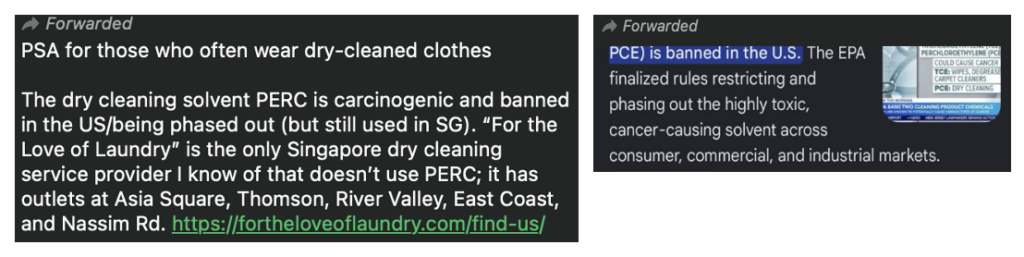
A claim circulating on local chat groups warns that a dry-cleaning solvent known as PERC, which remains in use in Singapore, has been banned in the US because it is a carcinogenic substance and harmful to humans. Given that dry cleaning is a routine part of life for many Singaporeans, particularly those who wear formal wear or delicate fabrics, we decided to examine this claim further.
What is PERC and what’s its use in dry cleaning?
Dry cleaning refers to the process of cleaning clothing and textiles using a chemical solvent instead of water. The solvent most commonly used is perchloroethylene (PERC), also known as tetrachloroethylene or PCE. A colourless, non-flammable liquid, PERC has been the dominant solvent in the dry-cleaning industry since the 1940s because of its ability to dissolve oils, greases, and stains effectively without damaging delicate fabrics. Beyond dry cleaning, PERC is also used as a degreasing agent in metalworking and in the formulation of some adhesives and sealants.
Is PERC carcinogenic?
A carcinogen is a substance that has been associated with an increased risk of developing cancer.
The International Agency for Research on Cancer (IARC), the cancer research agency of the World Health Organisation, classifies substances into five groups according to the strength of evidence linking them to cancer in humans. Group 1 substances, such as tobacco and asbestos, are confirmed to cause cancer in humans based on sufficient evidence. Group 2A substances are classified as “probably carcinogenic to humans”, indicating strong but not conclusive evidence of carcinogenicity. Group 2B substances are considered “possibly carcinogenic to humans”, where evidence of a potential link exists but remains limited. Group 3 substances cannot currently be classified due to insufficient evidence, while Group 4 substances are considered unlikely to cause cancer based on available evidence.
PERC is classified by IARC as a Group 2A substance, or “probably carcinogenic to humans”, based on limited evidence from human studies and sufficient evidence from animal studies.
Similarly, the US Environmental Protection Agency (EPA) classifies PERC as a likely human carcinogen, citing associations between exposure and cancers such as bladder cancer, non-Hodgkin lymphoma, and multiple myeloma, particularly among workers in the dry-cleaning industry. In addition to potential cancer risks, long-term exposure to PERC has been linked to neurological effects, including impaired memory, dizziness, and headaches, as well as possible liver and kidney damage.
Is PERC banned in the US?
The US finalised a federal rule in December 2024 under the Toxic Substances Control Act establishing a phased elimination of PERC in dry cleaning, requiring all commercial dry-cleaning use of PERC to cease by December 2034. While the EPA is currently reconsidering certain aspects of the rule, it has confirmed that its overall assessment of PERC’s health risks remains unchanged.
Several US states had already moved to restrict or eliminate PERC use before the federal rule came into effect. California banned PERC in dry cleaning entirely as of January 2023. Minnesota passed its ban in 2021, which took full effect in January 2026.
Is PERC still used in Singapore?
Based on our research, PERC remains in use in Singapore’s dry-cleaning industry. In Singapore, the regulation of hazardous chemicals is divided across different authorities. The National Environment Agency oversees their import, storage and disposal, while safeguarding workers against hazardous chemicals in the workplace falls under the Ministry of Manpower (MOM).
As the relevant authority for workplace exposure, we reached out to MOM for clarification on the regulatory position.
MOM clarified that the management of hazardous chemicals in workplaces, including PERC, is addressed under the Workplace Safety and Health framework. Employers whose workers handle PERC are required to conduct a risk assessment, refer to the relevant Safety Data Sheet to understand the hazards involved, and adopt the hierarchy of risk controls, starting with eliminating PERC use altogether, or substituting it with a less hazardous alternative where elimination is not possible.
MOM’s website also confirms that employers must arrange annual medical examinations for workers exposed to PERC, aimed at early detection of occupational disease. MOM clarified that its guidelines are focused on occupational exposure and do not extend to consumer exposure scenarios.
Some Singapore dry-cleaning businesses continue to list PERC as a solvent option, while others have moved to alternatives including wet cleaning (a water-based method using gentle, biodegradable detergents), and liquid carbon dioxide.
What is the actual risk for people wearing dry-cleaned clothes?
For the general public, exposure to PERC is typically low, occurring through trace amounts in air, food, water or dry-cleaned clothes.
A 2024 New Zealand government-commissioned health risk assessment on consumer exposure to PERC, found that inhalation is the more significant exposure route for residual PERC in dry-cleaned clothes, with dermal exposure considered negligible. This is because PERC evaporates from fabric into the surrounding air rather than being primarily absorbed through skin contact.
The assessment also found that lifetime exposure to PERC from dry-cleaned clothes equated to an excess cancer risk of less than one case in 100,000 people, a very small additional risk.
Several studies cited in the assessment found that bringing freshly dry-cleaned clothes home can measurably raise PERC levels indoors, particularly in enclosed spaces like wardrobes and closets, tapering off in adjacent rooms. These levels typically peaked around the second day after dry cleaning and persisted for at least 48 hours. Of the fabrics studied, wool retained the highest concentrations. The risk to consumers lies primarily with inhaling PERC vapour in poorly ventilated spaces, not with wearing dry-cleaned clothes directly.
The greater risks are borne by dry-cleaning workers with sustained occupational exposure. A 2014 meta-analysis published in Environmental Health Perspectives, which reviewed 16 studies examining bladder cancer risk among dry-cleaning and laundry workers, found that dry-cleaning workers specifically had approximately 1.5 times the risk of bladder cancer compared to the general population. The study noted that while PERC is the primary solvent used in dry cleaning and the only one identified as a potential bladder carcinogen, the evidence specifically linking PERC to the excess risk remained limited.
Therefore, the core claims in the messages circulating are broadly accurate. PERC is classified as a probable human carcinogen, and the United States has introduced a phased ban on its use in dry cleaning. While measures exist in Singapore to govern the handling of PERC and protect workers from occupational exposure, there is currently no prohibition on its use in the dry-cleaning industry. For consumers who occasionally use dry-cleaning services, the risk from wearing dry-cleaned clothes is considered low. We rate this claim as mostly true.

If you are concerned about PERC exposure from dry-cleaned clothes, the Environmental Working Group, a US environmental health nonprofit, recommends airing dry-cleaned clothes outdoors before bringing them indoors, and asking your dry cleaner for alternatives to PERC.
It may also be worth reconsidering how often you dry clean, as not all clothes marked “dry clean only” actually need to be, according to fabric care experts. Many fabrics including cashmere, light-coloured silks, and cotton, can often be hand-washed instead in cold or tepid water with a gentle detergent, avoiding wringing the fabric. That said, before hand-washing any garment, it is worth spot-testing a small area first to check if the colour runs, and proceeding only if you are comfortable with the risk, as there is no guarantee that hand-washing will not affect the garment.