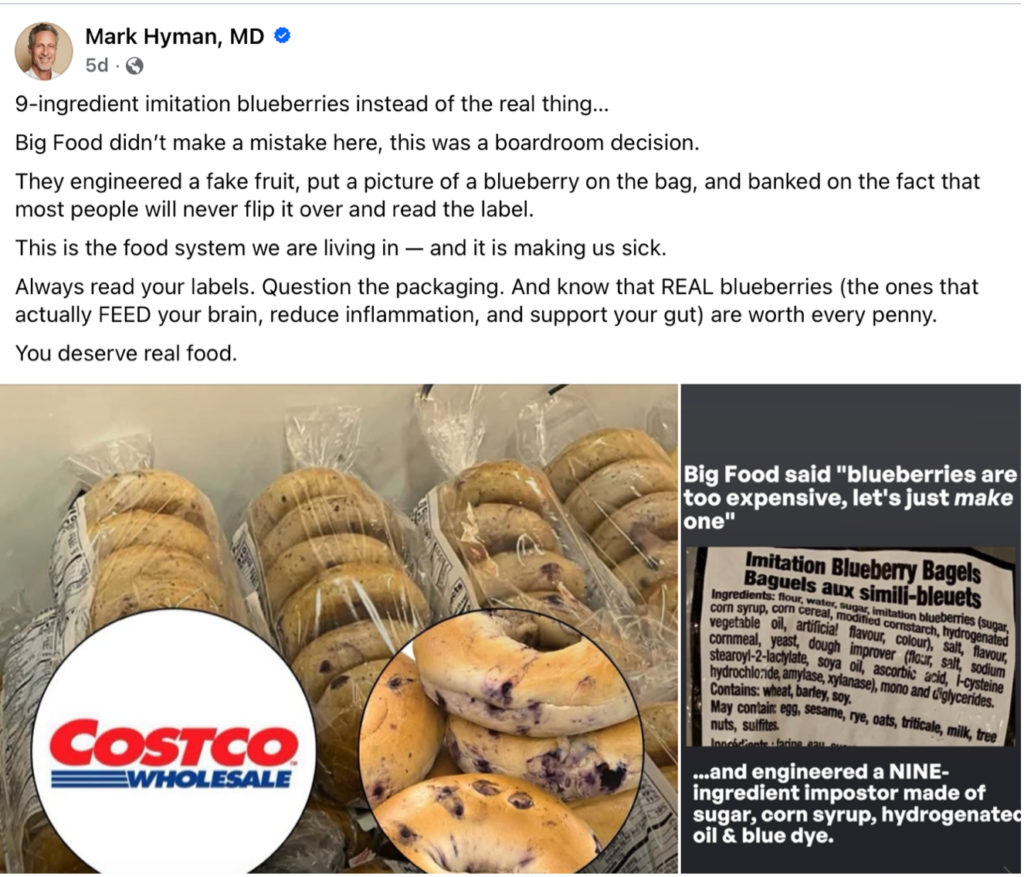
A Facebook post by Dr. Mark Hyman, an American physician with 1.5 million followers, claims that “Big Food” has engineered a nine-ingredient “synthetic” blueberry as a substitute for real blueberries in products sold by major retailers.
When we conducted a search on “simulated” or synthetic blueberries, we found that the core phenomenon Hyman describes is real and well-documented. Commercial baked goods and cereals routinely substitute engineered “blueberry bits” or “blue crunchlets” for actual fruit, built from artificial colours, partially hydrogenated oils, and high-fructose corn syrup, and they appear across cereals, breads, granola bars, bagels, yogurts, and dry baking mixes sold in North American markets.
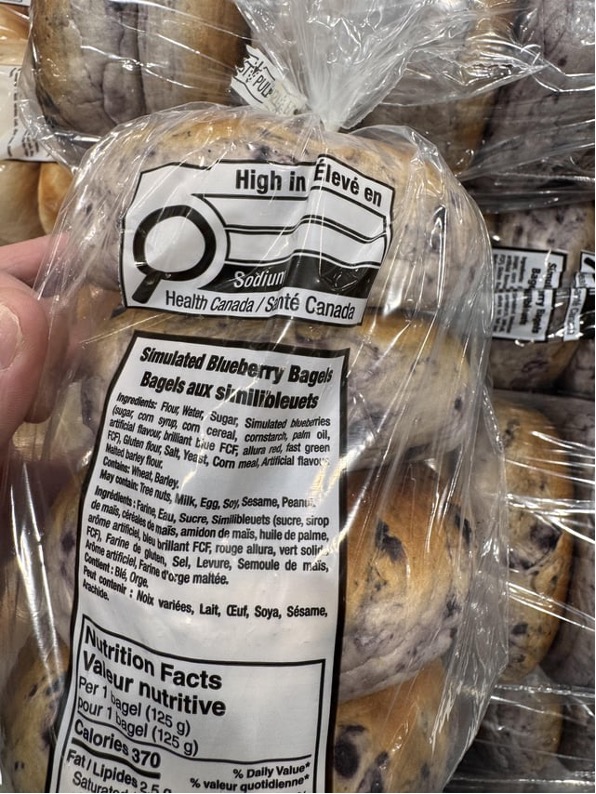
The specific Costco bagel that catalysed the outrage is also accurately characterised: its label identifies the simulated blueberry component as a compound of sugar, corn syrup, corn cereal, cornstarch, palm oil, artificial flavour, and the synthetic dyes brilliant blue FCF, allura red, and fast green FCF — appearing as the fourth ingredient overall, after flour, water, and sugar. Counting these sub-components yields roughly the nine-ingredient figure Hyman cites, and the commercial motivation he implies is likewise supported: artificial additives are favoured by manufacturers because they are cheaper to produce, preserve, and distribute than natural equivalents, a dynamic long observed in processed-food formulation.
Concerns over fake blueberries masquerading as real fruit are not new concerns. Our research found articles from NPRand CBS news from 2011 stating that blueberry muffins from Kelloggs contain “blueberry crunchlets”, made of sugars, soybean oil, and food colouring instead of actual blueberries. It is worth noting that the practice is not industry-wide: products in the same category, including from the same manufacturers, do use real fruit – Kellogg’s Special K Blueberry cereal, for instance, lists freeze-dried blueberries on its ingredient panel, as do brands such as Nature’s Path and Purely Elizabeth.
Taken together, the claim that big box retailers are selling “simulated” blueberries instead of the real thing is true. Companies substitute these “blueberries” primarily to cut production costs.
That said, this episode is a useful reminder of why reading ingredient labels matters. Front-of-pack imagery and product names can suggest one thing while the ingredient list tells another story – in this case, a product visually marketed with blueberries whose fruit component is, on the label, a compound of sugar, corn syrup, starches, palm oil, and synthetic dyes.
Consumers who want to avoid imitation or simulated ingredients can do so by checking the ingredient panel rather than relying on packaging cues, paying particular attention to terms such as “simulated,” “imitation,” “artificial,” or “flavoured” attached to a named fruit, and to the order in which ingredients appear, since items are listed by weight from most to least. Label-reading remains the most reliable defence consumers have against the gap between how a product is marketed and what it actually contains.