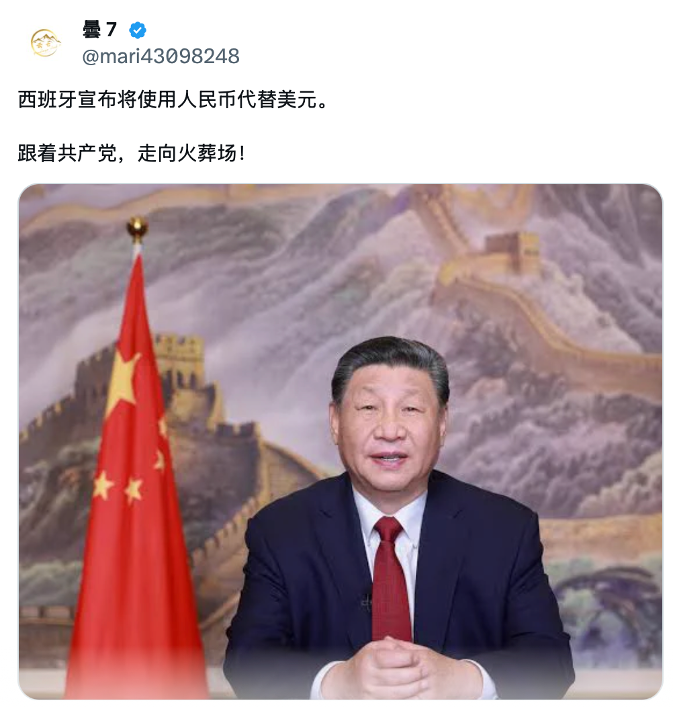
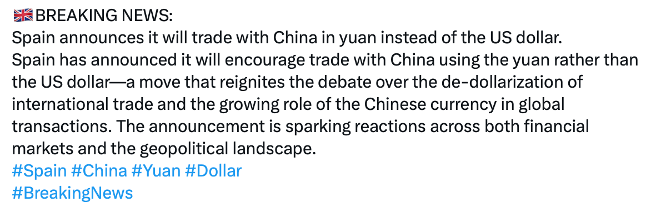
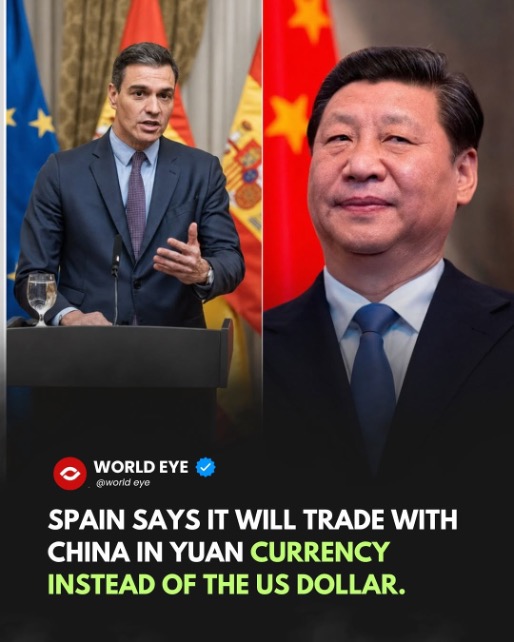
Several posts on X, one with over 30,000 likes claim that Spain had announced plans to replace its use of US dollars with the Chinese yuan. Some of the posts discuss the growing role of the Chinese currency in global transactions, as an alternative to the US dollar.
Where the claim came from
The post surfaced after a very public falling-out between the US and Spain. At the NATO summit held in Turkey from 7 to 8 July 2026, US President Donald Trump described Spain as a “terrible partner in NATO”, as a row deepened over Spain’s defence spending and its refusal to help the US in the Iran war. Trump went on to threaten to cut off trade relations with Spain – an echo of a similar threat he made in March, after Spain declined to let US aircraft use Spanish airspace for strikes on Iran.
Spanish Prime Minister Pedro Sánchez played down the rift soon afterwards, saying his country’s ties with the United States remained very positive, and that the two leaders had had a tension-free informal chat after the threat.
Spain’s reserves remain overwhelmingly in US dollars
Spain joined the European Communities – the forerunner of the European Union – in 1986, and has used the euro as its official currency since 1999. It does not transact in US dollars domestically, so there is no national dollar for the yuan to “replace”.
When we took a look at the Bank of Spain’s annual accounts for 2025, we found that 73.9 per cent of its international reserve assets are denominated in US dollars, against just one per cent in Chinese renminbi. Those assets include current accounts, deposits, investment fund shares and debt securities held in foreign currency. A country preparing to swap the dollar for the yuan would not be sitting on a balance sheet that looks like this.
Spanish authorities say no such directive exists
Spain’s Ministry of Economy, Trade and Business also told AFP on 24 July 2026 that it had issued no directive on currency requirements for international trade. Its press department said that no European or national authority had issued a directive of the kind described, and that no EU trade agreement contains provisions on billing currency – the choice is left entirely to the parties to each contract, according to their own commercial interests.
Why this one travelled
This claim is a good example of how a fabrication attaches itself to a real dispute. The row between the US and Spain over NATO spending and the Iran war was genuine and widely reported, which gave the invented currency announcement a plausible-sounding hook. Readers who had seen the real story were primed to accept a follow-on development that never happened.
Spain has not announced any plan to replace the US dollar with the Chinese yuan. Its official currency is the euro, its economy ministry has denied issuing any directive on trade currency, and its central bank’s reserves remain close to three-quarters US dollar dominant. The claim appears to have been fabricated on the back of a real diplomatic dispute. Therefore, we rate this claim as false.