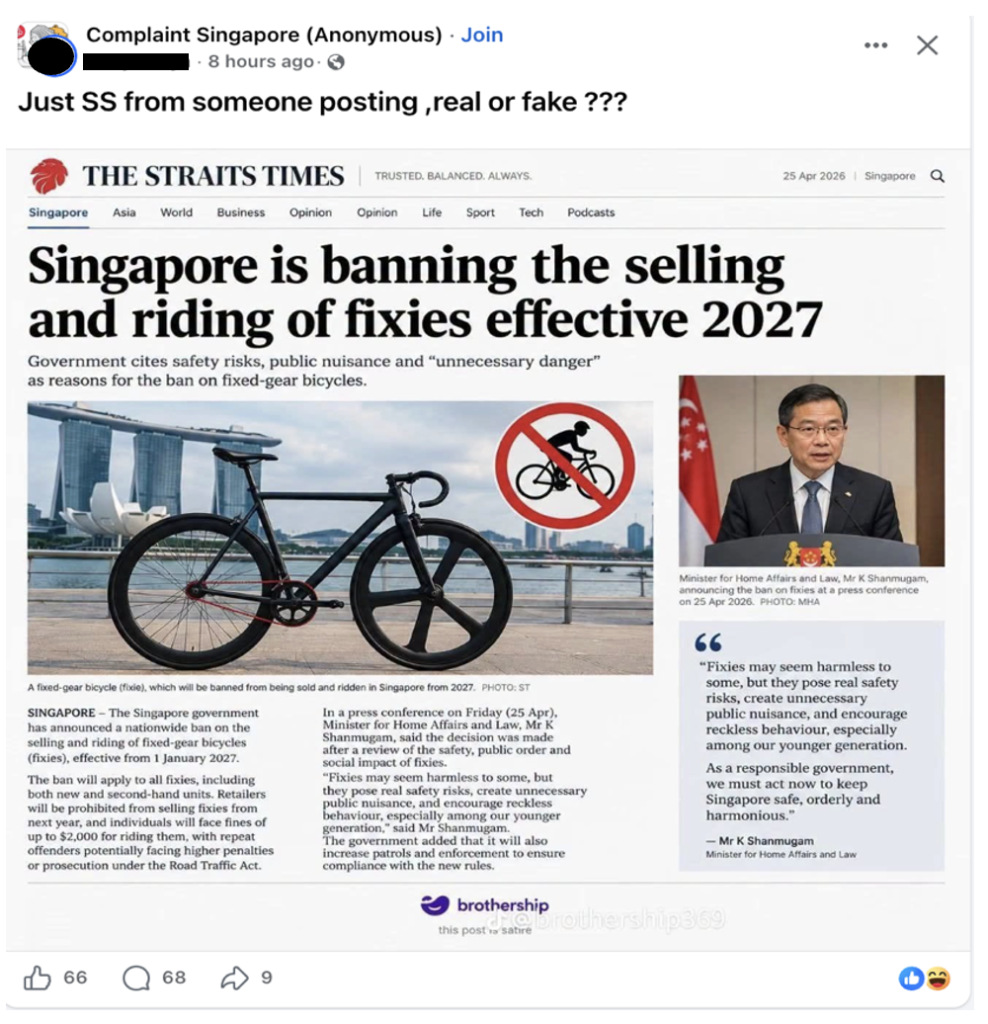
Over the past few days, we came across two Facebook posts sharing what looks like a Straits Times article headlined “Singapore is banning the selling and riding of fixies effective 2027”. Posted on 30 October and 3 November, they had drawn about 650 reactions between them.
The Facebook posts have not gone viral, but cycling is in the spotlight this weekend with the Tour de France Singapore Criterium, and the image looks like a genuine local news report. With several people asking whether it was real, we took a closer look.
The image states that the ban takes effect on 1 January 2027, with fines of up to S$2,000. It attributes a quote to Mr. K Shanmugam, who is Senior Minister, Coordinating Minister for National Security and Minister for Home Affairs, saying that fixies create safety risks and public nuisance and encourage reckless behaviour among young people.
Is there a ban on fixed-gear bicycles?
Fixies, short for fixed-gear bicycles, usually come without brakes, and require riders to resist the motion of the pedals with their feet to slow down or stop.
We did not find any government announcement of a ban on selling or riding fixies from 2027, and no such article on the Straits Times website. We also did not find any record of the quote attributed to Mr. Shanmugam.
There is, however, a rule on handbrakes. In December 2020, the Active Mobility Advisory Panel, which was set up in 2015 to guide the safe use of active mobility devices, recommended banning bicycles without brakes from public paths and roads, after a fatal accident involving a fixie that year. The rule took effect in September 2021 and requires all bicycles on public paths and roads to have at least one working handbrake. A fixie fitted with handbrakes can still be ridden, and by 2023, many bike dealers were selling them with a handbrake already installed.
More recently, Transport Minister Jeffrey Siow was asked about fixie accidents, youth ridership and whether the handbrake requirement is adequate. In a written reply on 7 October 2026, he said the requirement remains adequate and that LTA has not seen additional safety concerns since it took effect. The reply did not mention a ban.
Where the image comes from
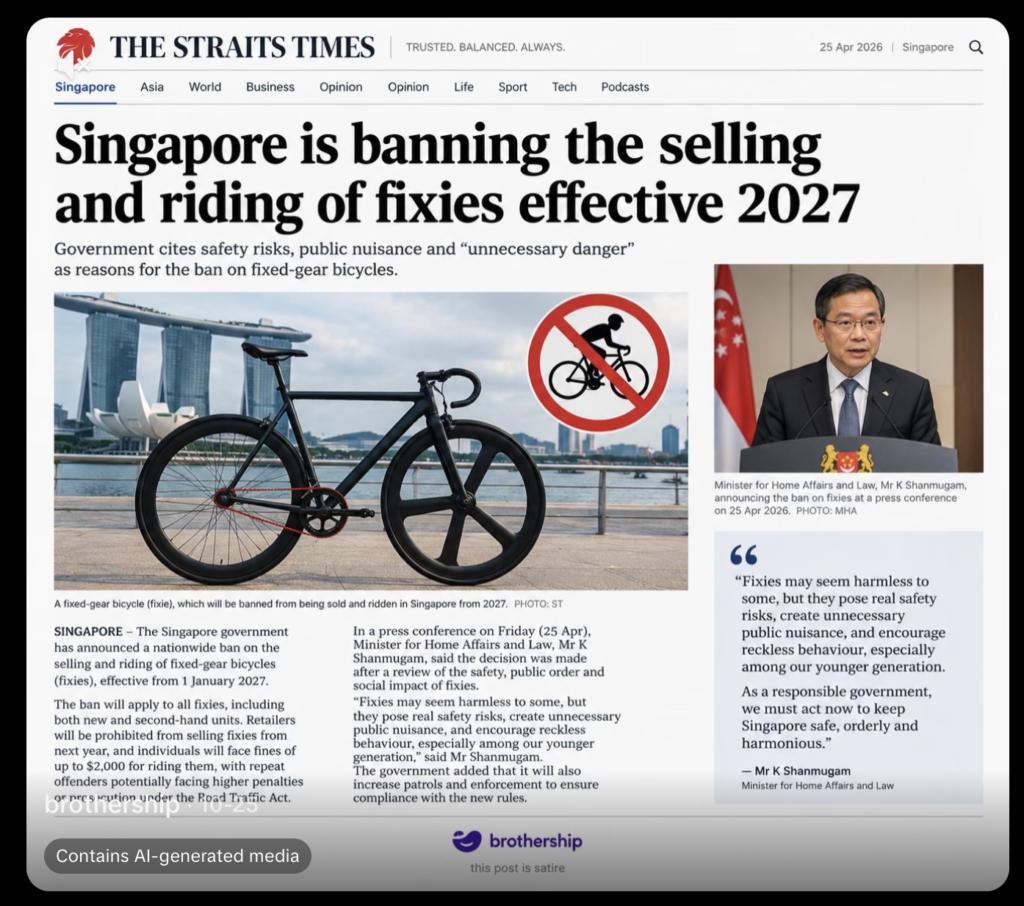
We ran the image through online AI-detector tools such as “AI or Not”, which flagged it as likely AI-generated.
The image carries a small watermark at the bottom with the name brothership and the handle @brothership369. We traced it to a TikTok account of that name, which posted the image on 25 October 2026. As of 4 November 2026, the post had about 67,900 views. The account’s bio says openly that the news it makes is satire and for entertainment, and not real. The image also has a small “this post is satire” line under the watermark, and TikTok marks the post as containing AI-generated media. The caption does not mention satire.
Some commenters on the Facebook post had already called it fake news, and the image bears this out in several ways. Among them, it is dated 25 April 2026 and says the announcement was made on “Friday (25 Apr)”, but 25 April 2026 was actually a Saturday. It calls Mr. Shanmugam “Minister for Home Affairs and Law”, although he was Minister for Law only until 2025. The menu bar at the top lists “Opinion” twice, and the image apparently of Mr. Shanmugam does not show him.
Hence, we rate the claim that Singapore is banning the selling and riding of fixed-gear bicycles from 2027 as satire. There is no ban on selling or riding fixies from 2027, and fixies fitted with a handbrake can still be ridden on public paths and roads.

Why posts like this might be easy to miss
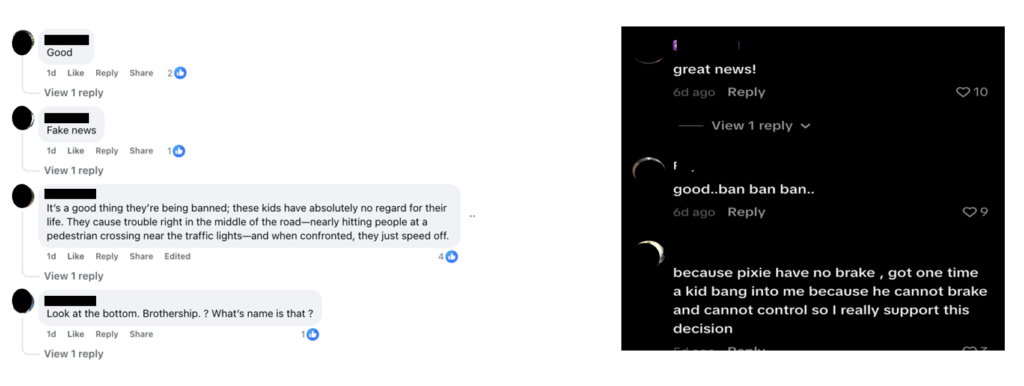
The comments on the posts we saw were split. On Facebook, several people called it fake news, one pointed out that the minister’s photo gave it away, and another asked about the Brothership name at the bottom of the image. On TikTok, one commenter asked whether the post was real, but many replied as if the ban were happening, welcoming it or giving their reasons for supporting it.
The fixie post is one of five on the account, all styled as official announcements. Four carry a “this post is satire” line in the image, and on the fixie post it is the smallest. Not all of the posts’ captions contain a disclaimer that the post is satire.

The problem is what happens when an image is shared. A label that sits inside the image, like the small one on the fixie post, can be cropped out in a screenshot, and the Facebook posts we saw did not mention the account’s bio. The image has also reached search results. When we searched whether Singapore was banning the selling and use of fixies by 2027 on the morning of 4 November 2026, Google’s AI Overview said Singapore is banning the selling and riding of fixed-gear bicycles from 2027 and linked a Facebook post that shared the image. It also described the handbrake rule correctly, so the inaccurate claim sat next to accurate information. This shows how a fake post can travel beyond the platform where it appeared. A reader who searched for the topic, and never saw the original, could be told the ban was real.
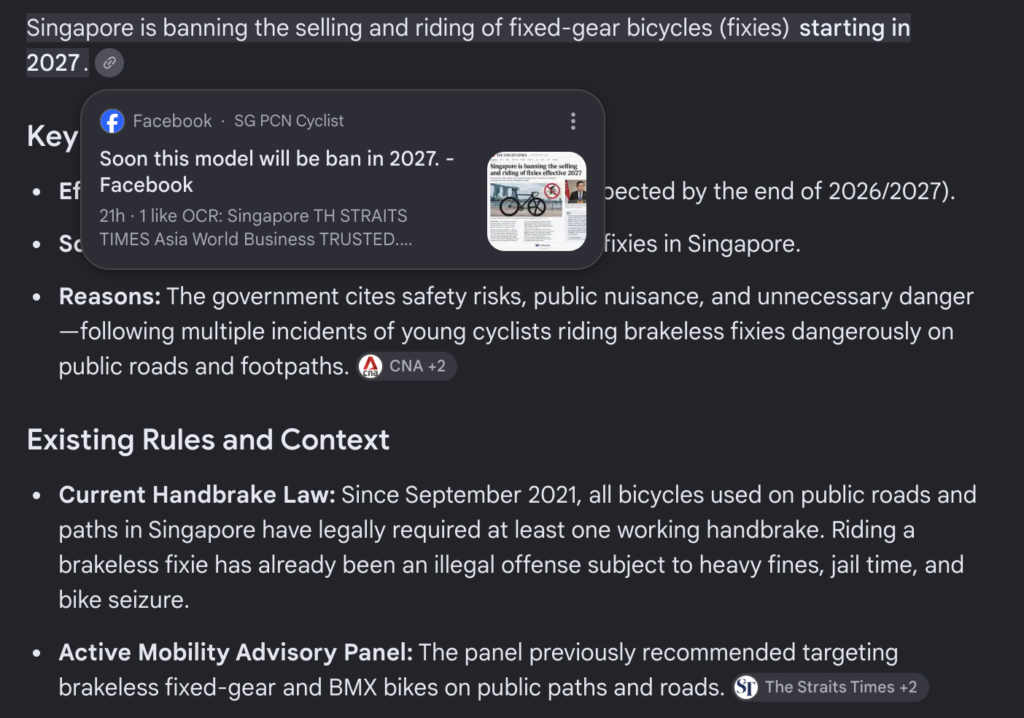
Satire relies on readers knowing the context, and that context can be lost once an image is passed around. This particular claim was satire about bicycles. A fake announcement about something with higher stakes, such as a rule change or a health warning, could cause harm in several ways, including panic and a flood of queries to public services. It is always worth double-checking the information and sources we come across online.