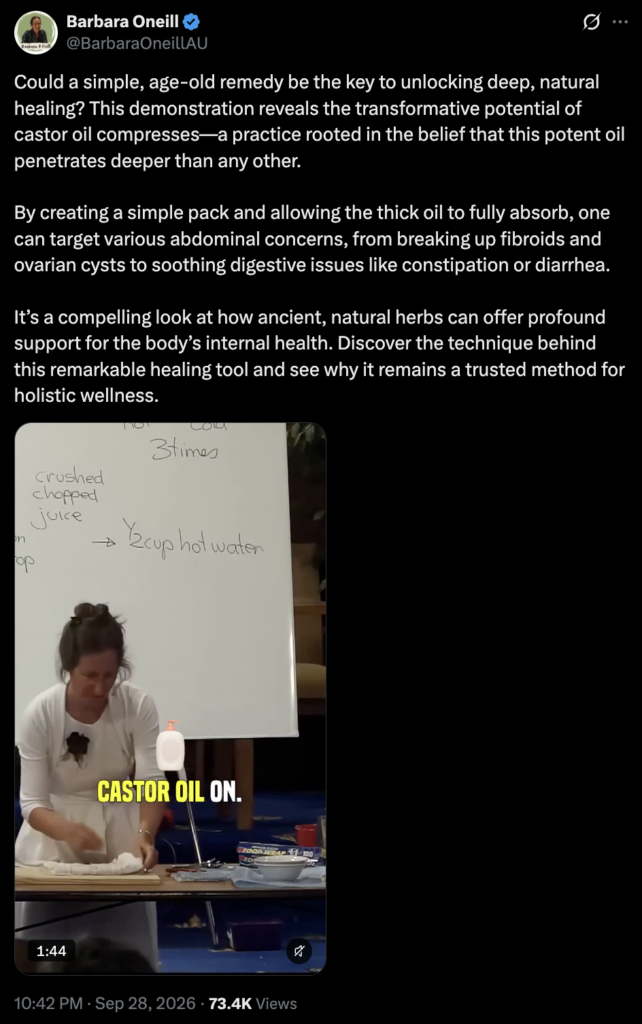
A post on X by the account @BarbaraOneillAU, posted on 28 September 2026, has drawn around 73,400 views sharing a video demonstrating how to make a castor oil compress, a cloth soaked in castor oil and placed on the skin for several hours. In it, Barbara O’Neill, an Australian naturopath, claims that applying a compress to the abdomen will heal any problems there. She states that the oil will penetrate and break up fibroids in the uterus, break up cysts on the ovaries, soften the colon to relieve constipation, and heal the colon in cases of bad diarrhoea.
The post’s caption repeats the same claims, stating the compress can target various abdominal concerns, from breaking up fibroids and ovarian cysts to soothing digestive issues like constipation or diarrhoea. The same account has posted other similar claims about castor oil. Two other posts have drawn 44,500 and 230,600 views respectively in recent weeks, putting its combined reach on this narrative well over 348,000 views.
O’Neill was permanently banned in 2019 by Australia’s New South Wales Health Care Complaints Commission from providing any health services, paid or unpaid, after an investigation found she had given dangerous, unqualified health advice on subjects including cancer, infant nutrition and vaccination.

The video snippet in the X post appears to be a genuine clip of O’Neill, based on comparison with material from her existing lectures on home remedies, and we found no apparent signs of AI manipulation. While we could not find the video on O’Neill’s own social-media accounts or website, we traced the footage to a longer video that appears to have been recorded at a seminar conducted by O’Neill, where she can be heard welcoming attendees. The earliest version we identified was uploaded by a Seventh-day Adventist church in New Zealand in 2016. We also found footage of O’Neill making a similar claim that castor-oil compresses can break down endometriosis-related cysts in a video uploaded recently by Living Springs Retreat, a wellness retreat she has worked with for courses and lectures and which her website lists as an authorised distributor. However, we could not verify that the X account is operated by O’Neill. Although it uses her name and appears to present itself as her account, it is not among the social media accounts linked from O’Neill’s official website. Her content is also frequently re-shared by unofficial fan accounts and accounts not affiliated with her but using her popularity for content.
Can castor oil break up fibroids and ovarian cysts?
Castor oil is a vegetable oil pressed from castor beans and has long been used as a laxative and skin treatment. It has been widely promoted in wellness circles recently as a home remedy for conditions far beyond those uses.
Uterine fibroids are a common type of noncancerous growth in or on the uterus. They may cause symptoms such as heavy menstrual bleeding and pelvic or back pain, although many cause no symptoms. Small fibroids do not usually require treatment, while larger fibroids may require medication or surgery. Ovarian cysts are also common. They are fluid-filled sac that develop on or inside the ovaries. The most common forms are harmless, cause no symptoms, and go away on their own without treatment. However, not all cysts are benign. Endometriomas, a type of cyst that can be filled with blood are typically a sign of endometriosis, a condition where uterine-like tissue grows elsewhere in the body causing pelvic pain and sometimes fertility issues, and some cysts may contain cancer cells, underscoring why a proper diagnosis matters.
Based on our review of the available scientific and clinical literature, we were unable to find evidence that applying castor oil as a compress shrinks or eliminates uterine fibroids or ovarian cysts.
There is little evidence that castor oil applied to the skin penetrates deeply into the body. In a small human study, participants took castor oil by mouth in one part of the study and used castor-oil packs (or compress) on the abdomen in another. Researchers looked for substances in the participants’ urine that would indicate the castor oil had been absorbed. These substances increased after oral consumption, but not after the castor-oil packs. The researchers noted that this could mean that castor oil may be poorly absorbed through the skin or may be processed differently by the body when applied to the skin.
A more recent narrative review of available research found that most of the oil applied to the skin remains in the outer layers, with little evidence that it reaches the bloodstream in significant amounts.
Castor oil is also not among the natural compounds discussed in a 2020 review of potential treatments for uterine fibroids. That review examined compounds including vitamin D, green tea extract, berberine and curcumin, while noting that many of these still require further human clinical research before their effectiveness can be established.
Additionally, research shows that applying heat to the abdomen can help reduce pain and cramping. Any temporary relief from a castor-oil compress could therefore be due, at least in part, to the warmth generated by the compress rather than the castor oil acting directly on fibroids or cysts.
Taken together, the available evidence does not establish that castor oil penetrates deeply enough to reach fibroids and cysts or that castor-oil compresses can shrink or eliminate them.
What about constipation and diarrhoea?
Castor oil taken by mouth is a well-established stimulant laxative. Its active component, ricinoleic acid, acts in the intestine to increase fluid secretion and stimulate bowel movement. Studies in humans have demonstrated this intestinal effect. However, consuming castor oil can cause severe cramping, diarrhoea and dehydration, and it should not be taken without guidance from a healthcare professional.
A castor-oil compress applied to the skin is a different matter. A small 2011 study involving elderly people found that castor-oil packs improved some reported symptoms of constipation, including straining. However, the packs did not increase the number of bowel movements or the amount of stool passed. This provides some evidence of symptom relief but does not show that castor oil applied to the skin acts as a laxative.
We also found no evidence that applying castor oil to the skin treats diarrhoea. In short, there is some limited evidence that a castor-oil pack may ease certain symptoms of constipation, but this is not the same as showing that the oil is absorbed through the skin and acts as a laxative or treats diarrhoea.
Hence, we rate the claim that castor oil compresses break up fibroids and ovarian cysts, and relieve constipation and diarrhoea, as false.

Health advice online can travel far beyond its original source. Here, the claims go beyond what the available evidence supports, underscoring the importance of checking the research and consulting a qualified health professional rather than relying on advice from social media.