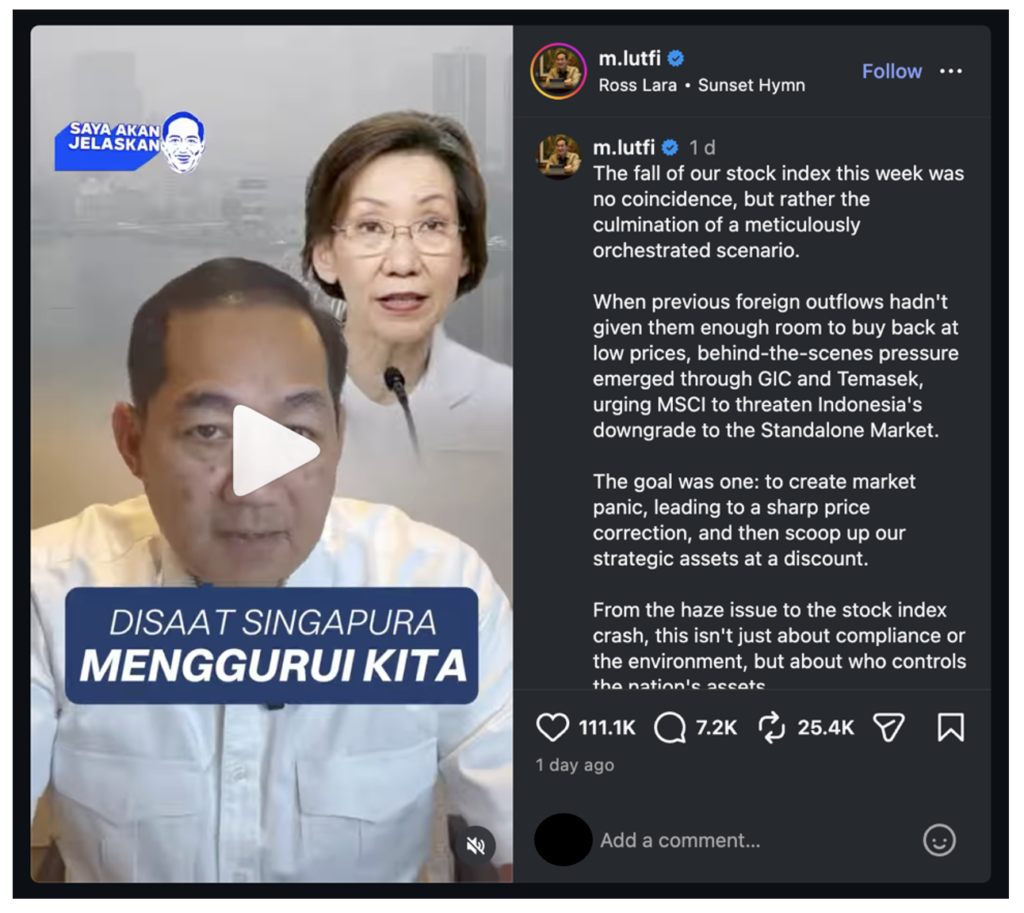
An Instagram video posted by former Indonesian trade minister Muhammad Lutfi on 19 October 2026, which has drawn over 110,000 views so far, alleges that Singapore pressured global index provider MSCI to threaten to downgrade Indonesia’s stock market. He claims that the pressure came through GIC, a sovereign wealth fund that manages Singapore’s foreign reserves, and state investment company Temasek, with the aim of destabilising the Indonesian economy so that foreign investors can buy Indonesian assets at a discount.
The caption of the post describes this week’s fall in Indonesia’s stock index as the result of a carefully planned scheme and links it to the present transnational haze crisis. Recent fires in Indonesia have sent smoke across the border, pushing Singapore’s air quality into the unhealthy range from September.
Lufti’s comments come after Singapore served notices on 10 companies in Indonesia under its Transboundary Haze Pollution Act on 16 and 19 October 2026, requiring them to deploy firefighters to put out fires or stop them spreading on land they own or occupy, stop any ongoing burning and refrain from starting new fires. They must also submit action plans to Singapore’s National Environment Agency on how they will put out fires and prevent them from recurring.
Lufti’s claims have gained traction both in Indonesia and Singapore. Broadcast media outlet NusantaraTV shared Lufti’s claims on social media. Meanwhile, the video has also drawn pushback from some Singaporeans on social media.
What is MSCI?
MSCI, which stands for Morgan Stanley Capital International, is a financial research firm best known for its stock market indexes. These are lists of shares that track how a group of companies or markets is performing, and many big investment funds use them as a guide for where to invest.
MSCI also sorts countries’ stock markets into three main groups, based on how large and actively traded they are and how easy it is for foreign investors to use them. Developed markets, such as the US and Japan, sit at the top. Emerging markets, such as China, India and Indonesia, are larger, more actively traded and reasonably open to foreign investors. Frontier markets are smaller and harder for foreign investors to access. Standalone markets fit none of these groups and covers markets that are either new to MSCI or were previously closed to some investors, or that were moved out of another group after a severe deterioration in access, size or trading activity.
The groups matter because some funds are set up to hold exactly the shares in a particular MSCI index. If a country is moved out of that index, these funds must sell its shares, pulling money out of its stock market. More than US$1.8 trillion is tied to MSCI’s emerging-market indexes, and index-tracking funds would have to sell an estimated US$3 billion to US$6 billion of Indonesian shares if it were made standalone.
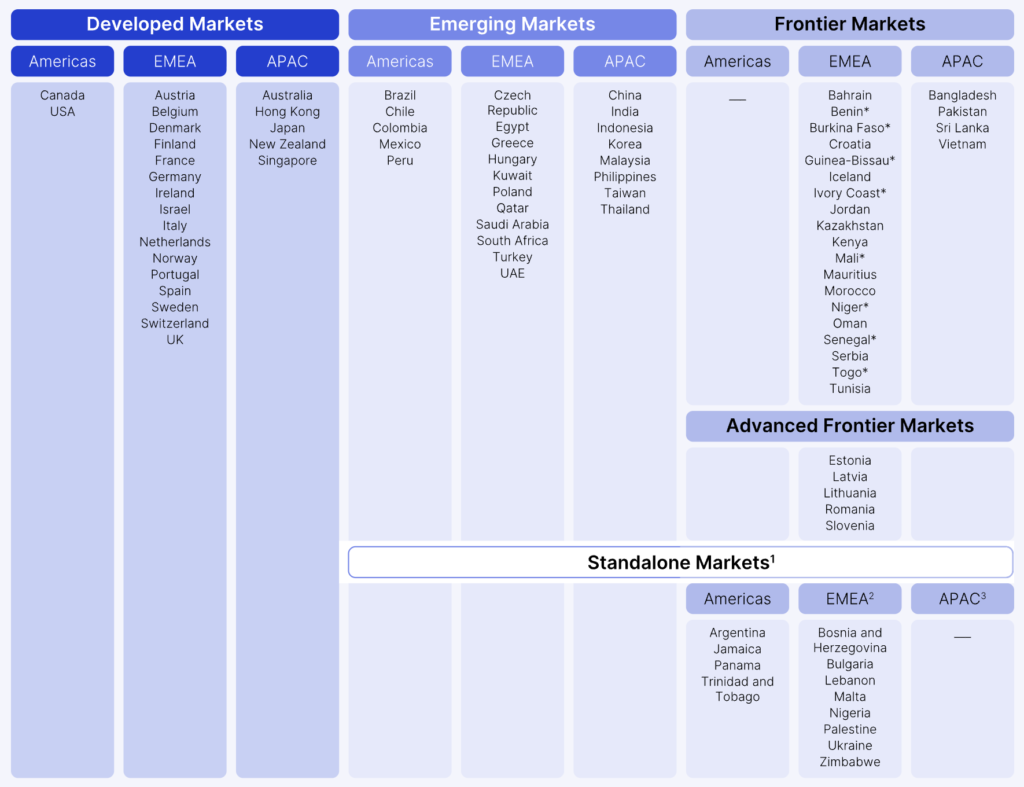
Image credit: MSCI
What did MSCI actually propose?
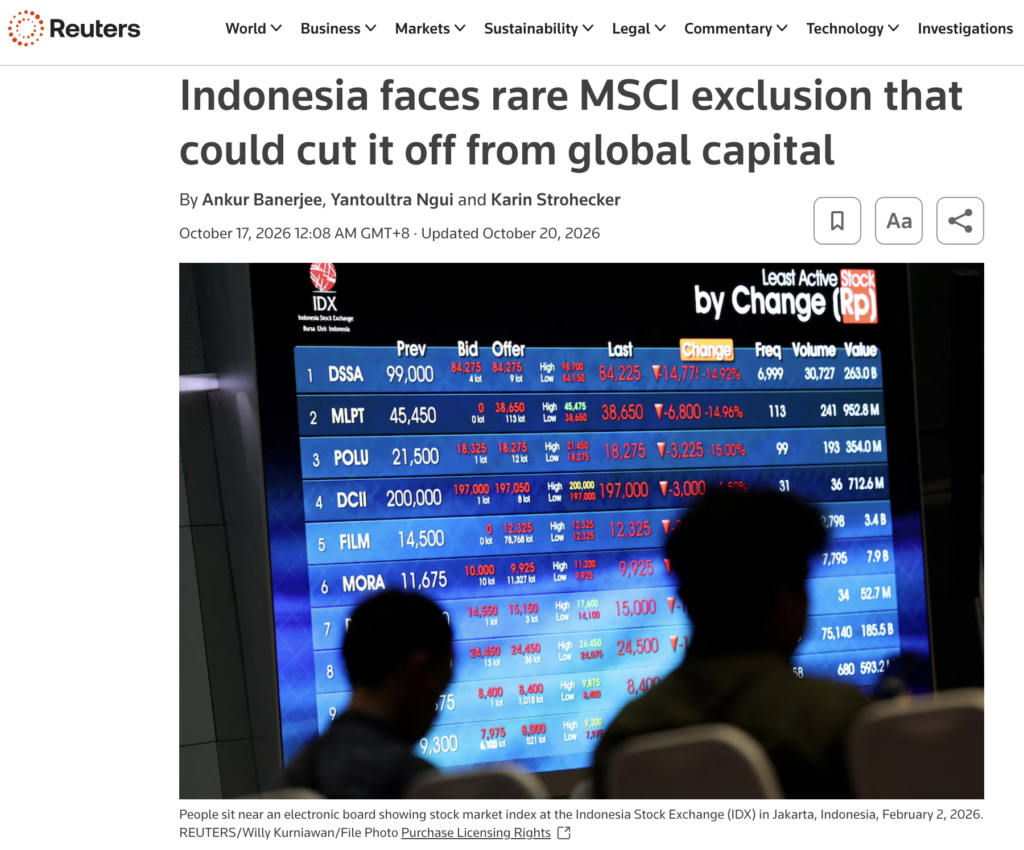
On 15 October 2026, MSCI launched a consultation on a proposal to move Indonesia from emerging market to standalone market status. The consultation accepts feedback until 30 April 2027, and MSCI says it will announce its decision on or before 30 June 2027. No downgrade has taken effect yet.
MSCI’s consultation document states that investors have raised concerns about unclear shareholding structures and suspected coordinated trading in Indonesia’s stock market. It says Indonesia has announced reforms, such as disclosing shareholders who own more than one per cent of a company, but that progress has not been consistent, and it points to a lack of evidence of meaningful enforcement.
Importantly, MSCI says these concerns came from market participants, without naming them.
The concerns also predate October 2026. In January 2026, MSCI first flagged concerns over the investability of Indonesian equities, saying its clients had pointed to market data that obscured how many shares could be freely traded and how the exchange categorised shareholders. In June 2026, it said it could consult on moving Indonesia to frontier status if progress was not evident by its November index review. All of this came before Singapore issued its haze notices this month.
The October 2026 proposal goes further than the earlier warnings. Frontier status would have been a one-step drop from emerging, but standalone goes below that. When it announced the proposal, MSCI said that emerging status no longer suits Indonesia, and that frontier status would not go far enough given how serious the problems are. The consultation also asks for feedback on whether frontier should be the outcome if standalone is rejected.
Is standalone status a category for countries with capital controls?
The video states that standalone status is for countries with capital controls, which it describes as fixing the exchange rate and banning people from freely trading foreign currency. More broadly, capital controls are government or central bank limits on the flow of foreign money in or out of a country, such as taxes or transaction limits.
MSCI does not describe standalone status as a category for countries with capital controls. Its assessment of Indonesia does note constraints on the onshore currency market, but the reasons it gives for its proposal are opaque shareholding and suspected coordinated trading, not currency.
Is there evidence that GIC or Temasek pressured MSCI?
MSCI’s consultation document does not mention Singapore, GIC or Temasek. Lutfi has also provided no evidence to support his assertions.
In addition, GIC and Temasek have publicly stated that they have not had any impact on MSCI’s findings. Responding to media queries, a GIC spokesperson stated that assertions about “ GIC and our staff are untrue” while Temasek’s Global Investments’ head of Asia Pacific (excluding China and India), Mr Fock Wai Hoong, described them as “baseless” and “patently untrue” at a press conference on 21 October 2026.
Hence, we rate the claim that GIC and Temasek pressured MSCI to threaten a downgrade of Indonesia’s stock market as likely false.