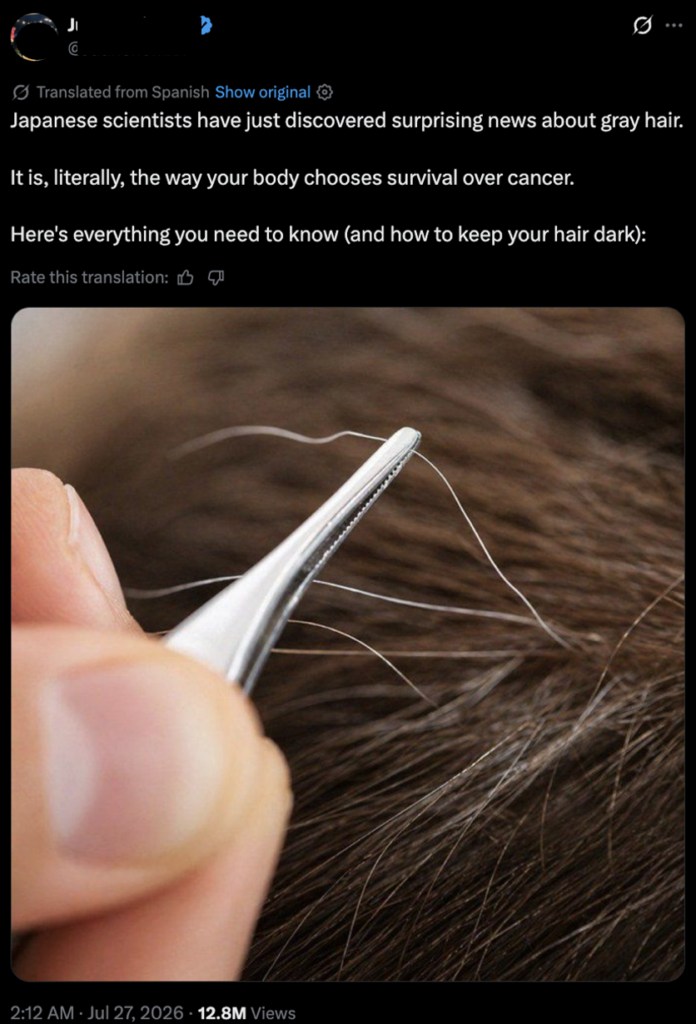
A thread on X, has gone viral, drawing 12.8 million views, with the claim that getting gray hair is the way your body chooses survival over cancer, implying that the process protects against the disease.
The thread explains that hair colour comes from melanocyte stem cells, and that when these cells suffer damage, they face a choice: keep dividing, which risks the cells becoming cancerous, or stop, which halts pigment production and turns the hair gray. It describes this shutdown as cellular senescence, in which damaged cells are deactivated before they can turn into tumours, and claims the process speeds up with stress, poor sleep, inflammation, and nutritional deficiencies. The thread then offers tips for slowing or reversing graying, covering stress, sleep, nutrients, and scalp care.
Given the attention the claim has drawn, we took a closer look at it.
What does the research say?
Melanocyte stem cells are the cells inside hair follicles that generate the pigment-producing cells responsible for hair colour. As people age, hair follicles go through more growth cycles over a lifetime, and this is associated with a decline in the number of melanocyte stem cells within the follicle. This decline is thought to be what leads to gray hair, though researchers describe it as an association rather than a fully proven mechanism.
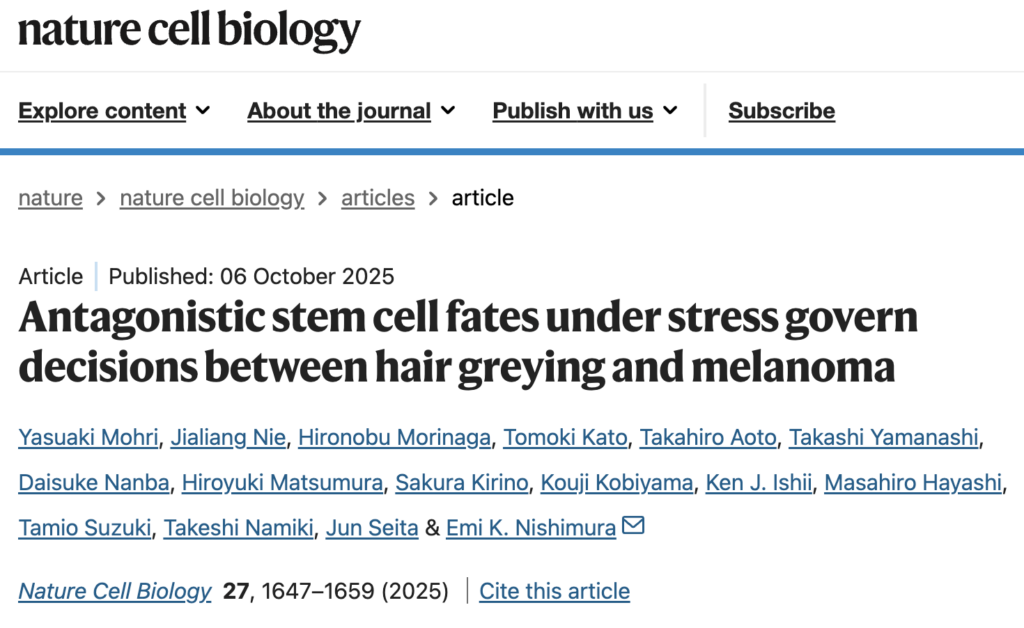
The thread does not cite a specific study, stating only that Japanese scientists have discovered surprising news about gray hair. Based on our research, the claim appears to trace back to a study by researchers at the University of Tokyo, published in October 2025.
The researchers note that our cells are constantly exposed to factors that can damage DNA throughout life, and that while this damage is known to contribute to both aging and cancer, how damaged stem cells specifically shape long-term tissue health has been less clear.
Titled “Antagonistic stem cell fates under stress govern decisions between hair greying and melanoma”, the study set out to investigate how melanocyte stem cells respond to different types of DNA damage and found that this response can lead to either hair graying or melanoma (a serious form of skin cancer), depending on the type of damage involved.
Using long-term tracking in mice, the researchers found that when these stem cells suffer DNA damage, they face something like a fork in the road. One path is to permanently convert into ordinary, non-dividing cells and disappear from the pool of stem cells altogether, a process the researchers call “seno-differentiation.” Once a stem cell takes this path, it stops producing pigment for good, which is why hair that has gone gray this way does not turn back. The other path is for the damaged cell to keep dividing instead of shutting down. Certain carcinogens, the researchers found, push cells toward this second path. Rather than retiring safely, the damaged cells keep multiplying, in the same basic process that can lead to a tumour.
However, the researchers at the University of Tokyo stated explicitly that the study “does not suggest that graying hair prevents cancer,” describing the safe shutdown process instead as one that “removes potentially harmful cells.” When a stem cell bypasses this safety response and keeps dividing instead, the damage it carries may make it more likely to eventually develop into melanoma.
The finding is that the same stem cells can go one of two ways depending on the type of damage involved, not that any individual’s gray hair is evidence their body successfully fought off a tumour. The thread states the opposite of what the study’s own authors caution against. It is also worth noting this research was conducted in mice and has not been confirmed to work the same way in humans.
What might cause hair graying
While the thread’s central claim is about how graying protects against cancer, it also makes additional claims worth checking. It states that stress, poor sleep, nutritional deficiencies, and scalp damage accelerate cell damage, and that addressing them can slow or reverse graying as a result.
In offering tips to slow graying, the thread appears to contradict its own central claim that graying is a safe, protective outcome. The thread does not reconcile these two parts of its own claim. Regardless, we checked what evidence exists for the factors it names.
There is some evidence that stress may contribute to graying. A 2020 Harvard study found that in mice, stress triggers nerves to release a chemical that permanently depletes pigment stem cells. A 2021 Columbia University study in humans, tracked pigmentation patterns along individual hair strands in 14 volunteers, and found that graying could track with periods of stress, but, unlike in the mouse study, saw evidence that some graying could partially reverse once stress eased. Poor sleep, another factor the thread names separately, does not appear to have direct evidence linking it to pigment stem cell loss on its own, but chronic stress is known to disrupt sleep, so the two may be related rather than independent.
Of the nutritional deficiencies the thread points to, vitamin B12 has the clearest evidence behind it. Premature gray hair may be reversed with B12 supplementation, but only if vitamin B12 deficiency was the cause of graying. There is no evidence that extra B12 helps someone whose levels are already normal. Claims involving copper, zinc, iron, and scalp care have far less direct support. Genetics, meanwhile, a major factor the thread does not mention at all, is one of the strongest influences on when someone starts graying.
Hence, we rate the claim that gray hair is your body’s way of choosing survival over cancer as partially false. While melanocyte stem cells can respond to damage by either graying or, in some cases, moving toward a cancer-prone state, the claim built on top of that finding, that any individual’s gray hair reflects their body successfully choosing survival over cancer, is not something the study shows, and is explicitly contradicted by the researchers themselves.

When a claim cites “scientists have discovered,” it is worth checking what the scientists themselves say the finding means, not just the headline built around it. Here, the researchers cautioned against overstating their result, and the thread’s framing does exactly that, in a way that could potentially mislead people. The contradiction between presenting graying as protective and then offering ways to undo it also calls into question the accuracy of the claims made in the thread.