We’ve been seeing posts about baby carrots circulating on social media platforms such as X and Instagram gaining traction since last week. These claims, usually accompanied by a video, assert that a “majority of baby carrots” go through chlorine before being sold – with everything being absorbed into the vegetable’s flesh and subsequently into the system of whoever eats them.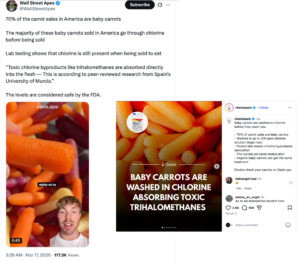
Baby carrots are made by peeling, cutting, and polishing full-sized carrots into 2-inch, baby-sized pieces that can be easily consumed without further peeling or cutting.
According to the more detailed claims, baby carrots are washed in the “legal maximum” amount of chlorine, which absorbs into them faster as they have already been peeled. Per the claims, the carrots are not tested after being rinsed, leaving doubt as to how much chlorine is really left in them despite regulating bodies such as the American Food and Drug Administration (FDA) deeming them safe.
Based on our research, claims about baby carrots are not new. We found social media posts with similar headlines as far back as 2008 – and also found fact-checks from the same time period by outlets such as Snopes.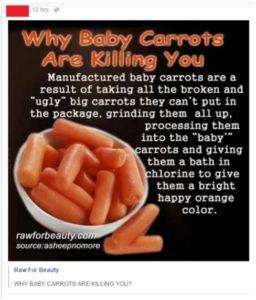 Based on these earlier debunkings and on our assessment of newer research, it appears that several things are true: for one, it is true that chlorine is commonly used in fresh-cut produce processing to sanitise fruits and vegetables – typically during the washing or peeling stage.
And, while chlorine can be a toxic element in certain forms and quantities, there appears to be no solid evidence that it is harmful or dangerous to consumers when used as a disinfectant for consumables such as food and drink. Rather, fresh produce that is usually eaten raw (such as baby carrots) are exposed to (and can be contaminated by) disease-causing microorganisms and contaminants.
There is a large body of research that includes clear information about the regulations and testing that ensures the safety of these processes. For instance, in most cases, the even the absolute upper limit of chlorine needed to sanitise and eliminate harmful microbials is still relatively low, after which the produce is also rinsed with potable water.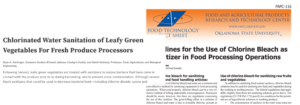
Aside from fresh produce, chlorine is also widely used for other sanitising applications – such as being added in tiny quantities to drinking water to eliminate harmful bacteria and viruses from water. This is also the case in Singapore, where, according to the PUB, chlorine quantities are well within World Health Organisations (WHO).
Some of the claims reference a study from 2019 which they claim showed chlorine is “absorbed directly into” the carrot flesh. However, the researchers who published the study clearly disclaimed that the work was still in “draft form” and only presented “provisional information” that should not be used to make risk assessments about chlorine quantities in fresh foods and vegetables. And, despite what the claims assert, the study did not examine carrots – only leafy greens. We also could not find a follow-up or continuation of this study from the researchers.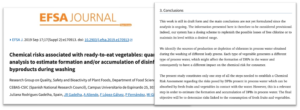 We therefore give the claim that baby carrots are “covered in chlorine” a rating of mostly false. The claim bypasses a great deal of research indicating chlorine washes are safe (as well as established consumer regulations that limit chlorine levels in food), and instead misleadingly suggests that baby carrots are toxic and dangerous using partially true statements.

On closer inspection, we also found that the most commonly circulated claim video in is actually an advertisement for an app called Oasis that markets itself as a tool to aggregate scientific data on different consumer products. The claim video ends with a call-to-action to download the app and check for the best carrots to buy, and is posted on the app’s social media platforms.
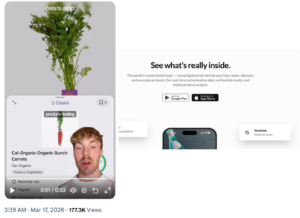 While it is not an issue to be aware and cautious about what we consume (and products such as the Oasis app might even be useful for us as consumers), it is concerning that marketing efforts can involve making dubious and inflammatory claims such as this one. It is also important to be aware of how claims and “warnings” might be spread in order to sell a product through consumer fear or anxiety.
Keeping an eye out for new research from reputable sources (for instance regulatory bodies updating their standards and publishing studies) is, instead, a much safer and more informed way to make appropriate food choices.