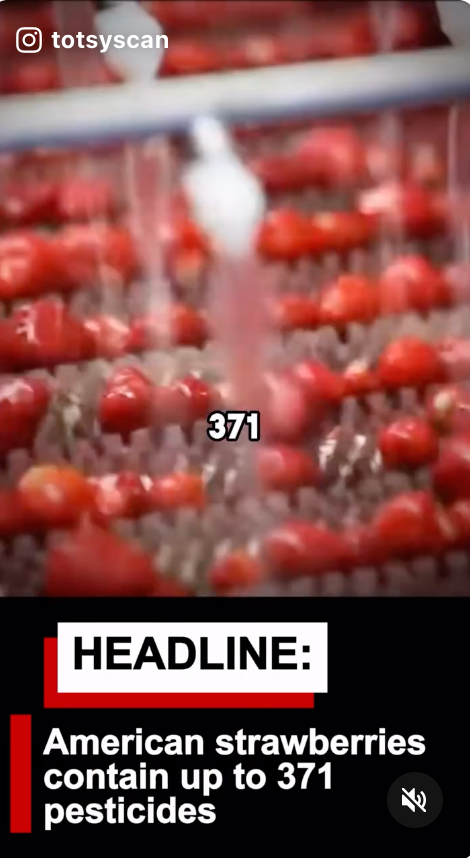
Videos circulating on Facebook and Instagram in May 2026 made alarming claims about Driscoll’s, the United States’ largest strawberry brand. One viral reel declared that “America’s number one strawberry brand is directly tied to cancer” and that the berries are “sprayed with up to 371 chemical pesticides” before reaching consumers. The posts urged viewers to boycott the brand, with some adding that no amount of rinsing could remove the toxic residue.
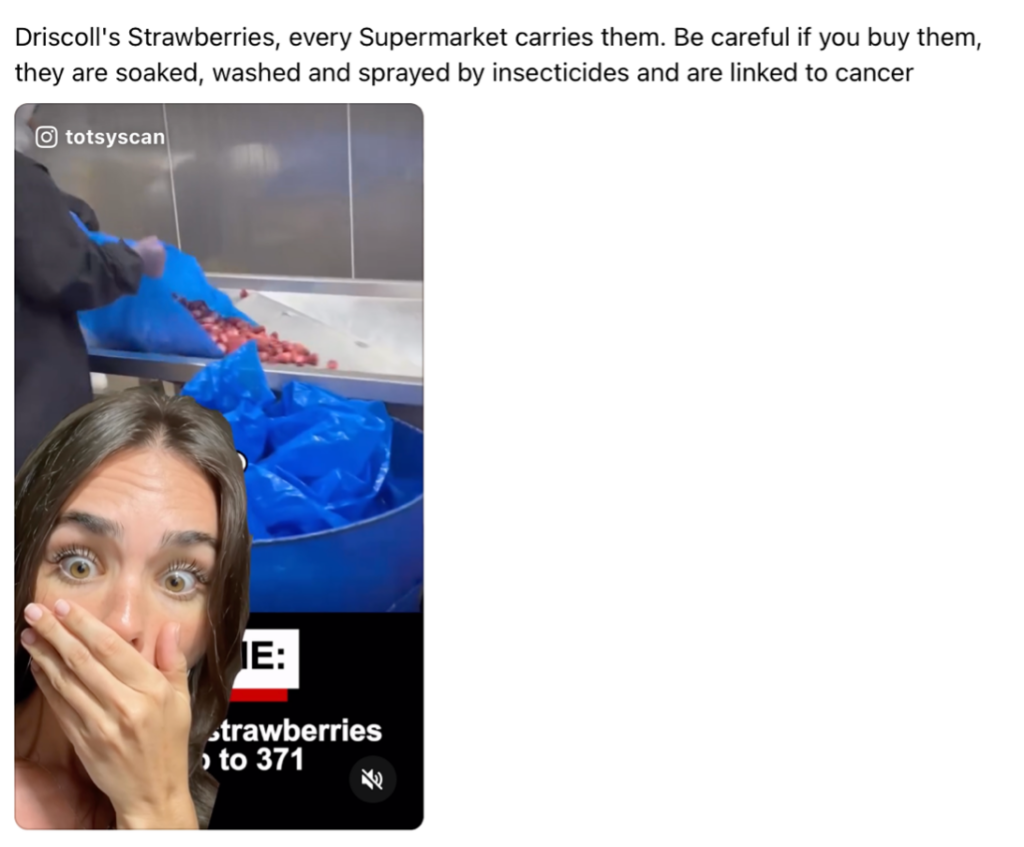
We traced the origin of the panic to a May 2026 report by Mamavation, a consumer watchdog website that has previously drawn criticism from science communicators for overstating research findings. According to the report, Mamavation purchased one conventional and one organic punnet of Driscoll’s strawberries from a Southern California grocery store and sent both to an EPA-certified laboratory for testing.
The lab screened for over 500 possible pesticide residues and found 12 in the conventional sample — including eight compounds associated with PFAS (per- and polyfluoroalkyl substances, a family of man-made chemicals that persist in the environment and have been linked to various health concerns) — while the organic sample returned “non-detect.” Mamavation noted that some of the detected levels would fall outside limits set by the EU, Taiwan, and several other jurisdictions, though it did not claim the residues exceeded U.S. legal thresholds. Crucially, Mamavation itself described the exercise as a limited “spot-check,” not a comprehensive survey of Driscoll’s produce nationwide.
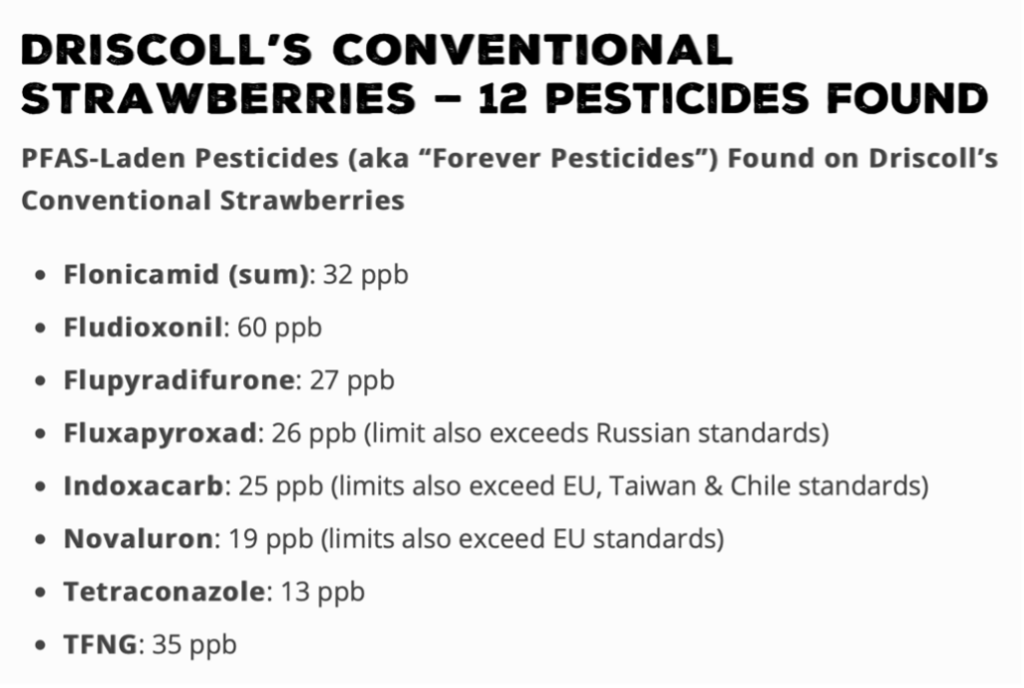
Social media posts took that modest finding and inflated it considerably. The figure of “371 pesticides” did not come from any test of Driscoll’s berries at all. It appears to originate from a UK government pesticide monitoring report published in 2010 which stated that regulators “tested for up to 371 pesticides” across various food categories — meaning laboratories screened for that many possible substances, not that any single crop contained them all.
The leap from “residues detected” to “causes cancer” is equally unsupported. Detecting a pesticide residue on food does not establish a cancer risk. Regulators assess risk based on the specific chemical involved, the concentration detected, typical consumer exposure levels, and whether residues exceed established safety thresholds — none of which the viral posts engaged with. Under the US system, the US Environmental Protection Agency (EPA) sets maximum residue tolerances for foods, and exceedances, not mere presence of these residues, are what trigger enforcement action.
Therefore, we rate the claim that Driscoll’s strawberries are sprayed with hundreds of pesticides and confirmed to cause cancer as false. A limited single-sample test found 12 pesticide residues on one conventional punnet within US legal limits. Social media posts misread an unrelated UK monitoring statistic, conflated residue detection with cancer causation, and exaggerated the information.
This case is a useful reminder of why food misinformation spreads so readily. Anxiety about what we eat is visceral and immediate — few things trigger alarm faster than the suggestion that a mass marketed food product is secretly toxic. That emotional charge makes food claims especially shareable, and platforms reward the velocity of that sharing regardless of accuracy. Once a frightening statistic circulates, corrections rarely travel as far or as fast as the original claim.
In this instance, the viral posts also exploited a real and legitimate public concern: PFAS contamination in the food supply is a genuine and active area of scientific inquiry, lending the false claims a veneer of plausibility. Beyond simple panic, food misinformation of this kind can serve other ends too. Rival producers and organic certification advocates benefit when consumers lose confidence in conventional produce; content creators benefit from the engagement that outrage generates; and ideologically motivated accounts might mobilise food scares as a vehicle for broader anti-corporate or anti-Western-agriculture narratives.
None of that means every alarming food headline is coordinated or malicious, most are simply the product of misread sources and careless sharing, but it is worth asking who gains when a particular claim goes viral.