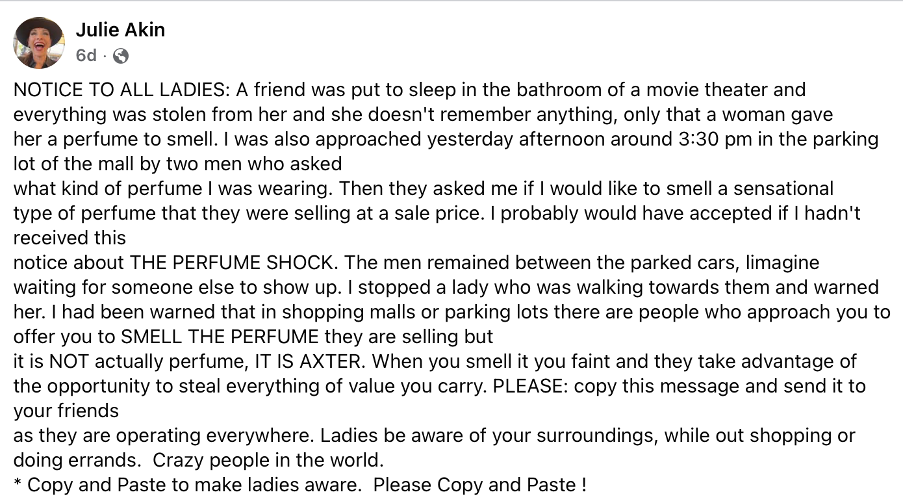
A warning message has been circulating widely on Facebook in May and June 2026, claiming that thieves are approaching women in shopping malls and car parks and offering them a perfume sample that contains a drug called “Axter” which renders the victim unconscious, allowing them to be robbed. The message is styled as a first-person warning forwarded by a friend and closes with an explicit instruction to copy and share it widely.
We traced the warning’s origins to a single, unverified police report from November 1999 in which a woman in Mobile, Alabama claimed she had smelled a cologne sample offered by a stranger in a car park and woke up half an hour later near a different shop with no memory of the intervening time. Snopes, a US-based fact-checking organisation, investigated the original report and found that toxicology reports concerning tests run on blood and urine samples from the woman after the attack did not indicate the presence of any unusual or abnormal substances in her system. Snopes first debunked the claim in June 2000 and has since covered multiple re-emergences of the same story, receiving nearly 1,300 reader enquiries about it since 2015 alone.
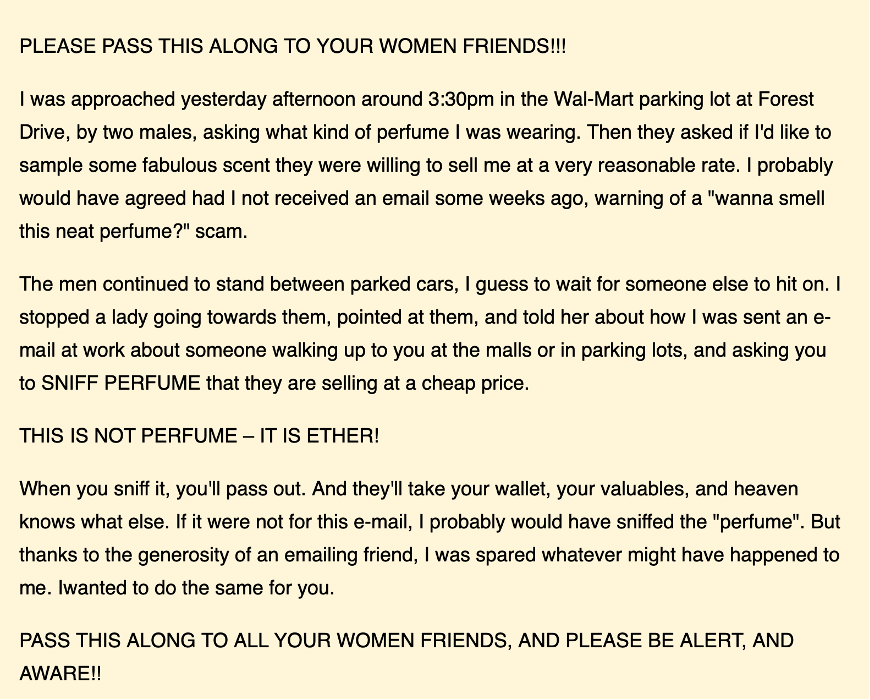
The 2026 version is structurally identical to the original, with one cosmetic change: the supposed knockout agent has been renamed from “ether” to “Axter.” Even granular details — perpetrators “waiting between parked cars” for their next victim — are preserved verbatim across more than 25 years of re-circulation. Africa Check, a fact-checking organisation based in South Africa, documented a further wave of the claim in early 2026, with posts appearing across Facebook and Instagram in multiple countries.
The substance named — Axter — appears to refer to a brand of hydroxyzine hydrochloride, a prescription antihistamine used to treat anxiety, allergic reactions, and as a pre-surgical sedative. Its better-known brand name is Atarax. According to Tech ARP, which reviewed the science behind this claim, hydroxyzine is not volatile — it does not evaporate into the air in a form that can be inhaled. It is administered orally as a tablet or by intramuscular injection. Even if the drug were crushed into a powder and wafted under someone’s nose, it would not cause them to lose consciousness.
The mechanism the warning describes of a brief, involuntary sniff producing near-instant unconsciousness is pharmacologically impossible for this class of compound.
The warning’s longevity reflects a pattern common to health-and-safety hoaxes. It taps into real and legitimate fears about crime, particularly the vulnerability of women in public spaces. It is written in an intimate, confessional register that implies the sharer has personal knowledge of the incident. And its explicit call to action — “please copy this message and send it to all the women you know” — exploits social obligation to drive further amplification.
One of the practical consequences of such warnings is the erosion of trust in legitimate safety advisories. When high-volume false alarms circulate unchecked, audiences may discount genuine alerts. There is also a more direct harm: the warning can generate real distress among recipients who believe they or their loved ones are at risk from a threat that does not exist.
For Singaporeans, the relevance is less about the fictional “Axter” perfume and more about the delivery mechanism. This hoax travels through exactly the channels — forwarded WhatsApp chats, family group messages and Facebook reshares — that scammers here rely on to reach victims, and it works on the same instinct: that a message passed along by someone you trust must be true. The safest response to any “share this with everyone you know” message is the opposite of what it asks: pause, and verify before forwarding. Genuine public-safety alerts in Singapore come through official channels such as the Police, and suspected scams can be checked against the ScamShield helpline on 1799 — not against a message that simply tells you to keep passing it on.
Therefore, we rate the claim that strangers are using drug-laced perfume to knock out and rob women as false. The warning is a decades-old copypasta hoax, traceable to an unverified 1999 incident that produced no forensic evidence. The supposed knockout agent, hydroxyzine, cannot cause unconsciousness through inhalation. No verified incident matching the described scenario has ever been documented in more than 25 years of the claim’s circulation.