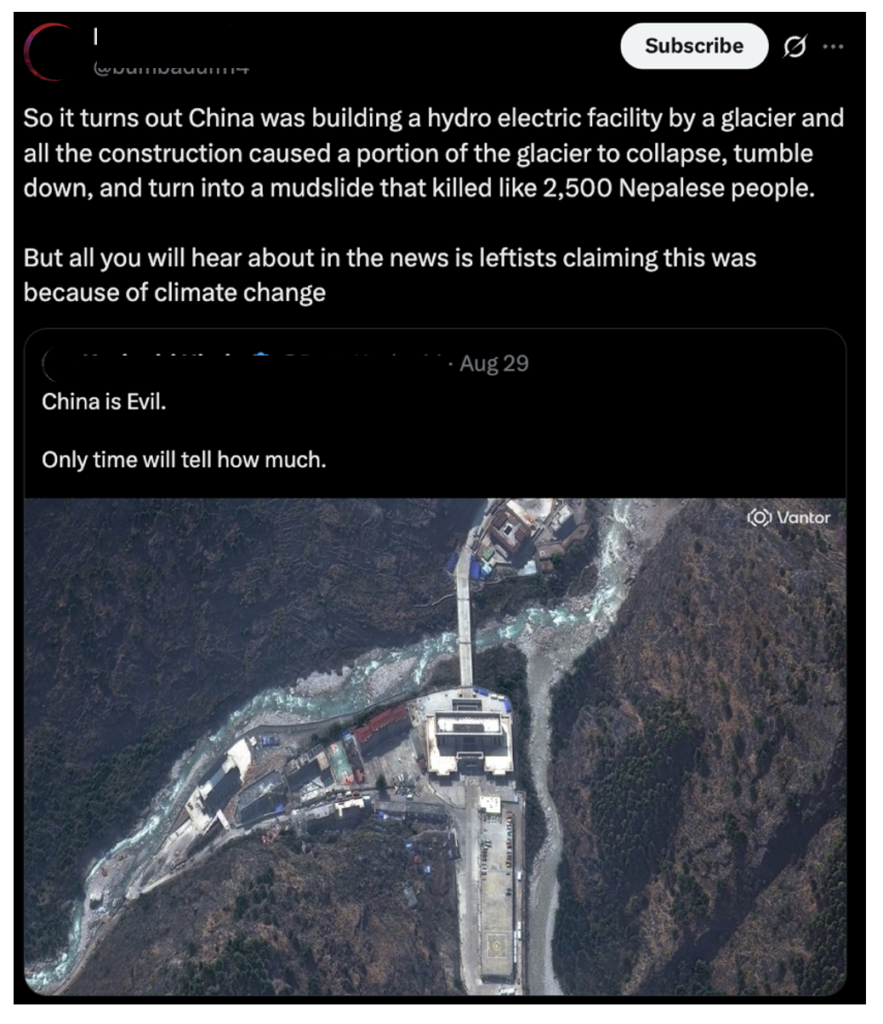
A viral post on X, which has drawn over 10.8 million views, claims that the construction of a Chinese hydroelectric facility by a glacier caused it to collapse into a mudslide that killed an estimated 2,500 people in Nepal. It also claims that the only explanation reported in the news will be “leftists claiming this was because of climate change.” The post quotes an earlier tweet captioned “China is Evil,” which includes a satellite image, labelled Vantor, of a of a structure beside a river.
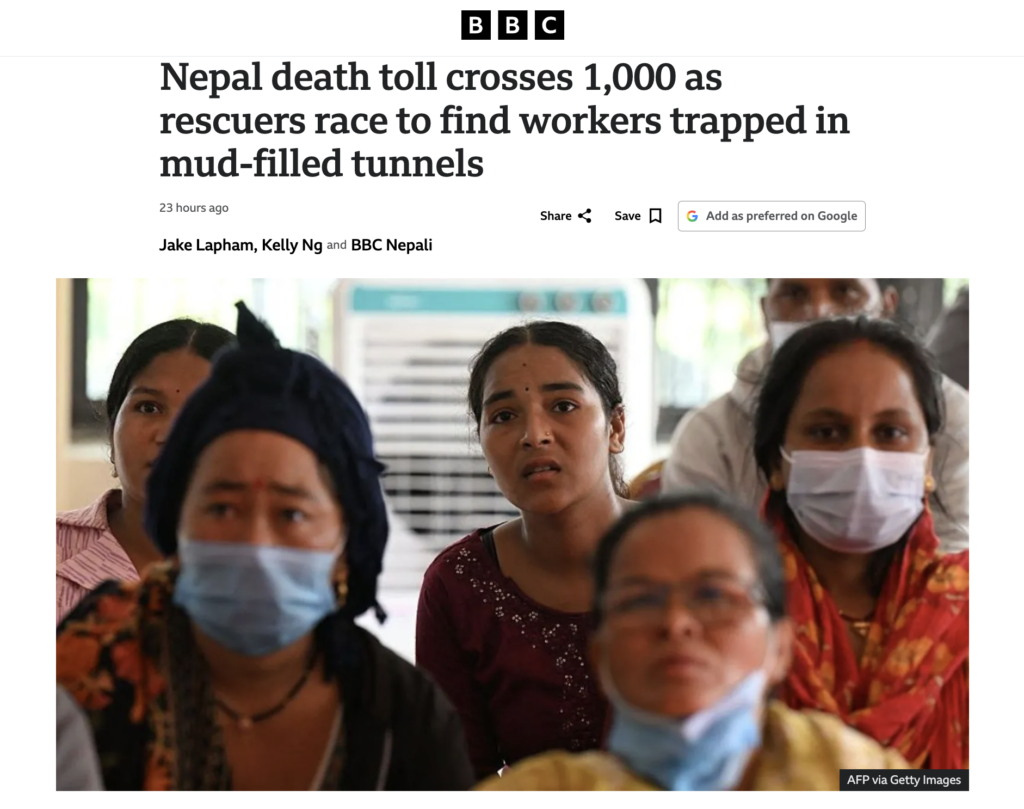
The post references the recent Nepal-Tibet floods, which have been widely covered in the news, with a death toll of over 1,000 and more than 3,900 people currently missing. Given the attention the disaster has drawn, as well as the post, we took a closer look at what actually happened.
Nepal-Tibet floods
On 26 August 2026, a section of glacier collapsed at around 5,200 metres on the north side of Langtang Lirung, a mountain in Nepal’s Himalayas, near the border with Tibet. The collapse triggered a massive ice-rock avalanche that plunged roughly 1,200 metres down the mountainside, gathering rock and debris, before surging into the Trishuli and Lhende river valleys and crossing the border into Tibet.
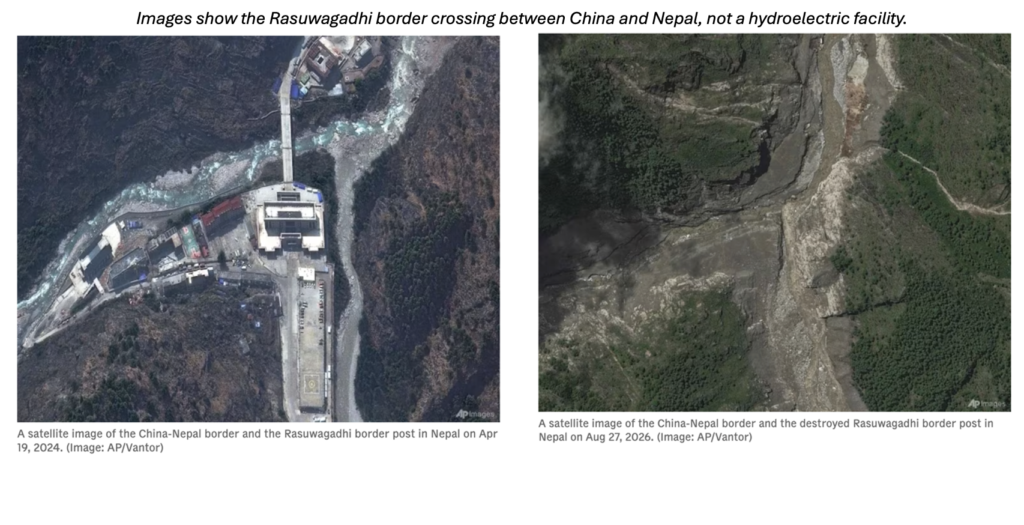
The resulting flood tore through villages, destroying homes and critical infrastructure, including the Rasuwagadhi and Gyirong Port border crossings on the China-Nepal border.
Was the glacier collapse caused by construction?
We were unable to find any credible sources attributing the collapse to the construction of a Chinese hydroelectric facility. Geoscientists instead point to a natural mechanism. The lower part of the glacier is believed to have sheared away after the rock beneath it failed, possibly worsened by unusually warm conditions before the collapse.
While initial reports attributed the glacier collapse to a magnitude 4.4 earthquake, the United States Geological Survey subsequently revised its assessment to conclude that the seismic signal detected worldwide, registering as a magnitude 5.2 event, was generated by the collapse and resulting debris flow and not an earthquake.
Twelve separate hydropower projects downstream were badly affected by the flood, according to Nepal’s disaster management authority, with rescue teams working to reach more than 900 missing hydropower workers. However, no official assessment links the disaster to a Chinese facility under construction at or near the collapse site, and there is no indication that the latest disaster was linked to manmade development.
What does the satellite image show?
The satellite image shared alongside the claim does not show a hydroelectric facility. It shows the Rasuwagadhi border crossing between China and Nepal. We traced the same image, credited to the satellite imagery company Vantor and distributed by AP, to several other outlets, including Outlook India, where it carries this exact caption: “A satellite image of the China-Nepal border and the Rasuwagadhi border post in Nepal.” AP also released a second photo from the same location, taken after the flood, showing that same border post destroyed.
Is climate change being unfairly blamed?
The claim implies that news coverage has pinned the disaster entirely on climate change, but that is not how it has actually been covered. Mainstream reporting on the event has been rather cautious rather than definitive. Multiple outlets have reported that scientists are still investigating what triggered the glacier collapse, and that it is too early to say how much climate change contributed to this specific event, while noting the region’s rapid warming is making mountain slopes less stable.
Some public figures have drawn a more direct line. UN climate chief Simon Stiell said the disaster served as a reminder of how fragile mountain environments have become, noting that scientists and local communities have warned for years about the risks of climate change in the area, adding that a warming climate is “making tragedies like this one… much more likely, frequent and severe.“
Hence, we rate the claim that Chinese hydropower construction caused the glacier collapse as likely false. No credible investigation links the collapse to a Chinese hydroelectric facility under construction.

Disasters like this one tend to attract misinformation before the facts are known, with claims pinning the blame on a preferred villain while investigations are still ongoing. A dramatic explanation may not be the same as a true one and is worth checking before it spreads further.