We’ve seen posts being circulated on social media platforms such as X, Facebook, and Instagram claiming scientists have discovered that teabags are a “massive source of microplastics.” These posts go on to assert that a single teabag steeped in water can release “literal billions” of microplastics into the tea we drink.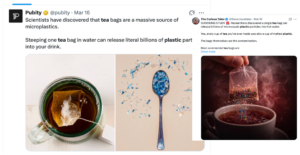 Given that an estimated 100 billion tea bags are consumed globally per year, these posts have garnered thousands (and some even millions) of views – with many commenters seeming to take it at face value. Is this claim really based on new and reputable research? And, should tea drinkers be concerned about a potential immediate health risk?
We looked closer and found that the recent wave of claims seem to have been sparked by an March 14 article on earth.com (a science news platform) titled: “Study shows tea bags release up to one billion plastic particles during the brewing process.”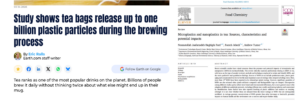 It discusses a recently published review of existing studies conducted on the existence of microplastics and nanoplastics in tea – pointing out different findings and breaking down how they can be interpreted and understood by a layperson.
However, while the earth.com article does point out (rather vaguely in their conclusion) that the “takeaway is not panic – it’s perspective” and the studies should not be used to make sweeping generalizations about tea, social media users have nevertheless used it’s headline to suggest a new study has definitively shown that a single teabag releases a billion microplastics when brewed.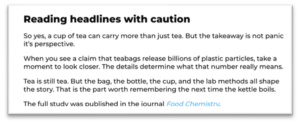 From what we could find, the “one billion” number mentioned in the article and the claims comes from a study conducted in 2019 by McGill University, where a team of researchers found that (with their specific testing methodology) plastic teabags steeped at 95 degrees celcius releases approximately 11.6 billion microplastics and 3.1 billion nanoplastics into a single cup.
 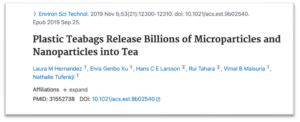 While other more recent studies have shown that microplastics are released from tea bags when brewed, the McGill study has also been criticised by other scientists for their testing methodology. Studies conducted using different methods have also reported much lower numbers (in the thousands rather than billions). Therefore, the question of how much microplastic is released from tea bags is, itself, still a matter of debate within the scientific community, rather than a confirmed statistic.
Most significantly however, this study only examined plastic (nylon or PET) tea bags, while a majority of tea bags being produced and consumed are largely made of paper or other natural fibres. This is important to note as most of the viral claim posts feature images of paper tea bags while also neglecting to point out that only plastic tea bags were used. And, while some paper tea bags do make use of sealants that contain plastic, as of 2026, many widely available tea brands produce tea bags that are entirely plastic-free.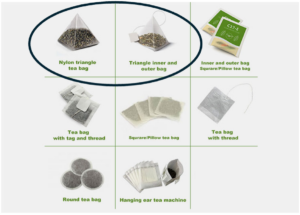 Therefore, while it is true that a study from 2019 reported “billions of plastic particles” from a single tea bag, it misleadingly omits that only plastic teabags were examined, which impacts the entire premise of the claim. Many claim posts also present this as new information, rather than an older study being rehashed and inaccurately described.

Some claims have also extrapolated that all tea made from tea bags are “pools of plastic,” and imply that microplastics are a direct health risk to consumers.
Microplastics (which are plastic fragments under 5 millimeters long) are ever-present in our lives – in the air, food, water, and dust around us. They are present in the range of plastic products we use and interact with (from bottled water, to toothpaste, to wall paint) and in agricultural, textile, and farming industries. It is impossible to completely avoid them.
However, we consulted the official stances of different health and organizations around the world and found that while emerging studies have raised concerns about the long-term impact of microplastics on human health, there have not yet been clear conclusions drawn on the direct correlation to specific illnesses or health outcomes.
Many of these organisations such as the World Health Organisation and the European Food Safety Authority have stated that the current data on exposure and risk is insufficient for them to produce risk thresholds or health-based exposure limits. This is also the case in Singapore, where relevant agencies such as Singapore Food Agency (SFA) and the Ministry of Sustainability and the Environment (MSE) have stated that while there are microplastics in products such as tap water and food, they have not yet raised any cause for concern – although these agencies are continuing to monitor scientific developments. 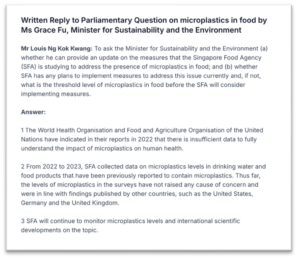 The ways in which microplastics are discussed in the news and on social media can be cause for alarm, and it is also a valid concern that many individuals might have. Anyone who wishes to limit their plastic consumption as a personal health choice should be able to do so with accurate information rather than misleading headlines and reporting such as in this claim. It is important to consult reputable scientific sources and statements from official organisations before sharing or believing sensationalist claims and headlines.